
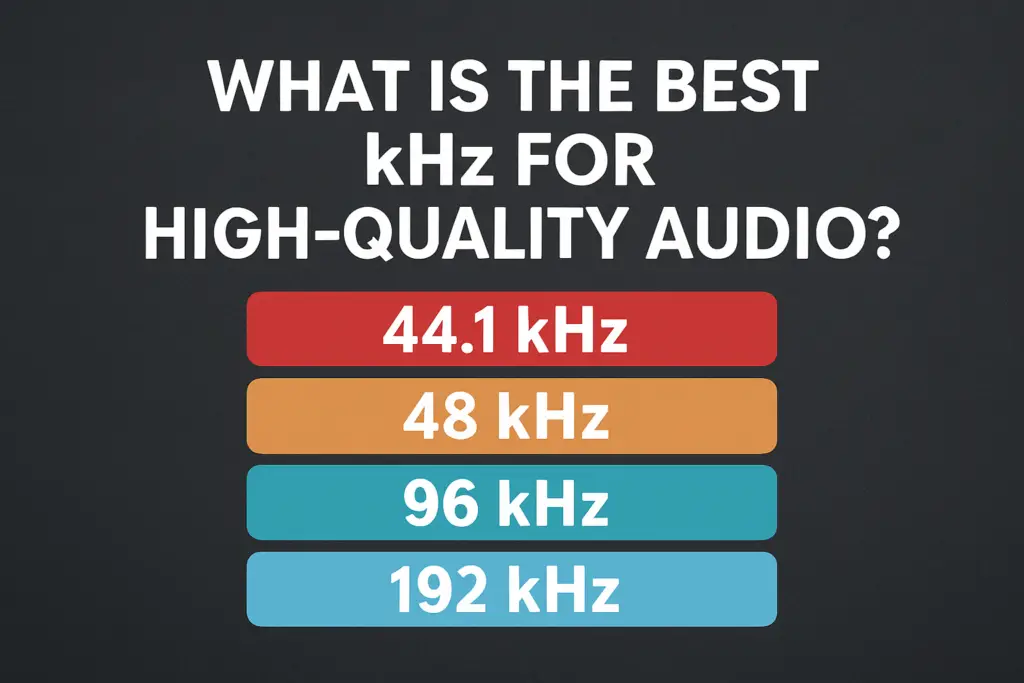
When it comes to digital audio, few topics spark more confusion—and debate—than sample rate, often expressed in kilohertz (kHz). Whether you’re streaming music, using a high-end DAC, or diving into hi-res audio formats, you’ve probably seen numbers like 44.1 kHz, 48 kHz, 96 kHz, and 192 kHz.
But what do these numbers really mean? And more importantly:
What is the best kHz for high-quality audio?
Let’s break it down clearly, accurately, and from an audiophile perspective.
Understanding kHz in Audio
In digital audio, the sample rate (in kHz) tells you how many times per second the system captures a “snapshot” of the sound wave.
- 44.1 kHz = 44,100 samples per second
- 96 kHz = 96,000 samples per second
According to the Nyquist theorem, the sample rate needs to be at least twice the highest frequency you want to capture. Since the limit of human hearing is roughly 20 kHz, anything above 40 kHz is technically sufficient.
And this is why the famous 44.1 kHz standard was born.
44.1 kHz — The Gold Standard for Music Listening
Best for:
- Music streaming (Spotify, Apple Music, Tidal, Qobuz)
- CD-quality playback
- Bit-perfect audio from commercial releases
44.1 kHz captures up to 22 kHz—slightly above the human hearing threshold. For the vast majority of music, this is transparent and accurate.
Why It’s Enough
- Covers full human hearing range
- Minimizes file size and CPU load
- Avoids unnecessary resampling
- Matches the format of most professionally mastered music
If your goal is pure, faithful music listening, 44.1 kHz already provides high-quality audio.
48 kHz — The Modern Multimedia Standard
Best for:
- Movies, shows, gaming
- Audio for video production
- Many modern DACs and interfaces
48 kHz is standard in video production because it syncs cleanly with common frame rates. Many DACs are internally optimized for 48 kHz and its multiples (96/192 kHz), making it a strong contender for general-purpose high-quality audio.
When 48 kHz Sounds Better
- If your DAC’s best measured performance is at 48k family rates
- If you use systems with built-in DSP (room correction, virtual surround, etc.)
- If your media is primarily video-based
96 kHz — The Audiophile Sweet Spot for DSP
Best for:
- Digital signal processing (EQ, room correction)
- Upsampling in HQPlayer, Roon, Foobar
- High-end audio production
96 kHz gives more “headroom” for digital processing tools. Plugins and DSP filters can operate more cleanly, reducing distortion and aliasing.
Why Audiophiles Choose 96 kHz
- Smoother ultrasonics for DAC filters
- Cleaner transients
- Higher precision when applying DSP
- Supported universally by hi-res DACs
If you use EQ, crossovers, or room correction, 96 kHz often provides audible improvements.
192 kHz — Spec Sheet Bragging or Real Benefit?
192 kHz is typically reserved for:
- Archiving studio masters
- Certain DACs with analog-like filter designs
- Heavy-duty DSP processing
But for normal music listening, the benefits become extremely small—and sometimes nonexistent.
Many DACs don’t perform optimally at 192 kHz, despite the big number.
So… What Is the Best kHz for High-Quality Audio?
The best sample rate depends on your use case, not on a single magic number.
For audiophile music listening (no DSP):
👉 44.1 kHz is ideal.
For video, gaming, and general multimedia:
👉 48 kHz is the best match.
For DSP-heavy systems (EQ, room correction, upsampling):
👉 96 kHz offers the best balance of clarity and performance.
For studio archiving or advanced processing:
👉 192 kHz may be useful, though often unnecessary.
The Real Truth: Other Factors Matter More
Sample rate is just one part of the equation. These have far greater impact on sound quality:
- Mastering quality
- DAC design and filters
- Headphones, speakers, and amps
- Room acoustics
- Volume-matched A/B testing
A poorly mastered 192 kHz track will always sound worse than a well-mastered 44.1 kHz track.
Final Verdict
| Goal | Best kHz |
|---|---|
| High-quality music listening | 44.1 kHz |
| Multimedia & gaming | 48 kHz |
| DSP, EQ, upsampling | 96 kHz |
| Studio master archiving | 192 kHz |
For most audiophiles, the best kHz is either 44.1 or 96—depending on whether you use DSP.