
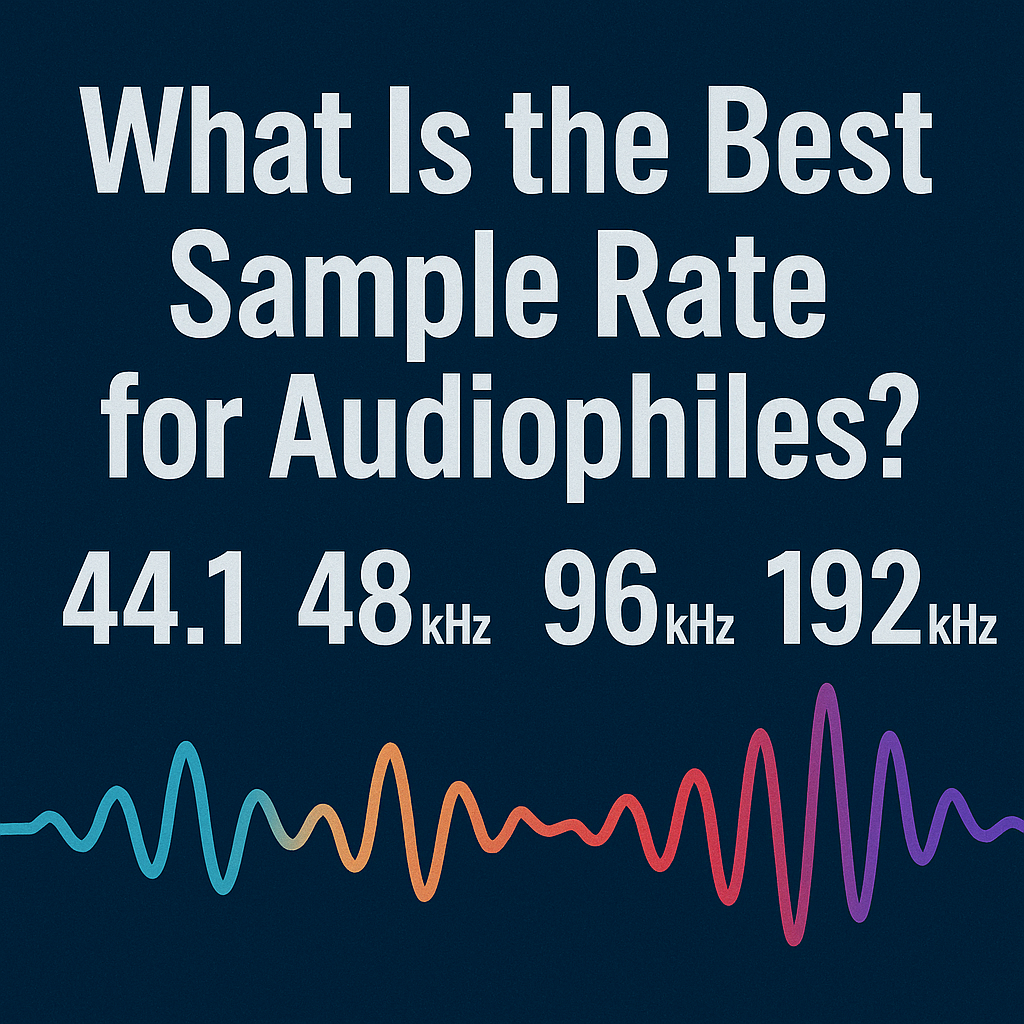
In the audiophile world, few debates spark as much discussion as sample rate. Whether you’re streaming hi-res music, playing vinyl rips, or running a high-end DAC, you’ve likely encountered numbers like 44.1 kHz, 48 kHz, 96 kHz, or even 192 kHz.
But what do these sample rates really mean—and more importantly:
Which one gives you the best sound quality?
The answer is both simpler and more complex than you might expect.
What Does Sample Rate Actually Do?
Sample rate determines how many “snapshots” of an audio waveform are captured every second.
- 44.1 kHz = 44,100 samples per second
- 96 kHz = 96,000 samples per second
According to the Nyquist theorem, a sample rate can reproduce frequencies up to half its value. So 44.1 kHz captures up to ~22 kHz—slightly above the limit of human hearing.
This is why, technically speaking, anything above 44.1 kHz is beyond the range we can hear directly. However, higher sample rates can still affect:
- Filter behavior
- Distortion
- Transient accuracy
- Plugin/DSP performance
- DAC oversampling quality
These factors influence how we experience sound, even if we can’t hear the ultra-high frequencies themselves.
The Truth: There Is No Single “Best” Sample Rate
The ideal sample rate depends on what you’re doing and what equipment you’re using. The best one for pure listening isn’t the same as the best one for recording or for certain DAC architectures.
Let’s break it down.
44.1 kHz – The Music Listening Standard
Best For:
- Streaming (Spotify, Apple Music, Tidal, Qobuz)
- CD-quality FLAC
- Bit-perfect playback
- Remastered commercial albums
Most professionally mastered music is created for (and distributed in) 44.1 kHz. Playing it as-is avoids any resampling artifacts.
Why It Sounds Great
- Covers full human hearing range
- Produces neutral, transparent playback
- Best for libraries sourced from CDs or lossless streaming
- Lowest CPU load and smallest files
If your primary goal is audiophile music listening, 44.1 kHz is already optimal.
48 kHz – The Modern Digital Standard
Best For:
- Video content (YouTube, Netflix)
- Gaming audio
- DACs optimized for 48k family (48/96/192 kHz)
- DSP filters and room correction
Some DACs actually measure better at 48 kHz because of their internal clocking. If you use digital signal processing (EQ, upsampling, room correction), 48 kHz may provide cleaner results.
96 kHz – The Sweet Spot for Audiophile DSP
Best For:
- High-end digital EQ
- Up-sampling
- Professional mixing
- Audiophiles using HQPlayer, Roon, Foobar
- DACs with advanced oversampling filters
96 kHz gives plugins and DSP more headroom, reducing aliasing and distortion. Many enthusiasts consider 96 kHz the sweet spot—cleaner than 44.1, lighter than 192.
Benefits
- Better transient accuracy
- Gentler digital filters
- Lower distortion in DSP chains
- Supported by nearly all hi-res DACs
192 kHz – Audiophile or Overkill?
Best For:
- Archiving studio masters
- Specialized DACs and analog-like filters
- Extreme DSP processing
At this rate, you’re capturing frequencies way above human hearing—and the improvements become extremely subtle. For most listening, 192 kHz offers diminishing returns.
Some high-end DACs sound exceptional at 192 kHz, but many do not—performance depends on the DAC’s internal engineering, not just the number on the spec sheet.
So… What Sample Rate Actually Sounds Best?
If your goal is pure audiophile listening of commercially mastered music:
👉 44.1 kHz (bit-perfect playback is king)
If you use DSP, EQ, or room correction:
👉 48 kHz or 96 kHz
If you want the “cleanest” possible digital processing chain:
👉 96 kHz (best balance of performance and realism)
If you’re archiving or producing audio:
👉 96 kHz or 192 kHz
If you listen to movies/games:
👉 48 kHz
The Real Audiophile Secret: Sample Rate Isn’t Everything
A high sample rate won’t fix:
- Bad mastering
- Compression artifacts
- Poor speaker placement
- Weak amplification
- Bad room acoustics
A well-produced 44.1 kHz track will beat a poorly mastered 192 kHz track every time.
Your DAC, headphones, speakers, and room contribute far more to sound quality than sample rate alone.
Final Verdict
There is no absolute best sample rate—only the best for your setup and purpose:
| Purpose | Best Sample Rate |
|---|---|
| Music playback | 44.1 kHz |
| Video/gaming | 48 kHz |
| Audiophile DSP (EQ, room correction) | 96 kHz |
| Studio work | 96–192 kHz |
| Archiving | 192 kHz |
If you want the most faithful playback for typical audiophile listening, stick with 44.1 kHz or 96 kHz, depending on whether you apply DSP.