
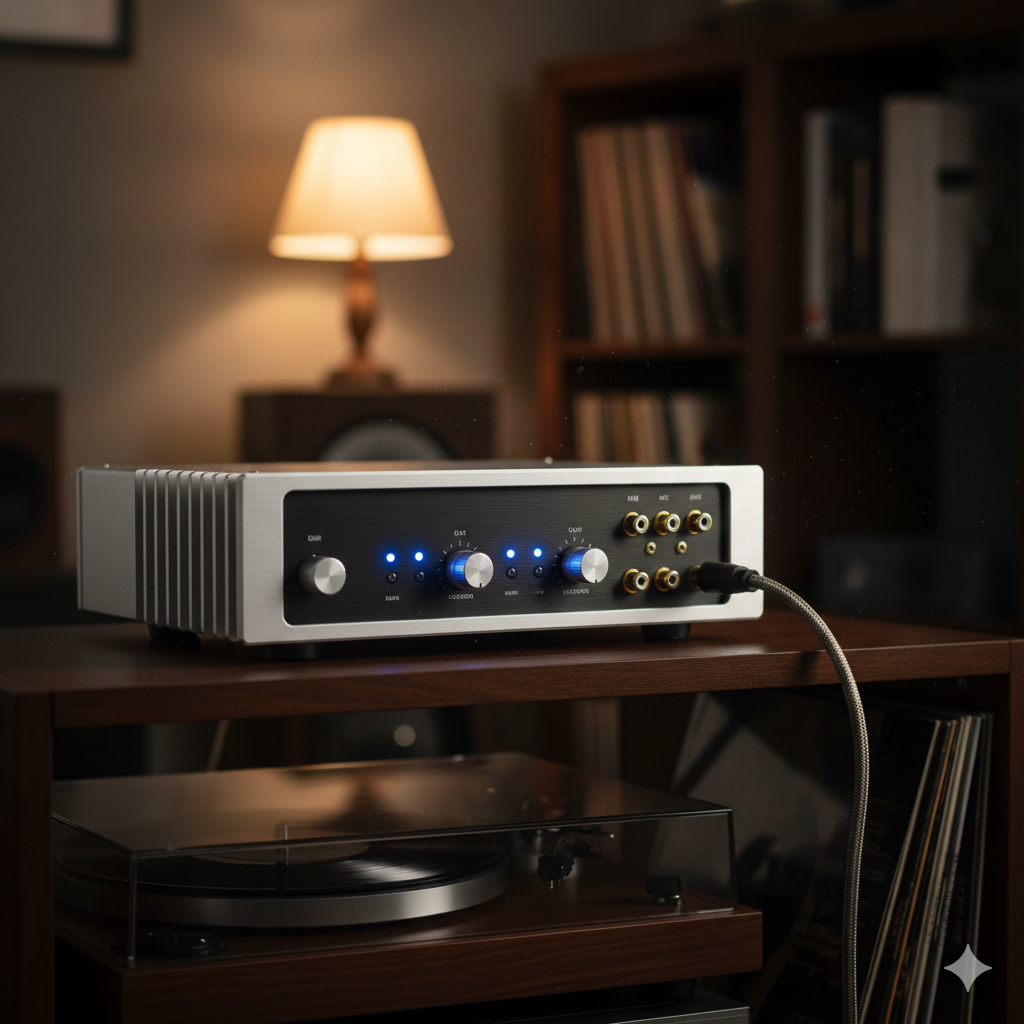
If you’re new to vinyl, you might wonder why some turntables need an extra box called a phono preamp—or why your setup sounds quiet, thin, or distorted without one. Whether built into your turntable or purchased separately, the phono preamp plays a critical role in making your records sound the way they should.
This beginner-friendly guide explains what a phono preamp does, why it’s essential, and how to choose the right one for your setup.
What Is a Phono Preamp?
A phono preamp—also known as a phono stage—is a small amplifier designed specifically for turntables. It performs two essential jobs:
1. Boosting the weak phono signal
Cartridges produce a very tiny signal called a phono-level output—far weaker than the standard line-level used by speakers, amplifiers, and mixers.
A phono preamp amplifies this low-level signal to line-level so your audio system can actually play it.
2. Applying the RIAA equalization curve
Vinyl records are cut using the RIAA EQ curve, which:
- Reduces bass (to prevent groove distortion)
- Boosts treble during cutting
A phono preamp reverses this EQ curve during playback:
- Restoring the bass
- Softening the treble
- Balancing the frequency response
Without RIAA correction, vinyl would sound thin, shrill, and unnatural.
Do I Really Need a Phono Preamp?
Yes—every turntable needs a phono preamp.
The only difference is where it comes from:
You have one if:
- Your turntable has a “PHONO/LINE” switch
- Your receiver or amplifier has a “PHONO” input
You need one if:
- Your turntable only outputs PHONO and your amp does not have a PHONO input
- You want a better-quality preamp than the built-in option
- Your turntable’s built-in preamp sounds weak or noisy
A hi-fi system without a proper phono preamp will result in:
- Very low volume
- Lack of bass
- Harsh, bright treble
- Distortion
- Noise and hum
So yes—it’s essential to your vinyl chain.
Types of Phono Preamps
1. Built-In Phono Preamps (Turntable)
Many beginner and mid-range turntables include a built-in preamp. These are convenient and eliminate extra cables and boxes.
Pros:
- Plug-and-play
- Affordable
- No extra equipment needed
Cons:
- Lower quality
- Limited clarity and dynamic range
- Not upgradeable
2. Built-In Phono Inputs (Receiver / Amplifier)
Many vintage receivers and some modern integrated amps include a phono stage.
Pros:
- Better quality than most built-in turntable preamps
- Clean signal path
- Great for classic setups
Cons:
- Quality varies
- Not always optimized for modern cartridges
3. External Phono Preamps (Standalone Box)
Dedicated external phono stages offer higher-quality components and cleaner amplification.
Pros:
- Best sound quality
- Upgradeable
- Lower noise floor
- Enhanced clarity and dynamics
Cons:
- Extra cost
- Requires additional space and cables
For serious vinyl enthusiasts, an external phono preamp is often the biggest upgrade you can make.
MM vs. MC: How Cartridge Type Affects Your Phono Stage
Turntable cartridges come in two major types:
1. MM (Moving Magnet)
- Most common
- Higher output
- Works with nearly all basic preamps
2. MC (Moving Coil)
- Lower output
- More detailed and revealing
- Requires a special MC-capable preamp or step-up transformer
When buying a phono preamp, always check:
- Does it support MM?
- Does it support MC?
- Does it offer adjustable gain or loading?
Beginners typically start with MM setups, which are more versatile and easier to match.
How a Phono Preamp Affects Sound Quality
A good phono stage improves:
- Noise floor (less hiss & hum)
- Channel separation (wider stereo image)
- Dynamic range (more punch & clarity)
- Bass performance
- Treble smoothness
- Overall musical detail
Poor-quality preamps often sound:
- Flat
- Noisy
- Thin
- Harsh
Upgrading your phono stage can unlock the full potential of your cartridge and turntable.
How to Choose the Right Phono Preamp
Here are the most important factors:
1. Cartridge compatibility
MM only? MM/MC? Adjustable loading?
2. Gain
Make sure the preamp has enough gain for your cartridge without causing distortion.
3. Sound signature
Do you want:
- Warm?
- Neutral?
- Analytical?
4. Build quality & components
Higher-quality components produce cleaner amplification.
5. Budget
Great beginner preamps exist at all levels:
- Entry-level: clean, simple, plug-and-play
- Mid-tier: better components, adjustable features
- High-end: ultra-low noise and maximum fidelity
Final Thoughts
A phono preamp is one of the most important—and misunderstood—components of a vinyl setup. It transforms the tiny signal from your cartridge into a rich, full, balanced sound your system can actually enjoy.
Whether you’re using a built-in stage or upgrading to a dedicated external preamp, understanding how this component works will help you build a cleaner, better-sounding vinyl system from the ground up.