
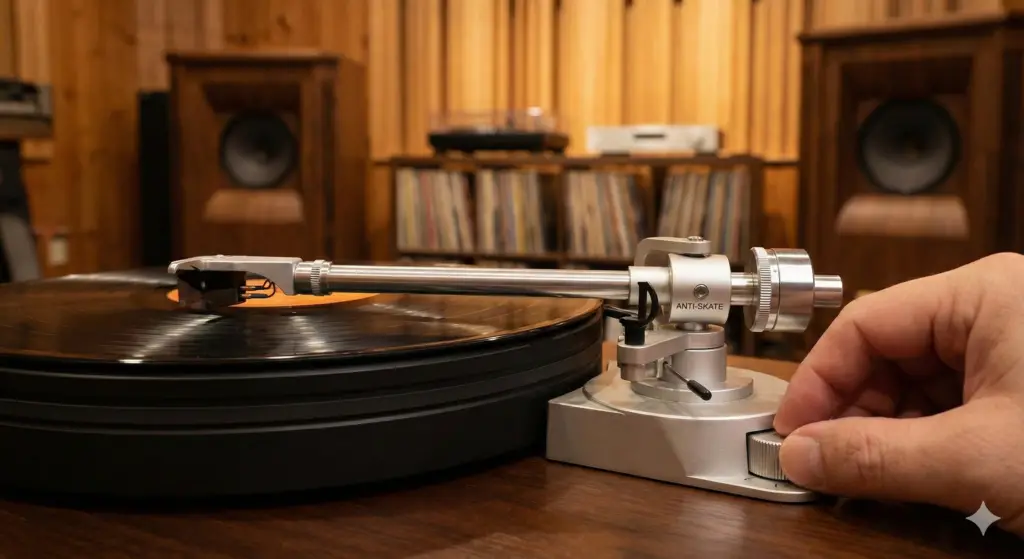
Among the essential—but often misunderstood—turntable settings, anti-skate plays a crucial role in protecting your records and ensuring clean, balanced playback.
If you’ve ever heard distortion in one channel, noticed your stylus drifting inward, or struggled with accurate tracking, anti-skate may be the key.
This guide breaks down what anti-skate actually does, why it matters, and how to set it correctly, even if you’re a complete beginner.
What Is Anti-Skate?
As a record spins, friction between the stylus and grooves naturally pulls the tonearm inward toward the center of the platter.
This inward force is known as skating force.
Anti-skate is a small outward force applied to the tonearm to counteract that pull.
In simple terms, anti-skate helps the stylus sit perfectly centered in the groove.
Why Anti-Skate Matters
1. Prevents Uneven Stylus and Record Wear
Without anti-skate, the stylus presses harder on one groove wall—usually the inner wall—leading to:
- Faster stylus wear
- Permanent groove damage
- Distorted playback on one channel
Proper anti-skate spreads pressure evenly on both walls.
2. Improves Tracking Stability
With the force balanced, the stylus stays firmly in the groove, even during:
- Dynamic passages
- Songs with strong bass
- Warped records
This reduces skipping and mistracking.
3. Preserves Stereo Balance
Because each groove wall carries one stereo channel (left and right), uneven pressure causes:
- Right-channel distortion
- Channel imbalance
- Harsh or smeared treble
Anti-skate ensures both channels play cleanly.
4. Enhances Sound Quality
Proper anti-skate produces:
- Clearer highs
- Cleaner vocals
- More stable imaging
- Less sibilance
You’ll especially notice improvements in the inner grooves where tracking is most challenging.
How Anti-Skate Works
Different turntables use different anti-skate systems:
1. Dial-Type Anti-Skate
The most common. You turn a small dial to increase or decrease the force.
2. Weight & String System
A small weight hangs from a string, creating outward tension through a lever arm.
3. Magnetic Anti-Skate
Uses magnetic force for smoother, more consistent adjustment.
Regardless of the system, the goal is the same: balance the inward pull with an equal outward counterforce.
How to Adjust Anti-Skate (Step-by-Step)
Before You Start:
Make sure your tracking force is already set correctly—anti-skate depends on it.
1. Start With the Manufacturer’s Recommendation
A simple rule of thumb:
Set anti-skate to match your tracking force.
Example:
If tracking force = 2.0g → Set anti-skate around 2.
This gets you very close to a proper setting.
2. Perform the “Drift Test” (Beginner-Friendly)
- With the platter stationary, place the stylus gently on the smooth part between the record’s run-out grooves.
- The stylus should stay still or drift very slightly inward.
If it shoots inward ➝ Increase anti-skate
If it drifts outward ➝ Decrease anti-skate
This test is simple but surprisingly effective.
3. Listen for Channel Balance and Distortion
Put on a clean record and listen for:
- Distortion in one channel
- Sibilance (“sss” sounds breaking up)
- Harshness in vocals
Adjust anti-skate until:
- Both channels sound clean
- Vocals stay centered
- No side sounds overly bright or distorted
This is the most reliable real-world test.
4. Use a Test Record (Optional for Precision)
Some test LPs include anti-skate bands with high-modulation tones.
If the stylus mistracks on one channel first:
- Right channel distorts ➝ Increase anti-skate
- Left channel distorts ➝ Decrease anti-skate
Common Anti-Skate Mistakes
1. Setting It Too High
Leads to outward drift, left-channel distortion, and a sharp or thin sound.
2. Ignoring It Completely
Some beginners leave anti-skate at zero—resulting in rapid stylus and record wear.
3. Matching the Dial Number Too Literally
Not all dials correlate perfectly to grams. Use your ears as the final judge.
4. Misdiagnosing Other Issues
Sometimes distortion isn’t anti-skate at all—it may be:
- Dirty stylus
- Damaged grooves
- Poor alignment
- Incorrect tracking force
Always check these first.
Does Every Turntable Need Anti-Skate?
Most pivoted tonearms require it.
However, linear-tracking turntables do not, because they move the tonearm straight across the record with no skating force.
Some ultra-budget turntables have fixed anti-skate you can’t adjust—these typically compensate automatically at an average level.
Final Thoughts
Anti-skate may seem like a small adjustment, but it has a big impact on your vinyl listening experience.
Setting it correctly ensures:
- Clean sound
- Balanced channels
- Proper tracking
- Longer stylus and record life
When combined with proper tracking force and alignment, anti-skate helps your turntable perform exactly as it was designed to—delivering warm, rich, distortion-free playback from the first track to the last.