
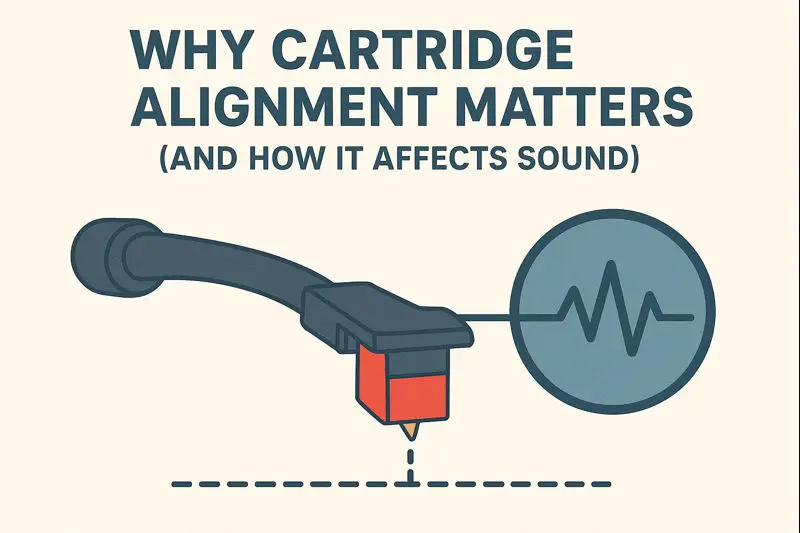
For many new vinyl enthusiasts, cartridge alignment feels like an intimidating, technical task reserved for audiophiles. But the truth is simple: proper alignment is one of the most important factors influencing your turntable’s performance, clarity, and record longevity.
Whether you’re setting up your first cartridge or fine-tuning a new system, understanding how alignment works—and why it matters—will instantly improve your listening experience.
What Is Cartridge Alignment?
Cartridge alignment refers to positioning the phono cartridge so the stylus sits at the correct angles when tracking a record’s grooves.
It involves three main components:
1. Overhang
How far the stylus extends past the tonearm’s pivot point.
2. Offset Angle
The slight twist of the cartridge so the stylus meets the groove at the proper angle.
3. Vertical Tracking Angle (VTA) / Stylus Rake Angle (SRA)
The vertical angle at which the stylus sits relative to the groove walls.
Together, these ensure the stylus traces the groove accurately from the outer edge to the inner grooves.
Why Alignment Matters
1. Better Sound Quality
Proper alignment allows the stylus to sit perfectly in the groove, producing:
- Cleaner highs
- Fuller mids
- More defined bass
- Improved stereo separation
- Wider soundstage
Misalignment causes audible issues such as muffled highs, distorted vocals, and harsh sibilance.
2. Less Distortion (Especially in Inner Grooves)
Inner grooves are naturally more difficult for the stylus to track.
Poor alignment exaggerates:
- Inner groove distortion
- Harsh treble
- Compression and loss of detail
A well-aligned cartridge tracks inner grooves with much greater accuracy.
3. Reduced Record Wear
A misaligned stylus can scrape or dig into groove walls unevenly.
This leads to:
- Permanent groove damage
- Audible wear
- Shortened record lifespan
Proper alignment distributes pressure evenly across both groove walls.
4. Longer Stylus Life
When the stylus tracks cleanly and evenly, friction is reduced, preserving the diamond tip and extending its usable life.
5. Tracking Stability
Alignment ensures the stylus stays centered in the groove.
Misaligned cartridges are more prone to:
- Skipping
- Mistracking during loud passages
- Channel imbalance
How Misalignment Affects Your Sound
Not sure if your cartridge is misaligned? Here’s what you may hear:
Signs of Bad Alignment
- Sibilance (“sss” sounds break up)
- Distortion in one or both channels
- Weak bass or muddy low-end
- Harsh or thin highs
- Uneven channel volume (left or right bias)
- Distortion increasing toward the inner groove
These symptoms often disappear immediately after proper alignment.
How to Align a Cartridge (Beginner-Friendly)
What You Need
- A cartridge protractor (Baerwald, Stevenson, or Löfgren)
- A flat, level surface
- Patience—this is precision work
Step-by-Step Basics
1. Level the Turntable
A level platter ensures accurate alignment across the entire record.
2. Set the Overhang
Place the protractor on the platter and align the stylus to the overhang point indicated.
3. Square the Cartridge
Align the cartridge body with the grid lines on the protractor.
Repeat for both null points.
4. Check the Offset Angle
Make sure the cartridge points slightly inward according to your protractor’s geometry.
5. Adjust VTA/SRA (Optional but Helpful)
Start with the tonearm parallel to the record.
Fine-tune by ear for:
- Clearer highs
- Better instrument separation
6. Lock Everything In
Once everything looks perfect, tighten screws evenly to avoid shifting the alignment.
Which Alignment Method Should You Use?
Baerwald (Löfgren A)
The most popular. Minimizes overall distortion across the entire record.
Stevenson
Best for reducing distortion in the inner grooves. Good for classical or long albums.
Löfgren B
Reduces distortion in the middle area but requires very precise tracking.
Do You Need to Align a Cartridge Often?
You should realign your cartridge if:
- You installed a new cartridge
- You changed your headshell
- You bumped the tonearm
- You upgraded your stylus
- You hear any of the distortion signs listed earlier
Otherwise, once aligned and tightened properly, it usually stays stable.
Final Thoughts
Cartridge alignment may seem tedious at first, but it’s one of the most rewarding adjustments you can make.
A properly aligned cartridge not only sounds significantly better—it also protects your records, extends stylus life, and allows your turntable to perform at its absolute best.
If you want an instant, free upgrade to your vinyl setup, cartridge alignment is the place to start.