
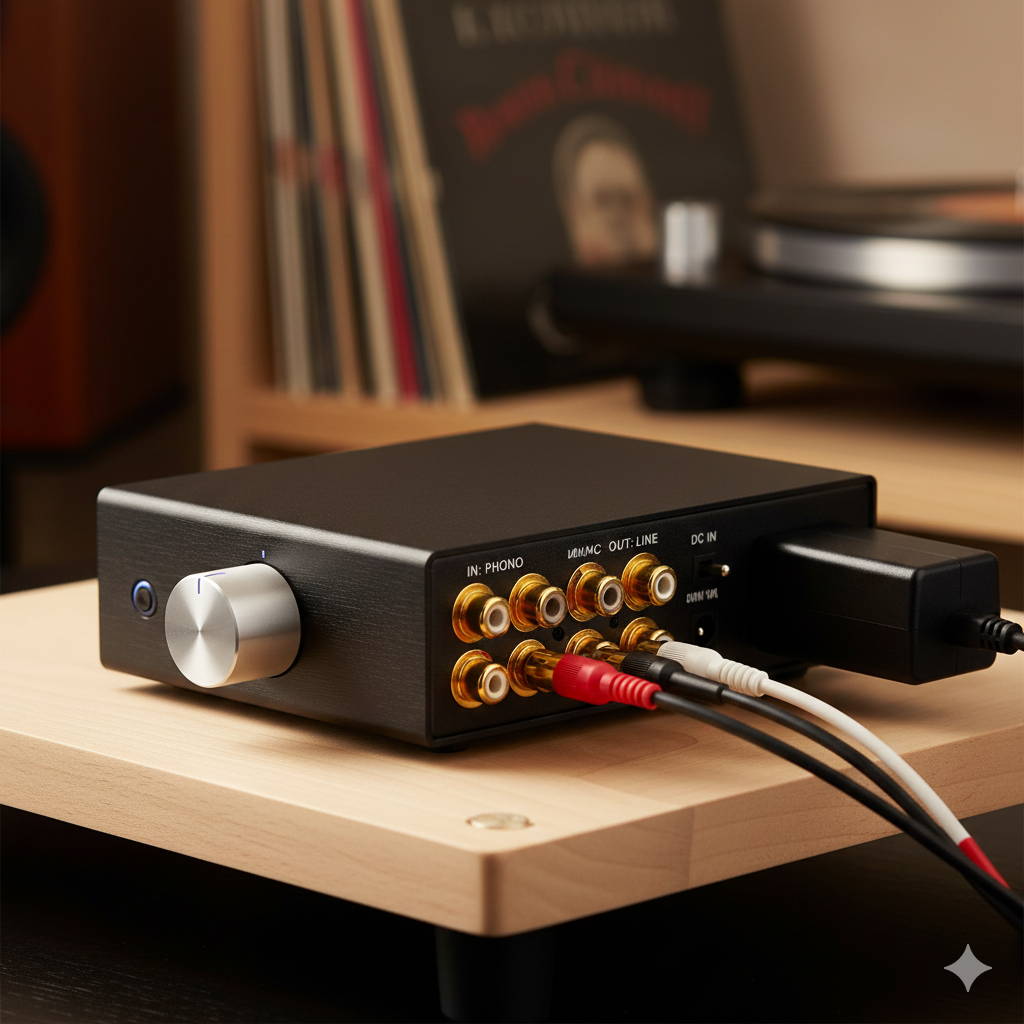
The short answer is that turntables produce a very different type of signal than most audio devices. Some turntables include a built-in phono preamp, while others rely on an external one.
This article explains what a phono preamp does, why it’s necessary, and how to tell if your turntable needs one.
What Is a Phono Preamp?
A phono preamp (also called a phono stage) performs two essential tasks:
- Boosts the tiny signal from a turntable cartridge
- Applies RIAA equalization, which restores the original tonal balance of the music
Without these two steps, a turntable will sound extremely quiet, thin, and distorted.
Why Turntables Output Such a Low Signal
Unlike digital sources, turntable cartridges generate sound mechanically.
- Typical cartridge output: 2–6 millivolts
- Line-level sources (CD, streaming): ~1–2 volts
That’s a massive difference. A phono preamp increases the signal by up to 100× before it reaches your amplifier or speakers.
What Is RIAA Equalization (and Why It Matters)
When records are cut:
- Bass is reduced
- Treble is boosted
This is done to:
- Fit more music on a record
- Reduce groove distortion and noise
A phono preamp reverses this curve, restoring:
- Full bass
- Natural midrange
- Smooth treble
Without RIAA correction, records sound thin and harsh.
When a Turntable DOES Need a Phono Preamp
Your turntable needs a phono preamp if:
- It has no built-in preamp
- You’re connecting it to:
- Powered speakers
- An amplifier without a PHONO input
- An audio interface
In this case, you must use an external phono preamp or a turntable with one built in.
When a Turntable Does NOT Need a Phono Preamp
You don’t need a separate phono preamp if:
- Your amplifier or receiver has a PHONO input
- Your turntable has a built-in, switchable phono preamp
In these setups, the signal is already boosted and equalized properly.
Built-In vs External Phono Preamps
Built-In Phono Preamp
Pros
- Simple, plug-and-play
- Great for beginners
- Fewer boxes and cables
Cons
- Limited upgrade potential
- Quality varies by model
External Phono Preamp
Pros
- Better sound quality potential
- Upgradable
- Matches cartridge quality
Cons
- Extra cost
- Requires more setup
Many enthusiasts start with built-in preamps and upgrade later.
Moving Magnet (MM) vs Moving Coil (MC) Considerations
Moving Magnet (MM)
- Most common
- Higher output
- Works with most phono preamps
Moving Coil (MC)
- Lower output
- Requires MC-compatible phono preamp or step-up device
- Usually found on higher-end systems
Always match your preamp to your cartridge type.
Common Connection Mistakes
Avoid these common errors:
- Plugging a turntable into a line-level input without a preamp
- Using two phono preamps at once
- Forgetting to switch off the built-in preamp when using an external one
- Ignoring grounding connections
These mistakes cause distortion, hum, or very low volume.
How to Tell If Your Turntable Has a Built-In Preamp
Check for:
- A LINE / PHONO switch
- Output labeled “LINE OUT”
- Manufacturer specifications
If unsure, consult the manual or model description.
Final Thoughts
A phono preamp isn’t an optional accessory—it’s an essential part of vinyl playback. Whether it’s built into your turntable, your amplifier, or a separate box, every turntable system uses one somewhere.
Understanding where the phono preamp belongs in your setup eliminates confusion, improves sound quality, and prevents costly mistakes.
Once it’s set up correctly, vinyl becomes simple—and sounds exactly as it should.