
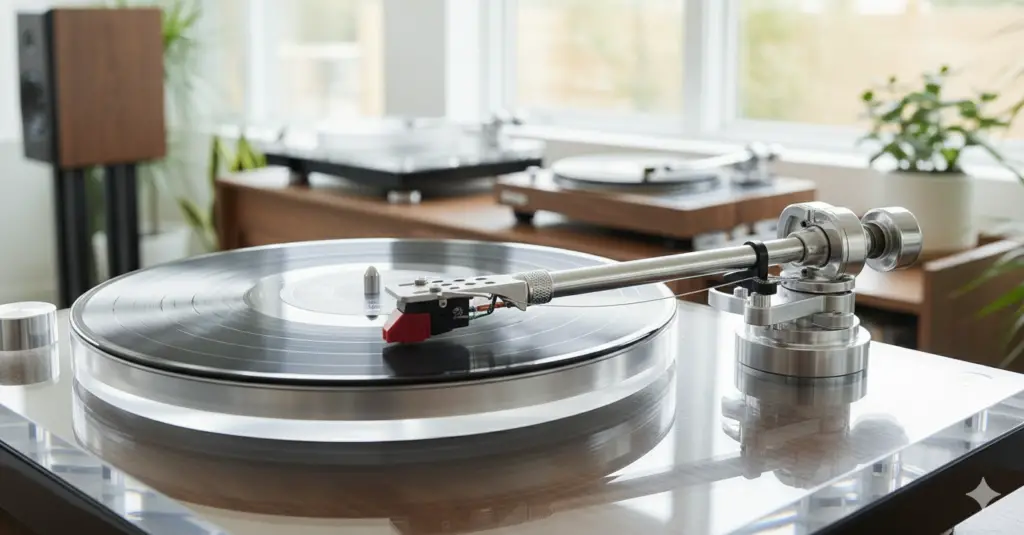
The tonearm is one of the most critical components of a turntable. While cartridges and stylus shapes often get the spotlight, the shape of the tonearm itself plays a major role in tracking accuracy, resonance control, and overall sound quality. Among the most common designs are straight, S-shaped, and J-shaped tonearms—each with its own strengths, compromises, and ideal use cases.
Understanding these differences can help you choose the right turntable for your listening style.
Why Tonearm Shape Matters
As a record spins, the stylus must follow a curved groove using a pivoted arm. Because this motion is not perfectly linear, tracking error is unavoidable. Tonearm shape influences:
- Tracking angle error
- Cartridge alignment options
- Effective mass and resonance behavior
- Compatibility with different cartridges
No design is perfect—each represents a different engineering solution.
Straight Tonearms
What Is a Straight Tonearm?
A straight tonearm runs directly from the pivot to the headshell with no curves. Some straight arms have a fixed headshell, while others use angled or offset headshells to reduce tracking error.
Straight tonearms are common on modern audiophile decks and many DJ turntables.
Advantages of Straight Tonearms
- Lower effective mass
- Excellent rigidity and stiffness
- Fast transient response
- Simple, clean mechanical design
These qualities make straight tonearms very responsive and accurate, particularly with lighter cartridges.
Potential Drawbacks
- Higher tracking error if poorly designed
- Limited cartridge alignment flexibility on fixed-headshell models
- Less forgiving of setup errors
Best For
- Audiophiles seeking detail and speed
- DJs who value fast cueing and scratching
- Moving-magnet cartridges with moderate compliance
S-Shaped Tonearms
What Is an S-Shaped Tonearm?
An S-shaped tonearm uses a gentle double curve to achieve correct cartridge offset while maintaining a pivoted design. Most S-shaped arms use detachable headshells, allowing easy cartridge swaps.
This design is iconic in both vintage hi-fi and professional DJ turntables.
Advantages of S-Shaped Tonearms
- Reduced tracking angle error
- Excellent cartridge alignment flexibility
- Detachable headshell convenience
- Broad cartridge compatibility
The curved geometry naturally places the cartridge at an optimal angle relative to the groove.
Potential Drawbacks
- Slightly higher effective mass
- More joints and connections can introduce resonance
- Not as rigid as some straight-arm designs
Best For
- Vinyl enthusiasts with multiple cartridges
- DJs who change cartridges frequently
- Moving-coil and lower-compliance cartridges
J-Shaped Tonearms
What Is a J-Shaped Tonearm?
A J-shaped tonearm is similar to an S-shaped arm but uses a single, elongated curve rather than a double bend. It achieves cartridge offset with fewer curves, offering a balance between simplicity and alignment accuracy.
J-shaped arms are often found on vintage and broadcast-style turntables.
Advantages of J-Shaped Tonearms
- Good tracking geometry
- Fewer bends than S-shaped arms
- Often excellent build quality on vintage models
- Smooth, stable tracking behavior
Potential Drawbacks
- Less common, fewer modern options
- Can be heavier than straight arms
- Limited upgrade availability
Best For
- Vintage turntable enthusiasts
- Listeners who prefer classic designs
- Medium to low-compliance cartridges
Tonearm Shape vs Sound Quality
Tonearm shape alone doesn’t determine sound quality—execution matters more than geometry. A well-engineered straight arm can outperform a poorly designed S-shaped arm, and vice versa.
That said, general tendencies include:
- Straight arms sounding fast and precise
- S-shaped arms offering balance and versatility
- J-shaped arms delivering smooth, stable playback
Which Tonearm Type Should You Choose?
Consider the following:
- Cartridge type and compliance
- Listening style (audiophile vs DJ use)
- Setup flexibility you want
- Availability of upgrades and replacements
If you value simplicity and precision, a straight tonearm may be ideal. If flexibility and alignment options matter most, S-shaped arms are hard to beat. For those who appreciate classic engineering, J-shaped arms offer a compelling middle ground.
Final Thoughts
Straight, S-shaped, and J-shaped tonearms each exist for good reasons. Rather than asking which is “best,” the better question is which design best suits your system, cartridges, and listening habits.
When properly matched and set up, any of these tonearm types can deliver exceptional sound—and help your vinyl collection shine.