
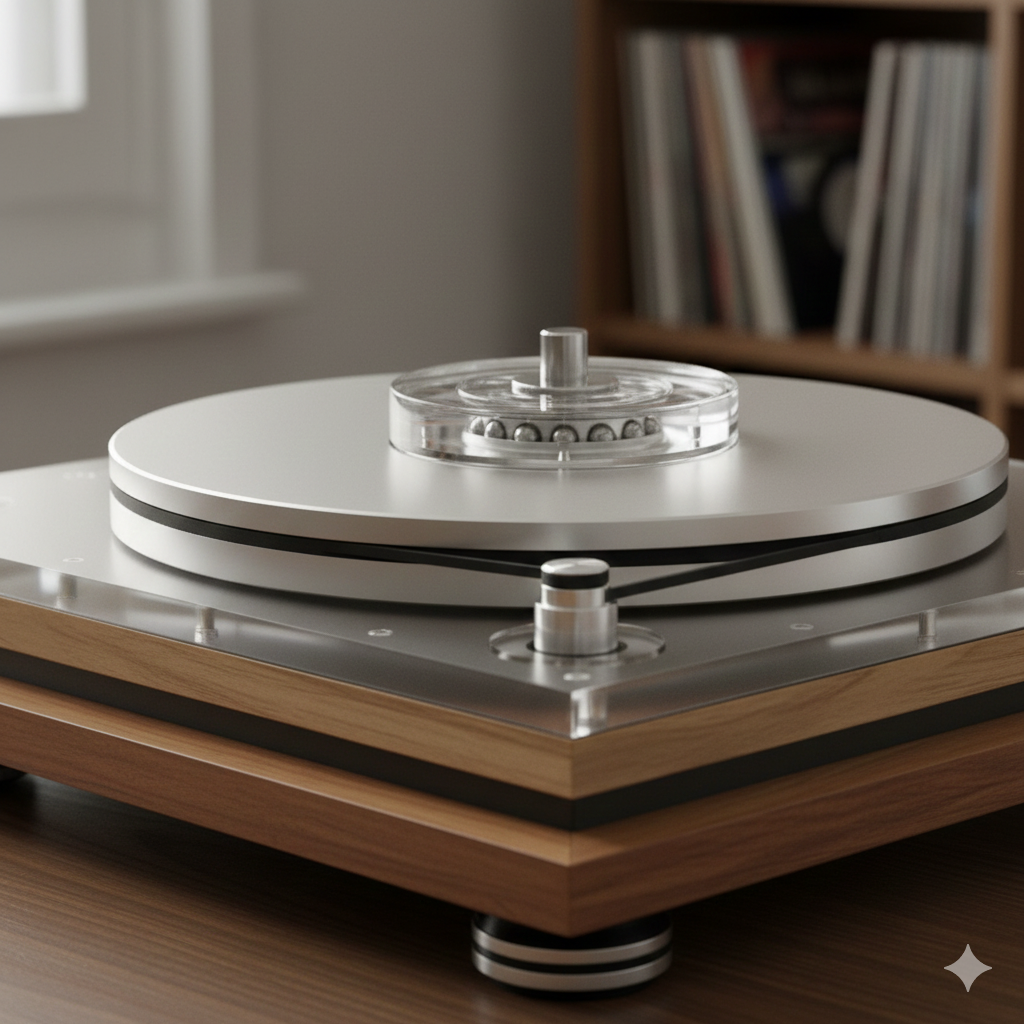
In the quest for better vinyl playback, manufacturers and enthusiasts often focus on cartridges, tonearms, and platters. Yet hidden beneath the main platter of many turntables is a component that quietly shapes performance: the sub-platter. Frequently mentioned in upgrade discussions and audiophile forums, the sub-platter raises an important question—does its design really improve sound quality, or is it just another hi-fi talking point?
Let’s take a closer look.
What Is a Sub-Platter?
A sub-platter is a secondary platter mounted directly on the turntable’s main bearing. The main platter sits on top of it, while the drive system—usually a belt—wraps around the sub-platter instead of the main platter.
This design is most commonly found in belt-drive turntables, especially minimalist and audiophile-oriented models.
Why Use a Sub-Platter?
The sub-platter serves several functional purposes:
- It provides a precise, consistent surface for the drive belt
- It isolates belt tension from the main platter
- It helps distribute rotational forces more evenly through the bearing
By separating the drive interface from the main platter, designers aim to improve speed consistency and reduce vibration.
How Sub-Platter Design Affects Performance
1. Speed Stability and Accuracy
Because the belt contacts the sub-platter directly, the quality of the sub-platter’s machining is critical. A perfectly round, well-balanced sub-platter allows the belt to move smoothly, minimizing speed variations.
Poorly machined sub-platters can introduce subtle speed fluctuations, while precision designs help maintain accurate and stable rotation—especially important for pitch-sensitive music.
2. Reduced Motor Vibration Transfer
The sub-platter acts as a buffer between the motor and the main platter. Any vibration or irregularity coming from the motor is less likely to reach the record surface directly.
This isolation can result in:
- Lower background noise
- Cleaner bass response
- Improved overall clarity
3. Bearing Performance and Longevity
Sub-platters are directly connected to the main bearing, meaning their mass and balance affect bearing load. Higher-quality sub-platters distribute weight evenly and reduce uneven wear, which can improve long-term performance and consistency.
Materials Matter: Plastic vs Metal
Plastic Sub-Platters
Often found in entry-level turntables, plastic sub-platters are lightweight and cost-effective. When well-made, they can perform adequately, but they are more prone to flexing, wear, and dimensional inaccuracies.
Sound impact: Functional but limited, especially at higher system resolutions.
Metal Sub-Platters (Aluminum, Steel, Brass)
Upgraded or high-end sub-platters are usually machined from solid metal. These offer greater mass, rigidity, and precision.
Sound impact: Better speed stability, tighter bass, and more focused imaging.
Are Sub-Platter Upgrades Worth It?
Sub-platter upgrades are popular because they address a fundamental part of the turntable’s drive system. Unlike cartridge upgrades, which primarily affect tonal character, sub-platter improvements target mechanical accuracy.
Upgrading can be worthwhile if:
- The original sub-platter is lightweight or poorly machined
- Speed accuracy is a concern
- The rest of the system is revealing enough to show improvements
However, benefits will be limited if the motor, bearing, or power supply is the primary weak point.
Sub-Platter vs One-Piece Platter Designs
Some turntables use a single heavy platter with the belt riding directly on it. These designs rely on platter mass rather than separation for stability.
Neither approach is universally better—it depends on execution. A well-designed sub-platter system can outperform a mediocre one-piece platter, and vice versa.
What Improvements Can You Expect?
When a sub-platter design is done right, listeners often report:
- More stable pitch
- Improved timing and rhythmic flow
- Cleaner transients
- A quieter background
These improvements may be subtle but contribute to a more natural and engaging listening experience.
Final Thoughts
Sub-platter design isn’t just marketing—it’s a meaningful part of how a turntable controls speed, vibration, and mechanical accuracy. While it won’t magically transform a poorly designed deck, a well-executed sub-platter can provide real performance benefits, especially in belt-drive turntables.
If you’re chasing better speed stability and lower noise without changing the core character of your system, the sub-platter might be one of the most overlooked yet effective components to consider.