
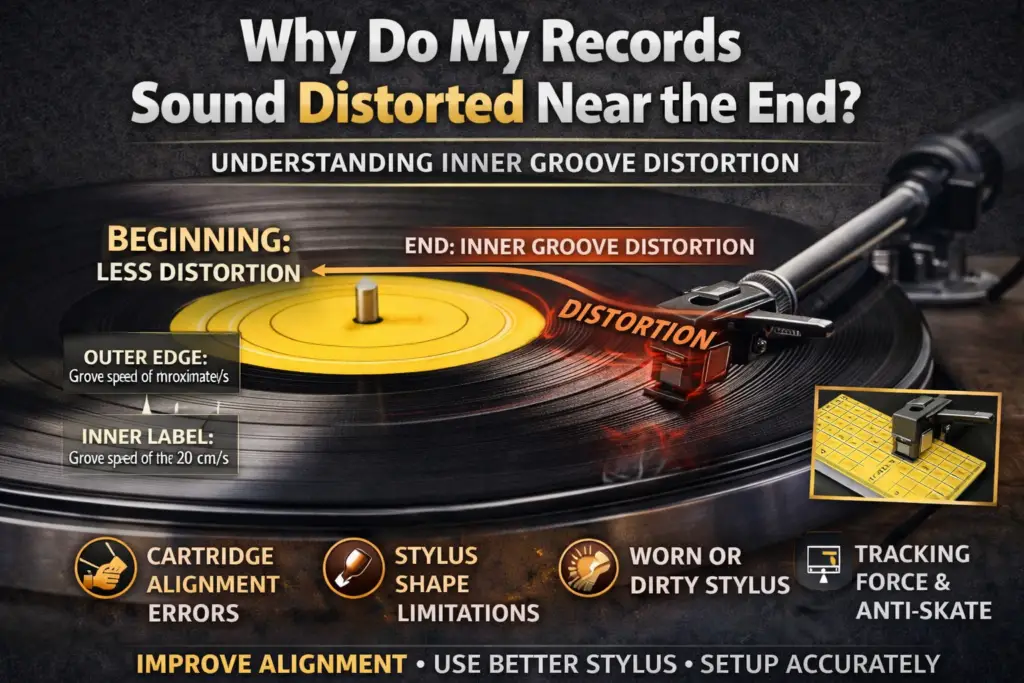
If your records sound clean and detailed at the start but become harsh, fuzzy, or congested near the final tracks, you’re not imagining it. This common vinyl issue is known as inner groove distortion (IGD)—and it affects even experienced listeners.
The good news? In many cases, it can be reduced or eliminated with proper setup and the right gear.
🔍 What Is Inner Groove Distortion?
Inner groove distortion occurs because:
- The inner grooves of a record are physically shorter
- Less vinyl passes under the stylus per second
- The stylus must track tighter curves at the same speed
This makes accurate tracking far more difficult toward the center of the record.
📐 Why Inner Grooves Are Harder to Track
At the outer edge of an LP:
- Groove speed ≈ 50 cm/s
Near the label:
- Groove speed drops to ≈ 20 cm/s
Slower groove speed means:
- Less detail available
- Higher tracking error
- More audible distortion, especially on vocals and cymbals
🎵 Main Causes of End-of-Side Distortion
1. Cartridge Alignment Errors
Poor alignment is the #1 cause of IGD.
Common issues:
- Incorrect overhang
- Wrong offset angle
- Cartridge twisted in the headshell
Even small alignment errors are amplified near the inner grooves.
2. Stylus Shape Limitations
Stylus profiles matter a lot.
More prone to distortion:
- Conical (spherical)
- Basic bonded elliptical
Better at inner groove tracking:
- Nude elliptical
- MicroLine / MicroRidge
- Shibata
- Fine Line
Advanced profiles contact more of the groove wall and trace complex modulations more accurately.
3. Worn or Dirty Stylus
A stylus that’s:
- Worn
- Chipped
- Dirty
Will mistrack first where tracking is hardest—at the inner grooves.
4. Incorrect Tracking Force
Too light:
- Stylus bounces and mistracks
Too heavy:
- Increased distortion and record wear
Always set tracking force using a digital scale, not the tonearm dial alone.
5. Anti-Skate Misadjustment
Anti-skate compensates for inward pull on the tonearm.
Incorrect anti-skate causes:
- Uneven groove wall pressure
- Channel imbalance
- Increased IGD
6. Tonearm Quality & Geometry
Shorter tonearms:
- Have higher tracking angle error
Longer arms or well-designed geometry:
- Reduce distortion across the record
This is why many high-end turntables use 9–12 inch tonearms.
7. Record Cutting Choices
Sometimes the distortion isn’t your fault.
- Loud, high-frequency content near the label
- Long album sides
- Poor mastering
These push vinyl beyond its physical limits.
🛠️ How to Reduce Inner Groove Distortion
✔ Align cartridge with a proper protractor
✔ Upgrade to a better stylus profile
✔ Clean and inspect your stylus regularly
✔ Set tracking force accurately
✔ Adjust anti-skate correctly
✔ Use clean, well-pressed records
📊 Quick Troubleshooting Checklist
| Symptom | Likely Cause |
|---|---|
| Distortion only at end | Alignment or stylus shape |
| Harsh vocals | Tracking force too light |
| One channel worse | Anti-skate issue |
| Distortion on many records | Worn stylus |
🏁 Final Thoughts
Inner groove distortion isn’t a flaw in vinyl—it’s a physical limitation of the format. But with proper setup and realistic expectations, it can be minimized to the point where it’s barely noticeable.
🎶 Vinyl rewards careful setup—and the end of the record doesn’t have to sound like the end of the fun.