
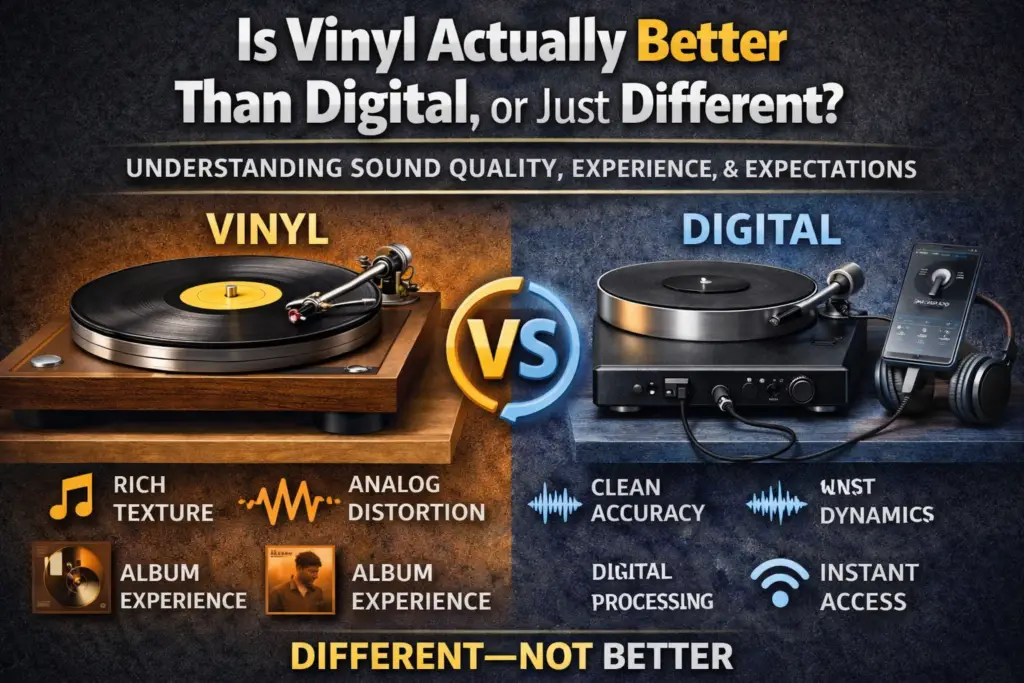
Few audio questions spark as much debate as vinyl vs digital. Some listeners swear vinyl is clearly superior, while others argue digital has already surpassed it in every measurable way. So what’s the truth?
Short answer: vinyl isn’t inherently better than digital—but it is different, and those differences matter depending on what you value.
Let’s unpack it.
🎧 “Better” Depends on What You Mean
Before comparing formats, we need to define better.
Do you mean:
- More accurate to the original recording?
- More emotionally engaging?
- More convenient?
- More enjoyable for long listening sessions?
Vinyl and digital excel at different goals.
📊 The Technical Reality
From a purely technical standpoint, modern digital audio wins easily.
Digital advantages:
- Lower noise floor
- Wider dynamic range
- Near-perfect channel separation
- Zero wear over time
- Exact playback repeatability
High-resolution digital is capable of reproducing audio far beyond human hearing limits.
Vinyl limitations:
- Surface noise and distortion
- Limited dynamic range
- Inner-groove distortion
- Physical wear
If accuracy is the metric, digital is objectively better.
🎵 Why Vinyl Still Sounds “Better” to Many Listeners
Despite its limitations, vinyl often feels better. Here’s why.
1. Different Distortion Profile
Vinyl playback adds:
- Even-order harmonic distortion
- Gentle compression
- Soft transient edges
These traits can make music sound:
- Fuller
- Smoother
- More forgiving
Digital removes these artifacts—which can sound cleaner, but also less “romantic.”
2. Different Mastering
Vinyl releases are often mastered with:
- Less aggressive loudness
- More midrange focus
- Careful bass control
In many cases, vinyl doesn’t sound better because of the format—but because it received a better master.
3. Listening Psychology
Vinyl encourages:
- Active listening
- Slower music consumption
- Intentional album playback
This context can dramatically improve perceived sound quality.
🧠 The Experience Factor
Vinyl offers:
- Album artwork
- Physical interaction
- Ritual and anticipation
Digital offers:
- Instant access
- Portability
- Perfect consistency
Neither is objectively superior—they deliver different emotional experiences.
🔁 When Vinyl Is Not Better
Vinyl is unlikely to outperform digital if:
- The pressing is poor
- The turntable setup is subpar
- The digital version uses a superior master
- Convenience and noise-free playback matter most
A bad vinyl system will always lose to a good digital one.
📊 Vinyl vs Digital: Side-by-Side
| Aspect | Vinyl | Digital |
|---|---|---|
| Sound accuracy | Lower | Higher |
| Noise floor | Higher | Extremely low |
| Distortion | Higher (often pleasant) | Minimal |
| Mastering differences | Often gentler | Often louder |
| Convenience | Low | Extremely high |
| Emotional engagement | High for many | Depends on listener |
🏁 Final Verdict: Different, Not Better
Vinyl isn’t a replacement for digital—it’s a complement.
- Digital is ideal for accuracy, discovery, and convenience
- Vinyl is ideal for engagement, intentional listening, and musical texture
🎶 The best format is the one that makes you want to listen longer.
For many music lovers, the real answer isn’t vinyl or digital—it’s both.