
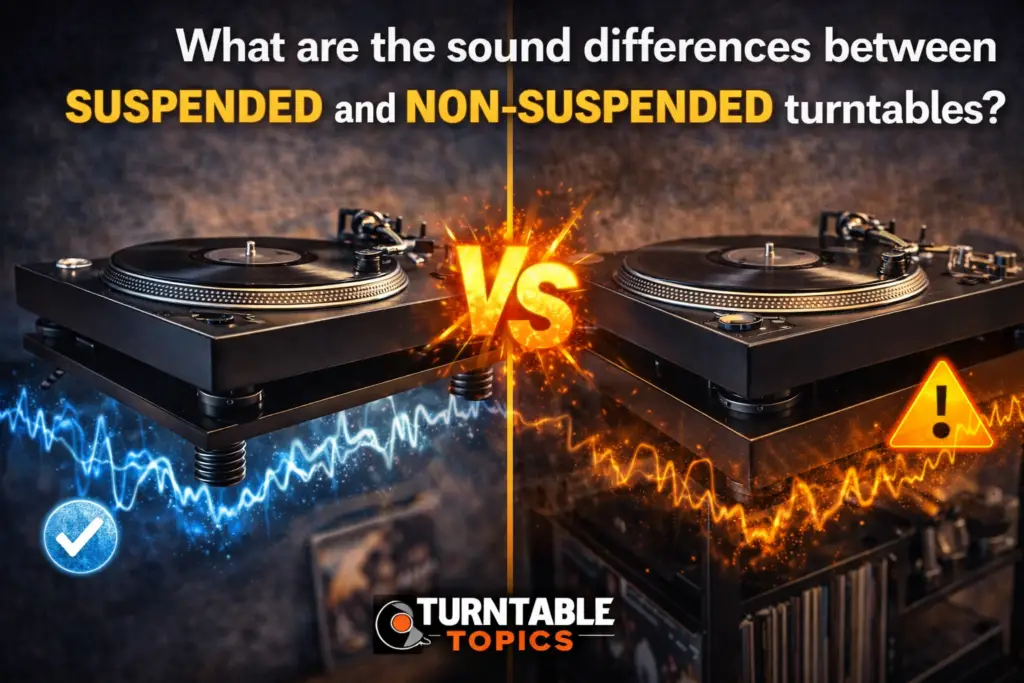
Few topics in turntable design inspire as much discussion as suspension. Some of the most iconic turntables in history rely on suspended sub-chassis designs, while many modern models favor rigid, non-suspended construction. Both approaches aim to solve the same problem—controlling vibration—but they do so in fundamentally different ways.
So what are the actual sound differences between suspended and non-suspended turntables? The answer lies in how each design handles energy, isolation, and timing.
The Core Difference: How Vibration Is Managed
At its heart, the suspension debate is about vibration control.
- Suspended turntables isolate the platter and tonearm on a spring- or elastomer-based sub-chassis, decoupling them from the motor and external vibration.
- Non-suspended turntables rely on rigid construction, mass, and controlled energy dissipation to manage vibration.
Each method shapes the sonic presentation in distinct ways.
Sonic Characteristics of Suspended Turntables
Suspended designs are prized for their isolation abilities, particularly in challenging rooms.
Typical sonic traits include:
- Smooth, refined midrange
- Lower sensitivity to footfall vibration
- Natural flow and musical cohesion
- Reduced background noise in lively environments
Because the platter and tonearm “float,” these turntables often sound forgiving and fluid, especially in rooms with suspended floors.
However, the suspension can store and release energy if not perfectly tuned.
Possible trade-offs:
- Slight softening of leading-edge transients
- Less sharply defined bass compared to rigid designs
- Sensitivity to setup and adjustment
Sonic Characteristics of Non-Suspended Turntables
Non-suspended designs focus on rigidity and mechanical grounding.
Typical sonic traits include:
- Strong sense of timing and rhythmic precision
- Tighter, more impactful bass
- Crisp transients and clear attack
- Excellent pitch stability in well-designed models
These turntables often excel in clarity and immediacy, making them popular for modern, high-resolution systems.
Potential downsides:
- Greater sensitivity to room vibration
- Footfall issues on suspended floors
- Dependence on careful placement and isolation
How Environment Shapes the Sound
The listening room plays a major role in how each design performs.
- Suspended floors: Suspended turntables often sound more stable and controlled
- Concrete floors: Non-suspended designs can deliver maximum precision
- High-volume listening: Rigid designs may offer better dynamic impact
- Compact rooms: Suspended designs may reduce feedback risk
In many cases, what sounds “better” is determined more by the room than the turntable itself.
Interaction with Cartridges and Tonearms
Design choice also affects cartridge and tonearm matching.
- Suspended turntables often pair well with moderate-compliance cartridges
- Non-suspended designs can accommodate a wider range of tonearms and cartridges
- Highly revealing cartridges may emphasize the strengths and weaknesses of each approach
Careful system matching is essential for either design to perform at its best.
Setup Sensitivity and Long-Term Stability
Suspended turntables:
- Require careful leveling and periodic tuning
- Can drift out of adjustment over time
- Reward patience and precision
Non-suspended turntables:
- Are generally easier to set up
- Require robust isolation solutions
- Offer greater long-term consistency
Ease of ownership is an important, often overlooked factor.
Is One Design “Better” Than the Other?
There is no universal winner.
- Suspended designs prioritize isolation and musical flow
- Non-suspended designs emphasize precision and immediacy
Both can deliver exceptional sound when well designed and properly matched to their environment.
Final Thoughts
The sound differences between suspended and non-suspended turntables reflect two valid engineering philosophies rather than right or wrong choices. One isolates from vibration; the other controls it through rigidity.
Choosing between them is less about absolute sound quality and more about your room, your system, and your listening priorities. When properly implemented, either approach can provide deeply satisfying analog playback.