
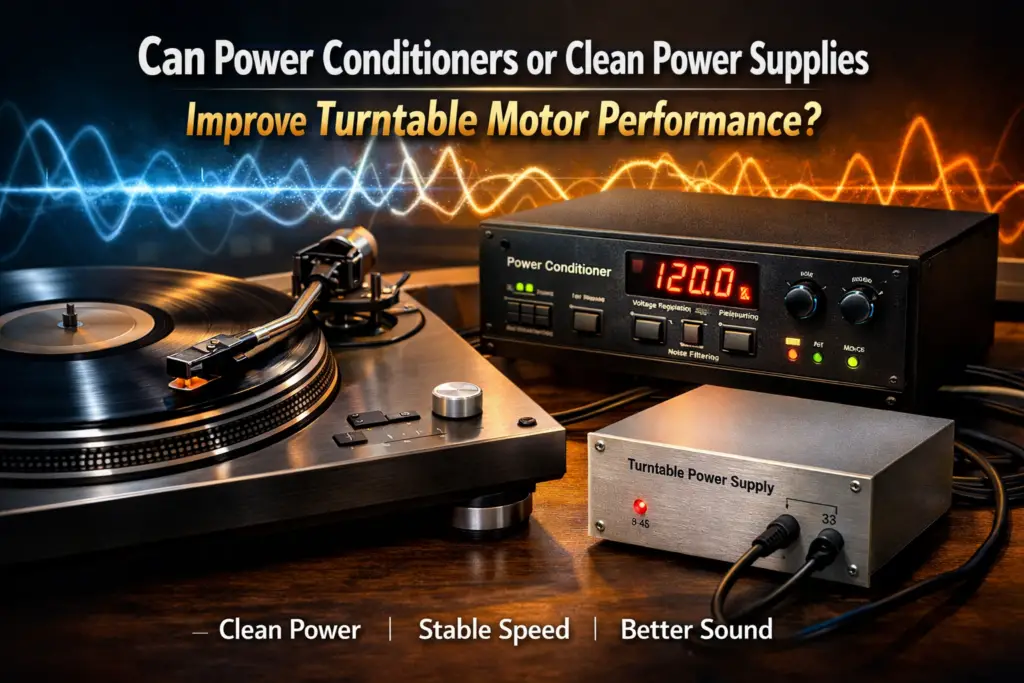
Few topics spark as much debate among vinyl enthusiasts as power quality. While speakers, cartridges, and tonearms often get the spotlight, the electricity feeding a turntable’s motor can be just as critical. The question is simple—but the answer is nuanced: can power conditioners or clean power supplies actually improve turntable motor performance?
Why Power Quality Matters for Turntables
A turntable motor is fundamentally an electromechanical device. Its job is deceptively simple: rotate the platter at a perfectly stable speed. Any fluctuation in the power feeding that motor—voltage variation, frequency drift, or electrical noise—can potentially translate into audible issues such as:
- Speed instability (wow and flutter)
- Subtle pitch variation
- Increased motor vibration
- Higher noise floor transmitted mechanically to the stylus
In theory, cleaner and more stable power should allow the motor to operate closer to its ideal design parameters.
What Power Conditioners Actually Do
Most power conditioners focus on three main tasks:
- Noise filtering – Removing high-frequency noise from household appliances, switching power supplies, and RF interference
- Surge protection – Protecting equipment from voltage spikes
- Voltage stabilization (in some designs) – Maintaining consistent output voltage
For turntables, the noise filtering and voltage stability aspects are the most relevant. However, not all conditioners are designed with low-current, precision motor loads in mind.
The Role of Dedicated Turntable Power Supplies
Many modern turntables—especially mid- to high-end models—use external or upgraded power supplies rather than generic wall adapters. These supplies often do more than simple AC-to-DC conversion:
- Regenerate a precise AC waveform at a fixed frequency
- Provide electronically controlled speed switching
- Reduce motor vibration by lowering torque ripple
- Isolate the motor from mains fluctuations
In belt-drive and AC synchronous motor designs, this can result in measurable improvements in speed accuracy and consistency.
Direct Drive vs Belt Drive: Does It Matter?
Yes—very much so.
- Direct-drive turntables typically rely on sophisticated internal regulation and servo control. In many cases, external power conditioners offer minimal audible improvement because the turntable already corrects for incoming power variations internally.
- Belt-drive turntables, especially those using AC synchronous motors, are often more sensitive to mains frequency and waveform quality. These designs tend to benefit more clearly from regenerated or stabilized power supplies.
Audible Improvements: Expect Subtlety, Not Miracles
When improvements are present, they tend to be subtle rather than dramatic. Listeners often report:
- More stable pitch on sustained piano notes
- Slightly cleaner transients
- Reduced background haze
- Improved rhythmic coherence
However, results vary widely depending on the turntable design, the quality of the local power grid, and the listener’s system resolution.
When a Power Conditioner Might Not Help
In some cases, a power conditioner can actually limit current delivery or introduce impedance that negatively affects motor startup or torque. Poorly matched conditioners may also offer no real benefit if the turntable already uses advanced internal regulation.
This is why many manufacturers recommend specific power supplies designed for their turntables, rather than generic conditioners.
The Bottom Line
Power conditioners and clean power supplies can improve turntable motor performance—but only under the right circumstances. They tend to be most effective when:
- The turntable uses a belt-drive or AC synchronous motor
- The local mains supply is noisy or unstable
- The conditioner or power supply is designed specifically for low-noise, precision applications
For many vinyl enthusiasts, a dedicated turntable power supply offers better value and predictability than a general-purpose power conditioner. As always in analog playback, synergy and careful listening matter more than theory alone.