
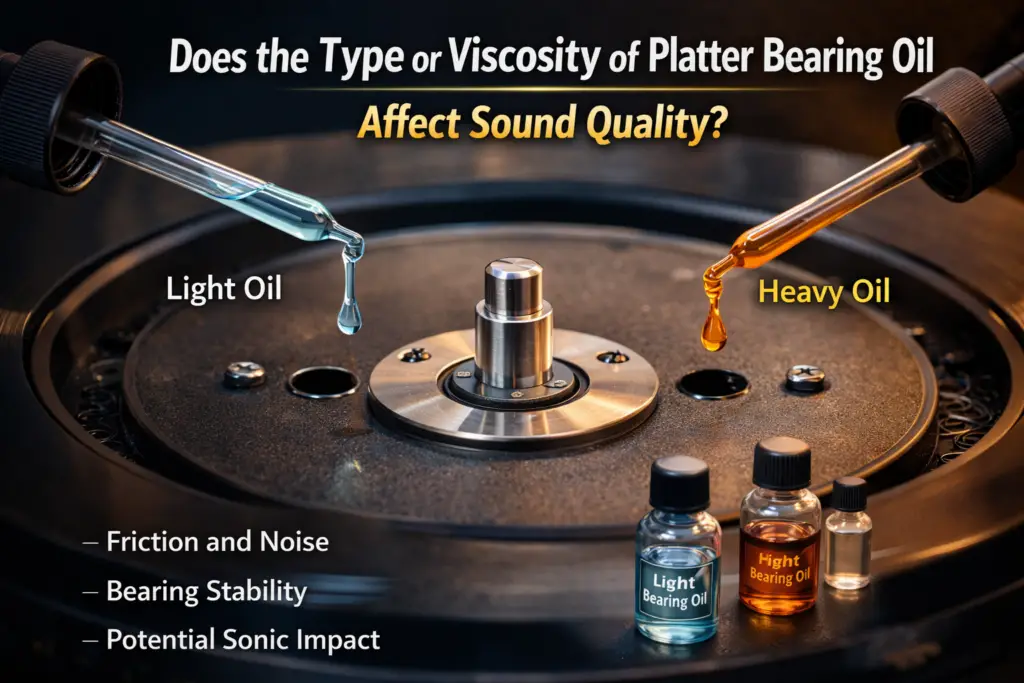
Among vinyl enthusiasts, few maintenance topics generate as much quiet experimentation as platter bearing oil. Often overshadowed by cartridges and tonearms, the main bearing plays a crucial role in a turntable’s mechanical stability. This raises a common question: can the type or viscosity of platter bearing oil actually affect sound quality?
Why the Platter Bearing Matters
The platter bearing supports the platter’s mass and ensures smooth, low-friction rotation. Any irregularity in this interface—friction, chatter, or uneven lubrication—can create microscopic speed variations and mechanical noise. These vibrations may travel up through the platter and record, ultimately reaching the stylus.
A well-lubricated bearing helps achieve:
- Consistent rotational speed
- Lower mechanical noise
- Reduced wear on the spindle and bearing sleeve
- Long-term reliability of the turntable
Understanding Oil Viscosity
Viscosity refers to how thick or thin an oil is. In turntable bearings, viscosity affects how the oil film forms between the spindle and bearing well.
- Lower-viscosity oils flow easily and reduce drag, which can help with quick startup and minimal resistance.
- Higher-viscosity oils create a thicker oil film, which can improve damping and reduce microscopic vibration—but may increase rotational resistance.
Finding the right balance is critical. Too thin, and the bearing may not be adequately cushioned. Too thick, and the motor may work harder or introduce speed instability.
Can Oil Choice Affect Sound?
While changes are typically subtle, many listeners report audible differences after changing bearing oil. Common observations include:
- Quieter backgrounds due to reduced mechanical noise
- Improved bass solidity from better vibration control
- Slightly smoother midrange textures
- More stable pitch on sustained notes
These effects are usually more noticeable on high-resolution systems and heavier platters, where bearing performance is under greater mechanical load.
Manufacturer-Specified Oils vs Aftermarket Options
Many turntable manufacturers specify a particular oil type or viscosity for good reason—the bearing tolerances, spindle material, and platter weight are all designed around it.
Aftermarket oils often promise sonic improvements, but results vary. In some cases, using a non-recommended oil can:
- Increase bearing wear
- Trap contaminants
- Cause inconsistent speed performance
For high-end turntables with inverted or ceramic bearings, using the wrong lubricant can be especially risky.
Design Differences Matter
Not all platter bearings are the same. The impact of oil choice depends on factors such as:
- Traditional sleeve bearings vs inverted bearings
- Steel, bronze, ceramic, or sapphire components
- Platter mass and distribution
- Motor torque and drive type
A low-mass belt-drive deck may react very differently to oil changes compared to a heavy, high-torque design.
Maintenance vs Tuning
It’s important to separate proper maintenance from sonic tuning. Fresh, clean oil of the correct type will almost always improve performance compared to old, contaminated lubricant. Beyond that, audible “tuning” effects tend to be minor and system-dependent.
In most cases, bearing oil should be viewed as a reliability and noise-reduction measure first, and a sound-tuning tweak second.
The Bottom Line
Yes, the type and viscosity of platter bearing oil can affect turntable performance—and in some systems, sound quality as well. However, the changes are usually subtle and should not be overstated. The safest and most consistent approach is to follow the manufacturer’s recommendation, especially for precision or high-value turntables.
For enthusiasts who enjoy careful experimentation, small changes in oil viscosity may offer incremental improvements—but they should be approached with caution, patience, and careful listening.