
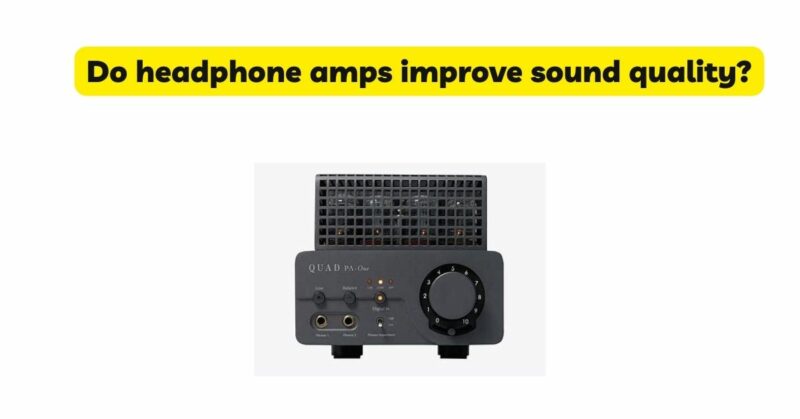
Headphones have become an integral part of our daily lives, allowing us to immerse ourselves in music and audio content. While many portable devices can drive headphones directly, there is an ongoing debate about whether dedicated headphone amplifiers truly enhance the sound quality. In this article, we will explore the role of headphone amplifiers and examine the ways in which they can potentially improve the listening experience.
The Importance of Headphone Impedance: Understanding the relationship between headphone impedance and amplification is essential when evaluating the impact of headphone amplifiers on sound quality. Headphones with high impedance require more power to achieve optimal performance. Portable devices may struggle to provide sufficient power, resulting in reduced dynamics, weaker bass response, and potential distortion. Dedicated headphone amplifiers, designed specifically to drive headphones, offer higher output power, allowing them to deliver the necessary voltage and current for optimal performance, especially with high-impedance headphones.
Improved Signal-to-Noise Ratio: Headphone amplifiers can contribute to a lower noise floor, resulting in improved signal-to-noise ratio (SNR). SNR measures the level of desired audio signal against unwanted noise. Integrated amplifiers found in portable devices often share circuitry with other components, leading to potential electrical interference and noise. Dedicated headphone amplifiers employ advanced circuit designs, shielding, and dedicated power supplies, minimizing electrical noise and creating a cleaner audio signal.
Enhanced Dynamic Range and Headroom: Dynamic range is the difference between the softest and loudest sounds in a recording. Headphone amplifiers with higher power output can provide a wider dynamic range, allowing for greater contrast and detail in audio playback. Additionally, increased headroom—the difference between the loudest signal and the maximum output of the amplifier—enables headphones to accurately reproduce transient peaks without distortion. This enhanced dynamic range and headroom provided by headphone amplifiers contribute to a more engaging and realistic listening experience.
Preserving Signal Integrity: Headphone amplifiers designed with high-quality components and precise circuitry can effectively preserve the integrity of the audio signal. They ensure that the original recording is faithfully reproduced without introducing distortion, coloration, or loss of detail. By maintaining signal integrity, dedicated headphone amplifiers allow listeners to experience the music as intended by the artists, free from unwanted artifacts or alterations.
Customization and Fine-Tuning: Many headphone amplifiers offer additional features and customization options that allow users to tailor the sound to their preferences. Some amplifiers provide adjustable gain settings, impedance matching switches, or tone controls, allowing users to optimize the sound signature according to their headphones and personal taste. These customization options provide a level of flexibility and control not typically available when driving headphones directly from portable devices.
Driving Demanding and High-End Headphones: High-end headphones, particularly those with low sensitivity or high impedance, can benefit significantly from dedicated headphone amplifiers. These demanding headphones require more power to reach their full potential and deliver optimal sound quality. Dedicated amplifiers provide the necessary power and current, ensuring that high-end headphones perform at their best, with improved clarity, dynamics, and overall fidelity.
Reducing Interference and Crosstalk: Integrated audio systems in portable devices may suffer from interference and crosstalk, where the left and right audio channels leak into each other. This can result in reduced channel separation and compromised stereo imaging. Dedicated headphone amplifiers, with their isolated circuitry and optimized design, offer improved channel separation and reduced crosstalk, resulting in a more accurate and immersive stereo soundstage.
Conclusion: Headphone amplifiers can indeed improve sound quality by providing higher power output, lower noise floor, enhanced dynamic range, and preserving the integrity of the audio signal. They offer customization options, the ability to drive demanding headphones, and reduce interference and crosstalk. While the impact may vary depending on the headphones, listening preferences, and source quality, dedicated headphone amplifiers can elevate the listening experience, revealing nuances, details, and dynamics that might otherwise be lost when using portable devices alone. If you’re an audiophile or someone seeking the highest level of audio fidelity, investing in a dedicated headphone amplifier can be a worthwhile endeavor.