
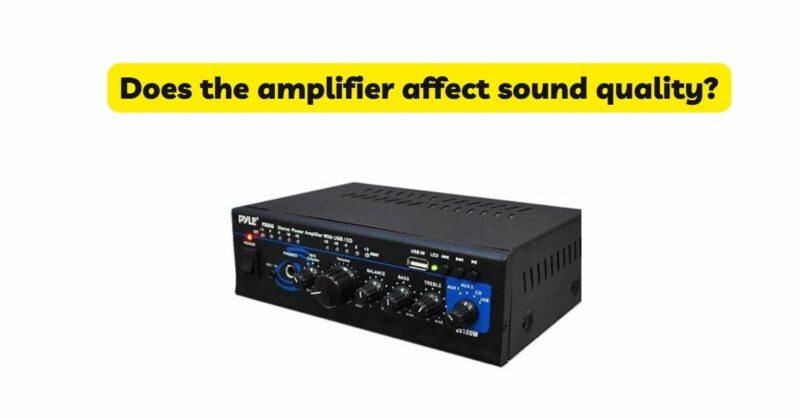
The role of amplifiers in audio systems is crucial, as they serve to amplify and drive the audio signals from source components to the speakers. While the primary function of an amplifier is to provide power, it is often debated whether amplifiers have a noticeable impact on sound quality. In this article, we will delve into the relationship between amplifiers and sound quality, exploring the various ways in which amplifiers can influence and shape the audio reproduction experience.
Signal Amplification and Transparency: At its core, the primary function of an amplifier is to amplify the audio signal without introducing distortion or coloration. A high-quality amplifier should ideally be transparent, faithfully reproducing the audio signal it receives. However, amplifiers, even those considered transparent, can exhibit subtle differences in their ability to accurately reproduce the signal due to variations in design, components, and circuitry. These differences can contribute to the perception of sound quality.
Frequency Response and Signal Accuracy: Amplifiers play a crucial role in maintaining the accuracy of the audio signal across the entire frequency spectrum. An amplifier with a flat frequency response ensures that each frequency is reproduced with equal emphasis and accuracy. Deviations from a flat frequency response can result in uneven sound reproduction, where certain frequencies may be emphasized or attenuated. Therefore, the design and engineering of the amplifier’s circuitry significantly impact its ability to maintain a faithful frequency response.
Distortion and Noise: Amplifiers can introduce distortion and noise into the audio signal, which can negatively impact sound quality. Distortion occurs when the amplifier alters the original waveform, resulting in the addition of harmonics or other unwanted artifacts. High-quality amplifiers aim to minimize distortion by employing superior components, careful circuit design, and effective feedback mechanisms. Additionally, noise, such as hiss or hum, can be introduced by the amplifier and can degrade the overall sound quality.
Power Output and Speaker Control: The power output of an amplifier is crucial in driving the speakers and providing sufficient energy to reproduce music accurately. Insufficient power can lead to clipping or distortion, particularly during dynamic passages. A high-quality amplifier with ample power reserves can effectively control the speakers, ensuring precise and accurate sound reproduction even at high volumes. The ability of an amplifier to deliver clean, controlled power contributes to a more engaging and realistic audio experience.
Damping Factor and Speaker Interaction: The damping factor of an amplifier refers to its ability to control the movement of the speaker’s diaphragm. A higher damping factor indicates better control, preventing the speaker’s cone from continuing to move after the audio signal has stopped. This control minimizes unwanted resonances and ensures tighter and more accurate bass reproduction. Amplifiers with a high damping factor can improve the overall clarity and precision of the sound.
Impedance Matching and Speaker Compatibility: Amplifiers need to be properly matched to the speakers they drive. Speakers have specific impedance characteristics, and amplifiers should have a compatible output impedance to ensure optimal power transfer. Mismatched impedance can result in impedance fluctuations, which can lead to uneven frequency response and poor sound quality. Therefore, it is essential to choose an amplifier that is compatible with the impedance requirements of the speakers to achieve optimal sound reproduction.
Subjective Listening Experience: The perception of sound quality is highly subjective and varies from person to person. Factors such as individual hearing acuity, personal preferences, and the listening environment can influence how an amplifier’s characteristics are perceived. Some listeners may have a discerning ear and can perceive subtle differences between amplifiers, while others may have a less discerning ear and may not notice significant distinctions. The subjective listening experience ultimately determines the perceived impact of an amplifier on sound quality.
System Synergy and Component Matching: Achieving optimal sound quality requires considering the overall system synergy and component matching. While the amplifier is a critical component, it works in conjunction with other elements such as the source components, speakers, cables, and room acoustics. A well-matched system, where all components complement each other, can result in a more cohesive and satisfying sound reproduction. Neglecting the synergy between components may limit the overall impact of the amplifier on sound quality.
Conclusion: Amplifiers play a vital role in sound reproduction, influencing various aspects of sound quality. Factors such as signal amplification, frequency response, distortion, power output, damping factor, impedance matching, and subjective listening experience all contribute to the overall impact an amplifier has on sound quality. However, it is essential to consider the holistic system synergy and individual preferences when evaluating the influence of amplifiers on sound reproduction. By carefully selecting and matching components, audio enthusiasts can create a system that optimizes the potential for exceptional sound quality.