
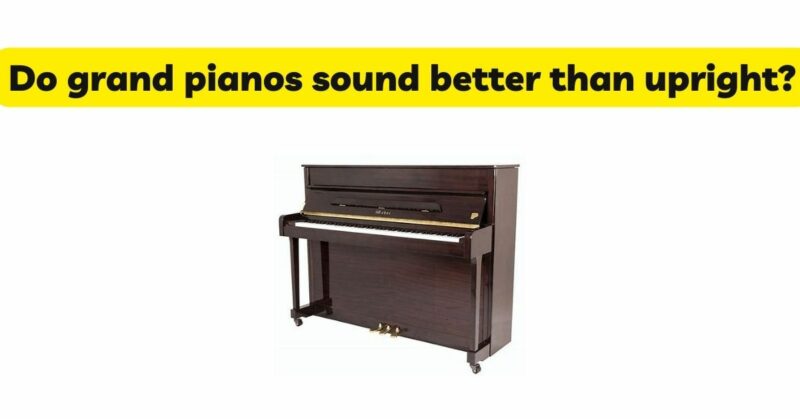
The comparison between grand pianos and upright pianos has long been a topic of debate among pianists, musicians, and piano enthusiasts. Both types of pianos offer unique characteristics and sound qualities that appeal to different individuals and musical contexts. In this article, we delve into the discussion of whether grand pianos sound better than upright pianos. By examining factors such as sound projection, tonal complexity, dynamic range, touch sensitivity, and individual preferences, we aim to shed light on the nuanced differences and subjective nature of piano sound evaluation.
- Sound Projection and Resonance: One of the notable advantages of grand pianos is their superior sound projection and resonance. Grand pianos feature a horizontal string arrangement and larger soundboards, allowing for a more expansive sound dispersion and tonal depth. The longer strings in grand pianos produce richer harmonics and sustain, resulting in a more resonant and enveloping sound. The combination of the horizontal string orientation and the larger soundboard surface area enables grand pianos to project sound with greater clarity and volume, making them particularly well-suited for concert halls and large performance spaces.
- Tonal Complexity and Nuance: Grand pianos are renowned for their tonal complexity and the ability to produce a wide range of tonal colors and nuances. The longer strings and larger soundboard area contribute to a broader tonal palette, allowing pianists to explore a vast spectrum of expressive possibilities. The horizontal string arrangement facilitates intricate interactions between strings, producing complex harmonies and overtones. The tonal complexity of grand pianos enables pianists to convey subtle musical nuances and expressiveness, enhancing their artistic interpretations.
- Dynamic Range and Expressiveness: Grand pianos excel in their dynamic range, offering a wide spectrum of volume and expressive possibilities. The combination of longer strings, larger soundboards, and responsive action mechanisms allows for precise control over dynamics, from delicate pianissimos to thunderous fortissimos. The dynamic responsiveness of grand pianos enhances the expressive capabilities of pianists, enabling them to shape the music with a greater range of contrasts and emotions. The ability to produce a vast dynamic range is particularly advantageous in genres that demand expressive versatility, such as classical music.
- Touch Sensitivity and Key Action: The touch sensitivity and key action of grand pianos are often regarded as superior to upright pianos. Grand pianos feature longer keys and more sophisticated action mechanisms that provide a greater level of responsiveness and control. The intricate design and craftsmanship of grand piano actions allow for subtle variations in touch, enabling pianists to articulate passages with precision and expressiveness. The enhanced touch sensitivity of grand pianos enhances the pianist’s ability to communicate musical nuances and achieve a more nuanced and refined performance.
- Individual Preferences and Musical Context: Determining whether grand pianos sound better than upright pianos is a subjective matter that depends on individual preferences and the specific musical context. While grand pianos may offer certain advantages in terms of sound projection, tonal complexity, and touch sensitivity, upright pianos have their unique charm and musical applications. Upright pianos, with their vertical string arrangement and more compact size, can produce a warm and intimate sound that is well-suited for genres such as jazz, pop, and small-scale performances. Additionally, the affordability and accessibility of upright pianos make them an attractive option for many pianists, particularly students and those with limited space and budget constraints.
- The Impact of Instrument Quality: It is crucial to note that the quality of the individual instrument plays a significant role in determining its sound and performance. Both grand pianos and upright pianos vary in terms of craftsmanship, materials used, and overall build quality. A high-quality upright piano can produce a sound that rivals some lower-quality grand pianos, while a poorly maintained or inferior grand piano may not exhibit the desired sound characteristics. It is essential for pianists to try out different instruments, evaluate their sound, and choose the one that resonates with their musical preferences and artistic vision.
Conclusion: The question of whether grand pianos sound better than upright pianos is multifaceted and subjective. Grand pianos offer advantages in terms of sound projection, tonal complexity, dynamic range, touch sensitivity, and overall sonic experience. They are often preferred in professional settings and concert halls. However, upright pianos possess their unique charm, warm sound, and practicality in smaller spaces. The determination of which piano sounds better ultimately depends on individual preferences, musical context, and the quality of the instrument itself. Pianists should consider their artistic goals, musical style, available space, budget constraints, and personal taste when making a choice between grand and upright pianos. Ultimately, the quest for the best-sounding piano is a deeply personal journey that should be guided by the musician’s own musical aspirations and the specific demands of their musical endeavors.