
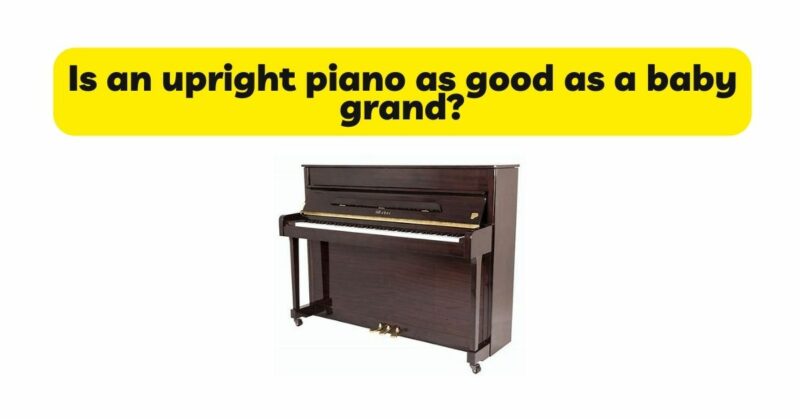
When it comes to choosing a piano, the decision between an upright piano and a baby grand piano is a common dilemma. Both instruments have their unique characteristics and offer distinct advantages. In this article, we aim to compare the merits of upright pianos and baby grand pianos, focusing on aspects such as sound quality, touch sensitivity, aesthetic appeal, space requirements, and versatility. By examining these factors, we aim to provide insight into whether an upright piano can be considered as good as a baby grand piano.
- Sound Quality: Sound quality is a crucial aspect to consider when evaluating pianos. Baby grand pianos are often praised for their rich and resonant sound. The horizontal string arrangement and larger soundboard allow for greater string length and tonal depth, resulting in a more expressive and dynamic sound. Upright pianos, on the other hand, have a more vertical string arrangement, which can affect their tonal projection and depth. While upright pianos may not match the tonal complexity and resonance of baby grand pianos, advancements in design and construction have resulted in improved sound quality in some high-quality upright pianos. The determination of sound quality ultimately depends on personal preference and the specific characteristics of the individual instrument.
- Touch Sensitivity and Key Action: Touch sensitivity and key action greatly influence the playing experience. Baby grand pianos often feature longer keys and a more sophisticated action mechanism, allowing for enhanced touch sensitivity and control. The longer keys provide a greater leverage and enable pianists to achieve a wider dynamic range and nuanced expression. Upright pianos, although they may not possess the same level of touch sensitivity as baby grand pianos, have made significant advancements in key action design. High-quality upright pianos can offer a satisfying touch response, making them suitable for pianists at various skill levels.
- Aesthetic Appeal: The aesthetic appeal of a piano can significantly influence its desirability and suitability for a particular space. Baby grand pianos are renowned for their elegance and visual impact. Their sleek and graceful design, combined with the exposed strings and lid, creates a captivating centerpiece in any room. On the other hand, upright pianos offer a more compact and vertical design. While they may not possess the same visual grandeur as baby grand pianos, upright pianos have their charm and can be incorporated seamlessly into various home settings.
- Space Requirements: The space available in a room is a practical consideration when choosing between an upright piano and a baby grand piano. Baby grand pianos typically require a larger footprint due to their horizontal design. They necessitate adequate space not only for the piano itself but also for the pianist and audience members. Upright pianos, with their vertical orientation, have a smaller footprint, making them suitable for smaller rooms or spaces with limited floor area. The space requirements of each instrument should be carefully evaluated to ensure a harmonious fit within the given environment.
- Versatility and Musical Applications: The versatility of a piano is an important aspect to consider, particularly for pianists with diverse musical interests. Baby grand pianos are often favored by professional musicians and in concert settings due to their expressive capabilities and tonal complexity. They excel in classical repertoire and genres that demand a wide dynamic range and tonal color. Upright pianos, although they may not offer the same level of tonal complexity as baby grand pianos, are highly versatile instruments. They are well-suited for various musical genres, including jazz, pop, and contemporary music. The versatility of upright pianos, combined with their compact size, makes them popular choices for home use and smaller performance venues.
- Cost Considerations: Cost is an important factor to consider when comparing upright pianos and baby grand pianos. Baby grand pianos generally have a higher price tag due to their design, construction, and the materials used. Upright pianos, while offering a more affordable option, can still provide a satisfactory playing experience and sound quality. The budget available and the desired level of investment should be taken into account when making a decision.
Conclusion: Determining whether an upright piano can be as good as a baby grand piano requires considering various factors and individual preferences. While baby grand pianos are often regarded as the epitome of elegance and sound quality, upright pianos have their merits and can provide a satisfactory musical experience. The sound quality, touch sensitivity, aesthetic appeal, space requirements, versatility, and cost considerations should all be weighed when choosing between the two types of pianos. Ultimately, the decision should be based on personal preference, musical goals, available space, and budget constraints. Both upright pianos and baby grand pianos have their unique characteristics, and selecting the right instrument depends on finding the one that resonates with the pianist’s artistic vision and musical aspirations.