
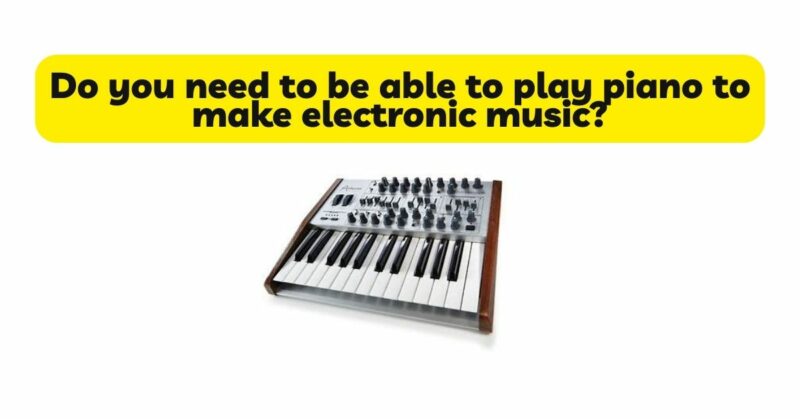
Electronic music production has witnessed remarkable growth and innovation in recent years, with advancements in technology enabling individuals to create music using various software tools and production techniques. However, a common question arises: Do you need to be able to play the piano to make electronic music? In this article, we will delve into the significance of piano skills in the context of electronic music production. From composition and arrangement to sound design and creativity, we will explore the role of piano skills and how they can impact the quality and versatility of electronic music.
I. Composition and Melodic Exploration:
While piano skills may not be mandatory for creating electronic music, they provide a significant advantage when it comes to composition and melodic exploration. The piano’s layout and its ability to play chords and melodies simultaneously make it an ideal instrument for generating musical ideas. Proficiency in playing the piano allows electronic music producers to experiment with harmonies, progressions, and melodic motifs more efficiently. The tactile nature of the piano enables a deeper connection with the music, facilitating the creation of memorable and expressive melodies.
II. Understanding Music Theory:
Piano skills contribute to a deeper understanding of music theory, which is essential for crafting well-structured and musically cohesive electronic tracks. Knowledge of scales, chords, intervals, and key signatures, gained through piano practice, allows producers to make informed decisions during the composition process. By understanding music theory, producers can create harmonically pleasing progressions, incorporate tension and release, and craft melodies that resonate with listeners. This theoretical foundation enhances the artistic quality and depth of electronic music compositions.
III. Sound Design and Arrangement:
Electronic music production involves meticulous sound design and arrangement to create unique sonic landscapes. While piano skills may not directly influence sound design techniques, they offer a valuable perspective when it comes to arranging and layering sounds. The ability to play the piano allows producers to experiment with different voicings, explore inversions, and test how various sound elements interact harmonically and rhythmically. This knowledge aids in making informed decisions during the arrangement phase, resulting in more balanced and cohesive electronic compositions.
IV. Creativity and Expressiveness:
Piano skills can greatly enhance creativity and expressiveness in electronic music production. Playing the piano provides an intimate and tactile connection to the instrument, allowing producers to infuse their emotions and personal style into their compositions. Keyboard skills enable dynamic and nuanced performances, allowing for expressive phrasing, timing variations, and subtle dynamics. This level of control over the music brings a human touch to electronic productions, creating a more engaging and emotive listening experience.
V. Collaboration and Communication:
Collaboration is a vital aspect of music production, and piano skills facilitate effective communication with other musicians and collaborators. Many musicians and vocalists have a background in piano, making it a common language for discussing musical ideas and arrangements. Being able to play the piano enables electronic music producers to communicate chord progressions, melodic ideas, and harmonic concepts more efficiently, fostering smoother collaborations and allowing for seamless integration of live performances or instrumental recordings.
VI. Flexibility and Versatility:
While electronic music production encompasses a wide range of subgenres and styles, having piano skills adds flexibility and versatility to a producer’s toolkit. The piano’s ability to cover different musical genres, from classical and jazz to pop and rock, allows producers to incorporate diverse musical elements into their electronic compositions. Piano skills open doors to improvisation, which can lead to unique and unexpected musical moments, enhancing the overall creativity and richness of electronic productions.
Conclusion:
While it is not a prerequisite to be able to play the piano to make electronic music, its significance and benefits are undeniable. From composition and melodic exploration to understanding music theory, sound design, creativity, and collaboration, piano skills contribute to a producer’s ability to create impactful and expressive electronic music. However, it is important to note that creativity knows no bounds, and electronic music producers can still thrive and innovate without formal piano training. Ultimately, the choice to develop piano skills for electronic music production depends on an individual’s aspirations, musical goals, and personal preferences.