
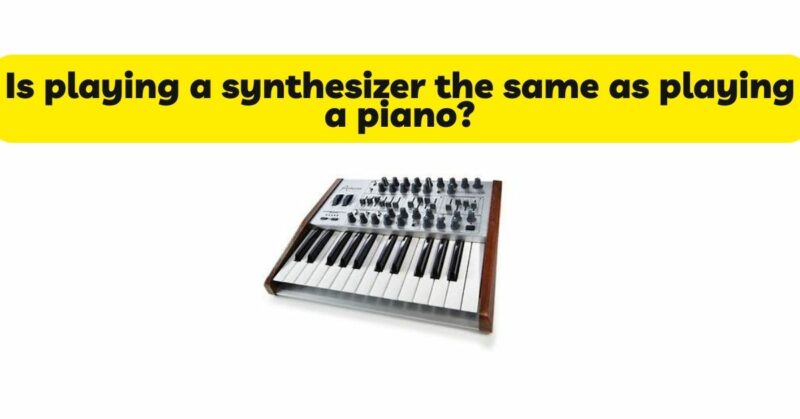
When it comes to keyboard instruments, the piano and the synthesizer are often mentioned in the same breath. However, it is essential to understand that despite sharing a similar interface, playing a synthesizer is not the same as playing a piano. In this article, we will explore the distinctions between playing a synthesizer and playing a piano. From their sound generation mechanisms to playing techniques and expressive capabilities, we will delve into the unique characteristics of each instrument, shedding light on their individuality and the experiences they offer to musicians.
I. Sound Generation Mechanisms: Acoustic vs. Electronic
The primary distinction between a piano and a synthesizer lies in their sound generation mechanisms. A piano is an acoustic instrument that produces sound by striking strings with hammers when keys are pressed. The resulting vibrations resonate through the soundboard, creating the characteristic piano tone.
On the other hand, a synthesizer is an electronic instrument that generates sound through various means, such as oscillators, filters, and modulations. It can mimic the sound of a piano, but it is not limited to replicating acoustic instruments. Synthesizers offer a vast array of synthetic and digitally generated sounds, allowing musicians to explore an extensive sonic palette beyond traditional piano tones.
II. Playing Techniques: Expressive Nuances and Adaptability
Playing techniques differ between a piano and a synthesizer due to their sound generation mechanisms. A piano’s expressive capabilities are deeply connected to its acoustic nature. The player can control dynamics, articulation, and timbre through touch and finger pressure on the keys. The piano’s weighted keys and the ability to manipulate the force applied allow for a wide range of expressive nuances.
On the other hand, synthesizers often have lighter and less responsive keys compared to pianos. However, synthesizers compensate for this by providing additional expressive controls, such as modulation wheels, pitch bend, aftertouch, and various assignable parameters. These features enable musicians to shape and modulate sounds in real-time, introducing expressive elements like vibrato, filter sweeps, and complex modulations that go beyond the capabilities of a piano.
III. Timbral Manipulation and Sound Design
Sound design and timbral manipulation are inherent to the world of synthesizers. Unlike a piano, which produces a fixed sound based on its construction, synthesizers offer extensive possibilities for shaping and designing sounds. Musicians can adjust oscillators, filters, envelopes, and modulation sources to sculpt unique tones, textures, and effects. This flexibility allows synthesizer players to explore various genres, experiment with unconventional sounds, and create personalized sonic signatures.
IV. Polyphony and Layering
Pianos and synthesizers also differ in terms of polyphony and layering capabilities. A piano typically has 88 keys, and each key produces a single sound. It offers natural polyphony, allowing simultaneous playing of multiple notes.
Synthesizers, on the other hand, can offer a range of polyphony options, from monophonic (one note at a time) to polyphonic (multiple notes simultaneously). Additionally, synthesizers often provide layering and splitting features, allowing players to combine multiple sounds or divide the keyboard into different zones with distinct sounds. This versatility enables musicians to create rich and complex arrangements, textures, and harmonies.
V. Performance and Live Manipulation
When it comes to live performance and manipulation, synthesizers offer distinct advantages. Their electronic nature allows for real-time control and modulation of various parameters. Musicians can adjust filters, add effects, trigger samples, and manipulate sound parameters on the fly, creating dynamic and evolving performances.
Pianos, while lacking the same level of live manipulation, offer their own unique performance experience. The acoustic resonance, tonal richness, and touch sensitivity of a piano allow for intricate and nuanced interpretations of classical compositions and intimate solo performances.
VI. Musical Styles and Genres
Both pianos and synthesizers have their place in different musical styles and genres. Pianos are deeply rooted in classical, jazz, and traditional genres, where their expressive range and tonal characteristics are highly valued. Pianos are often associated with melodic and harmonic structures found in classical compositions and are considered the backbone of many ensembles and orchestras.
Synthesizers, with their ability to produce a wide range of sounds, have found prominence in various genres, including electronic, pop, rock, and experimental music. Synthesizers offer the flexibility to create new sonic landscapes and push boundaries, making them ideal for modern and innovative musical expressions.
Conclusion:
While the piano and the synthesizer share a common interface, they represent distinct realms within the musical landscape. The piano’s acoustic nature, expressive capabilities, and emphasis on traditional tonalities make it an irreplaceable instrument in certain genres. Conversely, the synthesizer’s electronic nature, sound design possibilities, and real-time modulation offer musicians endless creative potential in exploring innovative sounds and genres.
Understanding the distinctions between playing a synthesizer and playing a piano is crucial for musicians seeking to explore diverse musical horizons. Each instrument brings its unique set of strengths and characteristics, enabling musicians to express themselves differently and navigate various musical contexts. Ultimately, the choice between a piano and a synthesizer depends on personal musical preferences, artistic goals, and the desire to delve into the nuances of each instrument’s distinct musical world.