
When venturing into the world of synthesizers, many aspiring musicians and producers wonder if prior piano knowledge is necessary to effectively play and navigate these electronic instruments. While the piano and synthesizer share similarities in terms of keyboard layout, the techniques, musical concepts, and learning approaches associated with each instrument can differ. In this article, we will explore the relationship between piano and synthesizer, discussing the advantages, considerations, and potential benefits of learning piano as a foundation for playing a synthesizer. By examining these aspects, we aim to provide insights into whether learning piano is essential for playing a synthesizer.
- Keyboard Layout and Familiarity:
The keyboard layout is a fundamental aspect shared by both the piano and synthesizer. Learning piano prior to playing a synthesizer can provide a solid foundation in understanding keyboard layout, note names, and basic finger positioning. The familiarity with piano keys and their relationship to musical notation can be advantageous when transitioning to a synthesizer.
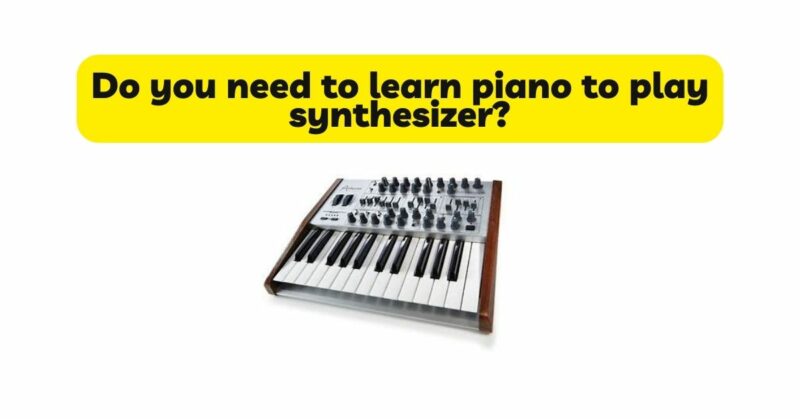
However, it is important to note that while piano and synthesizer keyboards share the same layout, synthesizers often incorporate additional controls, knobs, sliders, and buttons for sound manipulation and parameter adjustments. This expanded interface can require a separate learning curve specific to the synthesizer, regardless of prior piano knowledge.
- Musical Concepts and Theory:
Learning piano can provide a strong foundation in music theory and concepts that can be applied to playing a synthesizer. Piano lessons often cover essential elements such as rhythm, melody, harmony, scales, and chords. These concepts are fundamental in understanding and creating music, regardless of the instrument being played.
By learning piano, musicians gain a comprehensive understanding of key signatures, intervals, and chord progressions, which can be directly translated to synthesizer playing. This knowledge allows synthesizer players to navigate and experiment with different tonalities, create chordal structures, and understand the musical context when using synthesizer sounds.
- Technique and Playing Approach:
Piano technique and playing approach differ from playing a synthesizer due to the unique characteristics of each instrument. Learning piano requires the development of proper hand positioning, finger dexterity, and control over dynamics. Techniques such as legato, staccato, and pedaling are emphasized in piano playing to achieve expressive performances.
While piano technique may not directly translate to synthesizer playing, the foundation of finger independence, control, and coordination gained from learning piano can be valuable when playing a synthesizer. These technical skills can contribute to precise finger movements and an enhanced sense of touch and control over the synthesizer’s keys and controls.
- Expressiveness and Musical Interpretation:
Both the piano and the synthesizer offer opportunities for expressive performances and musical interpretation. Piano playing involves dynamics, phrasing, and subtleties in touch and tone production to convey emotions and musical nuances. Learning piano allows musicians to develop a deep understanding of musical expression and apply it to their synthesizer playing.
Although synthesizers have their own unique sound manipulation capabilities, the expressive techniques and musical interpretation skills learned through piano playing can greatly enhance the synthesizer playing experience. Translating the expressive qualities of the piano, such as dynamics and phrasing, to the synthesizer can result in more nuanced and captivating performances.
- Sound Design and Synthesis Principles:
While piano playing focuses on performing pre-existing compositions and repertoire, synthesizer playing often involves sound design and manipulation. Synthesizers offer vast possibilities for creating and modifying sounds using various synthesis techniques. Learning piano does not directly address sound design principles specific to synthesizers, such as oscillators, filters, envelopes, and modulation.
However, the foundation in music theory and understanding gained through piano lessons can facilitate the exploration and comprehension of synthesis principles. Musicians with a piano background may have an advantage in recognizing musical elements such as timbre, texture, and harmonics, which can be advantageous when shaping and creating sounds on a synthesizer.
Conclusion:
While it is not necessary to learn piano in order to play a synthesizer, the advantages and benefits of prior piano knowledge should not be overlooked. Learning piano can provide a solid foundation in musical concepts, theory, technique, and expressiveness that can enhance the overall experience of playing a synthesizer.
The piano’s emphasis on finger dexterity, control, and musical interpretation can contribute to a more refined and nuanced synthesizer playing technique. Additionally, the understanding of music theory, harmony, and chord progressions gained through piano lessons can be directly applied to synthesizer playing, allowing for greater creativity and musical exploration.
Ultimately, the decision to learn piano as a prerequisite for playing a synthesizer depends on individual musical goals, interests, and resources. While piano knowledge can offer advantages, it is important to remember that synthesizers are versatile instruments in their own right, and learning synthesizer-specific skills and techniques is equally important for maximizing their creative potential.
Whether you choose to learn piano before playing a synthesizer or dive directly into synthesizer exploration, the key to success lies in dedicated practice, curiosity, and a passion for music. By embracing the unique qualities of each instrument and fostering a continuous learning mindset, you can embark on a fulfilling musical journey with the synthesizer as your creative tool.