
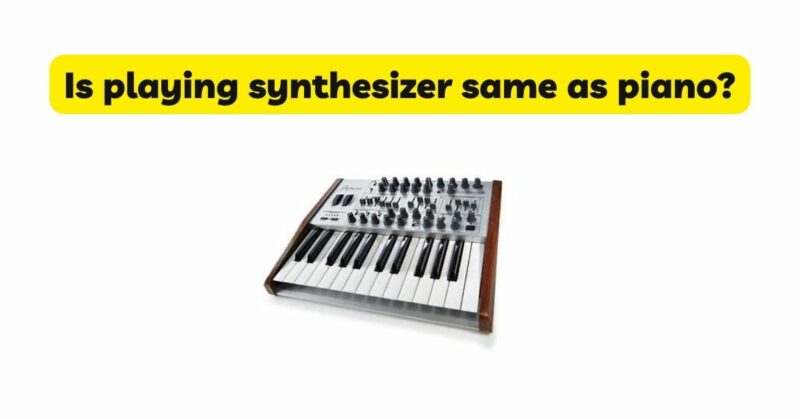
When it comes to keyboard instruments, synthesizers and pianos are often mentioned in the same breath. While they share some similarities due to their keyboard layout, there are significant differences in terms of sound generation, technique, and playing experience. In this article, we will delve into the distinctions between playing a synthesizer and a piano, discussing factors such as sound production, expressiveness, technique, learning curve, and musical applications. By examining these aspects, we aim to provide a comprehensive understanding of how playing a synthesizer differs from playing a piano.
- Sound Production and Characteristics:
One of the primary differences between synthesizers and pianos lies in their sound production methods. Pianos are acoustic instruments that produce sound through the vibration of strings when struck by hammers. This acoustic nature gives pianos a rich, resonant, and organic sound that is highly responsive to touch and dynamics. The timbre and tone of a piano can vary based on factors such as the piano’s construction, room acoustics, and how the keys are played.
Synthesizers, on the other hand, generate sound electronically through various methods such as oscillators, filters, and amplifiers. They offer a vast array of sound possibilities beyond traditional piano tones, including synthetic sounds, samples, and emulations of other instruments. Synthesizers can be programmed and manipulated to create a wide range of timbres, from simple and pure tones to complex and evolving textures. The ability to shape and modify sounds is a unique characteristic of synthesizers that sets them apart from pianos.
- Expressiveness and Dynamic Control:
Expressiveness and dynamic control are crucial elements in music performance. Pianos offer a high level of expressiveness due to their acoustic nature. Pianists can control the dynamics, articulation, and phrasing by varying the force applied to the keys. The touch sensitivity of a piano allows for subtle nuances in volume and tone, enhancing the expressive capabilities of the instrument.
Synthesizers, while capable of expressive performances, may require a different approach. The dynamic control on a synthesizer is often achieved through modulation parameters and control sources. Musicians can assign parameters such as volume, filter cutoff, or pitch to modulation sources like envelopes or LFOs (low-frequency oscillators). This enables them to shape the sound and create expressive performances. However, the tactile feedback and responsiveness found in a piano may differ in a synthesizer, depending on the specific instrument and its features.
- Technique and Playing Approach:
The technique and playing approach for synthesizers and pianos can vary significantly. Playing the piano requires proper hand positioning, finger dexterity, and coordination. Pianists develop a specific technique that allows them to navigate the keys smoothly, control dynamics, and perform complex passages. Piano technique emphasizes precise finger control, legato and staccato articulation, pedal usage, and other techniques unique to the instrument.
Synthesizers, while also played on a keyboard, may have a different technique. The focus on synthesizers often lies in sound manipulation, creating and modifying sounds using various parameters and controls. The playing technique on a synthesizer can vary depending on the sound design approach, performance features, and the specific synthesizer model. Techniques such as pitch bending, modulation wheel usage, and real-time sound manipulation become integral to synthesizer playing. However, it is important to note that while the techniques differ, learning piano technique can still provide a solid foundation for playing synthesizers due to the transferable skills in finger control and coordination.
- Learning Curve and Technical Understanding:
The learning curve and technical understanding associated with playing synthesizers and pianos can differ. Learning to play the piano often involves traditional music education methods, such as reading sheet music, learning music theory, and understanding musical notation. Pianists typically develop an understanding of musical concepts such as scales, chords, and harmony, which are essential for interpreting and performing music.
Playing a synthesizer can involve a different learning approach. While music theory is still applicable, synthesizer players may focus on understanding sound synthesis principles, programming techniques, and exploring various synthesis methods. Learning to program and manipulate sounds on a synthesizer often involves understanding oscillators, filters, envelopes, and modulation sources. However, it is important to note that the extent of technical understanding required depends on the complexity of the synthesizer and the desired level of sound design exploration.
- Musical Applications and Genres:
Both pianos and synthesizers find their places in various musical applications and genres. Pianos have a long-standing tradition in classical music, jazz, and many other genres where the expressive capabilities and rich tonal qualities of the instrument are highly valued. Pianos are also used in ensembles, chamber music, and as accompaniment instruments due to their versatility and dynamic range.
Synthesizers have become integral to electronic music, film scoring, sound design, and contemporary genres where innovative sound textures and manipulation play a significant role. Synthesizers are often used in live performances, studio recordings, and electronic music production due to their extensive sound design capabilities and ability to create unique sonic landscapes. Their versatility and adaptability to different musical styles make them popular in genres such as pop, rock, ambient, and experimental music.
Conclusion:
Playing a synthesizer and playing a piano offer distinct experiences and opportunities for musical expression. While synthesizers and pianos share similarities in terms of keyboard layout, the differences in sound production, expressiveness, technique, learning curve, and musical applications set them apart.
Pianos produce sound acoustically, offering a rich, resonant, and organic sound that is highly responsive to touch and dynamics. The technique and playing approach for pianos emphasize proper hand positioning, finger dexterity, and coordination. Pianists develop specific techniques to control dynamics, perform complex passages, and achieve expressive performances. Learning to play the piano often involves traditional music education methods, such as reading sheet music and understanding music theory.
Synthesizers, on the other hand, generate sound electronically and offer a vast array of sonic possibilities beyond traditional piano tones. They can create and manipulate sounds using parameters like oscillators, filters, and envelopes. The technique and playing approach for synthesizers often focus on sound manipulation, modulation, and real-time control. Learning to play a synthesizer involves understanding sound synthesis principles, programming techniques, and exploring various synthesis methods.
While learning piano can provide a solid foundation for playing synthesizers, it is not a prerequisite. Each instrument offers unique opportunities for musical expression and creativity. Pianos excel in their acoustic sound quality, expressiveness, and traditional playing techniques, while synthesizers offer extensive sound design possibilities and flexibility in genres like electronic music and sound experimentation.
The choice between playing a synthesizer or a piano ultimately depends on personal preferences, musical goals, and the desired sound palette. Some musicians may choose to explore both instruments, leveraging their unique strengths and capabilities. Regardless of the instrument chosen, dedication to practice, curiosity, and a passion for music will pave the way for a fulfilling musical journey.