
In the realm of music production and performance, the terms “digital piano” and “synthesizer” are often used interchangeably, causing confusion for those who are new to the world of electronic musical instruments. While both instruments produce sound electronically, they serve different purposes and possess distinct features. In this article, we will delve into the characteristics of digital pianos and synthesizers, highlighting their similarities and differences to clarify the question: Is a digital piano a synthesizer?
I. Understanding Digital Pianos: Digital pianos are electronic musical instruments designed to replicate the sound and feel of an acoustic piano. They utilize digital sampling technology to reproduce the sounds of real pianos, making them a popular choice for pianists seeking a portable and versatile alternative to traditional acoustic instruments. Key features of digital pianos include:
- Keyboard Action: Digital pianos are equipped with weighted or semi-weighted keys that mimic the touch and response of an acoustic piano. This feature ensures a realistic playing experience and enables pianists to develop proper finger technique.
- Sound Sampling: To produce authentic piano sounds, digital pianos employ high-quality sound samples recorded from acoustic pianos. These samples are often multi-layered, capturing the nuances and dynamics of each note played. This results in a rich and expressive piano sound.
- Additional Features: Digital pianos often offer various features to enhance the playing experience, such as built-in metronomes, headphone outputs for private practice, recording capabilities, and connectivity options for MIDI and USB.
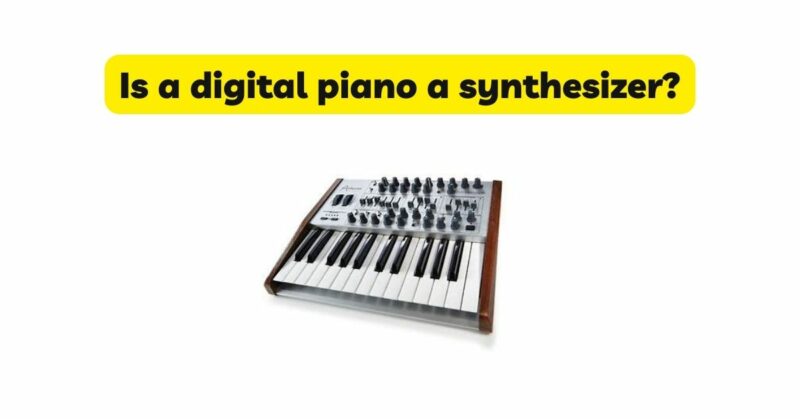
II. Unraveling Synthesizers: Unlike digital pianos, synthesizers are versatile instruments that generate sound through electronic signal processing and sound synthesis techniques. Synthesizers offer musicians the ability to create and manipulate a wide range of sounds, going beyond the traditional piano timbre. Key characteristics of synthesizers include:
- Sound Generation: Synthesizers utilize oscillators to produce sound waves, which can be manipulated using various parameters such as waveform selection, frequency modulation, and envelope shaping. This versatility allows musicians to create unique and complex sounds, including electronic tones, pads, basslines, and more.
- Programmability: One of the defining features of synthesizers is their programmability. They provide users with extensive control over sound parameters, allowing for the creation and storage of custom patches or presets. This flexibility enables musicians to shape and sculpt their sound to suit their creative vision.
- Performance and Effects: Synthesizers often include performance features like built-in arpeggiators, sequencers, and effects processors. These additions offer musicians greater creative potential and the ability to create complex arrangements and textures in real-time.
III. Bridging the Gap: While digital pianos and synthesizers have distinct characteristics, there are instances where the lines between them can become blurred. Some digital pianos incorporate basic synthesizer functionalities, such as the ability to layer sounds or apply effects to the piano samples. Similarly, certain synthesizers now come with sampled piano sounds, aiming to provide a more authentic piano-playing experience.
It is important to note that while digital pianos may possess some limited synthesizer capabilities, they primarily focus on faithfully reproducing the sound and playing experience of an acoustic piano. On the other hand, synthesizers prioritize sound synthesis and the creation of unique, electronically generated sounds.
IV. Conclusion: In conclusion, the distinction between a digital piano and a synthesizer lies in their primary purpose and features. A digital piano is designed to replicate the sound and playing experience of an acoustic piano, using digital sampling technology to achieve this goal. Conversely, a synthesizer is a versatile instrument that generates sound through electronic signal processing and sound synthesis techniques, offering musicians a wide range of sound design possibilities.
While there may be some overlap in functionality, particularly in modern instruments that incorporate hybrid features, understanding the core differences can help musicians and enthusiasts choose the instrument that best suits their musical goals. Whether it is the desire for an authentic piano experience or the exploration of limitless sonic possibilities, both digital pianos and synthesizers have their rightful place in the realm of music creation and performance.