
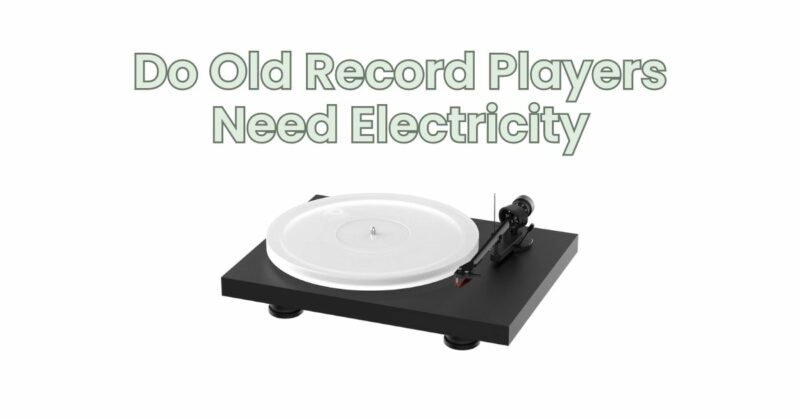
Old record players, with their vintage charm and nostalgia-inducing sound, often raise questions about their operational requirements. One common query is whether old record players need electricity to function. In this article, we aim to clarify the power requirements of old record players and shed light on the different types of record players and their power sources, helping you better understand how these vintage devices operate.
Understanding Old Record Players: Old record players, commonly known as turntables or phonographs, were prevalent before the digital era. They relied on mechanical and analog technology to play vinyl records. The power requirements of old record players can vary depending on their design and vintage.
Belt-Driven Record Players: Many old record players, especially those produced before the advent of direct-drive technology, are belt-driven. These turntables utilize a rubber belt to transfer power from the motor to the turntable platter. Belt-driven record players require electricity to power the motor, which, in turn, rotates the platter.
Mains-Powered Record Players: The majority of old record players need electricity to power the motor. These turntables typically feature a power cord that needs to be connected to a wall outlet or power source. The electricity powers the motor, allowing for the rotation of the turntable platter at the appropriate speed.
Battery-Powered Record Players: In some cases, particularly with portable or suitcase-style record players, battery power is used to operate the motor. These battery-powered record players feature built-in battery compartments or the ability to use replaceable batteries, enabling them to function without being connected to an electrical outlet. However, it’s important to note that batteries may require periodic replacement or recharging.
Spring-Wound Record Players: Certain vintage record players, particularly those from the early 20th century, were spring-wound. These devices utilized a spring mechanism that needed to be manually wound to provide the power for the motor to rotate the turntable platter. Spring-wound record players do not require electricity for operation but rely on the stored energy in the wound spring.
Conclusion: In summary, the power requirements of old record players can vary depending on their design and era of production. Most old record players, particularly belt-driven and mains-powered models, require electricity to power the motor and enable the rotation of the turntable platter. However, there are also battery-powered and spring-wound record players that can operate independently without being connected to an electrical source. Understanding the power requirements of your specific vintage record player is essential for its proper functioning and enjoyment. Whether you are a collector or a vinyl enthusiast, the world of old record players offers a glimpse into the past, where mechanical and analog technology converged to create the nostalgic soundscapes we cherish today.