
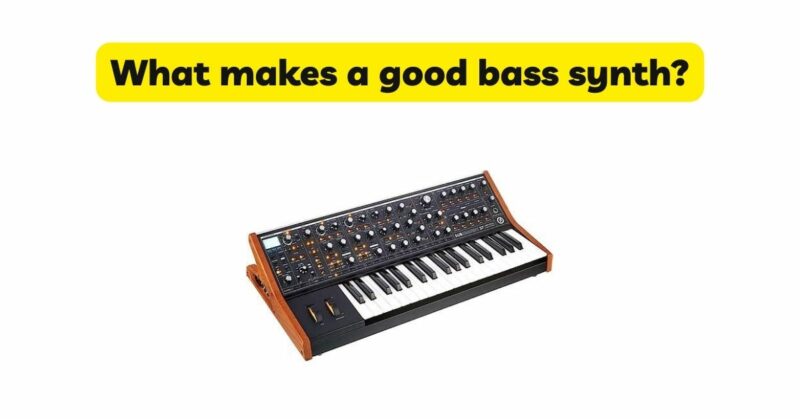
Bass synthesizers play a crucial role in modern music production, providing the foundation for powerful low-end frequencies. Crafting an exceptional bass sound requires a combination of key elements that contribute to its impact, depth, and character. In this article, we will delve into the essential components that make a good bass synth. By understanding these elements, musicians and producers can unlock the potential for creating compelling and captivating basslines.
- Sound Quality and Character: A fundamental aspect of a good bass synth is the quality and character of its sound. The ideal bass synth should produce a rich, deep, and full-bodied tone that resonates with the listener. Whether it’s a warm and analog-inspired sound or a modern and punchy digital timbre, the bass synth’s sonic personality should align with the intended musical style. The ability to shape and customize the sound through filters, envelopes, and modulation sources further enhances its character and uniqueness.
- Low-Frequency Capability: The bass synth’s ability to reproduce low frequencies accurately and powerfully is essential. It should deliver a solid low-end foundation with clear and defined bass frequencies. The synth’s oscillators and filters should be capable of generating and shaping sub-bass tones that provide weight and impact to the overall sound. Additionally, the bass synth should offer precise control over the low-frequency range to ensure it sits well in the mix without overpowering other elements.
- Oscillator Options and Waveforms: A good bass synth provides a variety of oscillator options and waveforms to shape the sound. Different waveforms, such as sine, triangle, sawtooth, and square, offer distinct tonal characteristics and harmonic content. The ability to blend or combine multiple waveforms, as well as adjust their detuning or phase relationships, adds depth and complexity to the bass sound. The synth should also provide options for frequency modulation (FM) or wavetable synthesis to further expand sonic possibilities.
- Filter Characteristics: Filters play a vital role in shaping the timbre and tone of a bass synth. The synth should offer flexible and responsive filter options, such as low-pass, high-pass, band-pass, and notch filters. The ability to adjust the filter cutoff frequency, resonance, and envelope modulation allows for precise control over the bass sound’s brightness, presence, and overall character. A good bass synth should provide filters that can accentuate the desired frequencies while removing unwanted elements.
- Envelope Control: Envelopes control the dynamic behavior of the sound over time, shaping the attack, decay, sustain, and release characteristics. A good bass synth should offer precise envelope control to shape the bass sound’s articulation and response. The ability to create quick and punchy attacks, smooth and sustained notes, or evolving textures through envelope modulation enhances the expressiveness and versatility of the bass synth.
- Modulation Capabilities: Modulation sources and destinations are essential in creating dynamic and evolving bass sounds. A good bass synth should provide a range of modulation options, including LFOs (Low-Frequency Oscillators), envelopes, and velocity sensitivity. These modulation sources can modulate parameters such as filter cutoff, oscillator pitch, amplitude, or even introduce effects like modulation-based distortion or chorus. The ability to introduce modulation adds movement and interest to the bass sound, making it more expressive and engaging.
- Playability and Control: A good bass synth should offer excellent playability and control to allow musicians to perform and manipulate the bass sound with ease. This includes factors such as the responsiveness of the keyboard or MIDI controller, the presence of velocity sensitivity and aftertouch, and the availability of modulation wheels or assignable control knobs. Intuitive and tactile control over parameters enhances the musician’s ability to shape the bass sound in real-time and deliver expressive performances.
- Integration and Connectivity: A bass synth that integrates seamlessly into a musician’s setup is highly valuable. Integration can include features like MIDI connectivity for precise control and synchronization with other devices or software, USB connectivity for direct computer integration, and CV/Gate compatibility for modular or analog systems. The ability to integrate the bass synth into a larger studio or live performance environment enhances its versatility and compatibility with existing setups.
- Presets and Sound Libraries: While sound customization is crucial, a good bass synth should also offer a variety of high-quality presets and sound libraries. These presets serve as starting points for musicians, providing instant access to professionally designed bass sounds that can be further modified to suit specific needs. A diverse range of presets allows for quick inspiration and experimentation, helping musicians explore different sonic possibilities.
- Build Quality and Durability: Lastly, a good bass synth should be built with high-quality materials and components, ensuring durability and longevity. A robust construction not only enhances the instrument’s reliability but also provides a sense of confidence and reassurance to the musician. A well-built bass synth withstands the demands of studio use, live performances, and touring, allowing musicians to focus on their craft without worrying about equipment failures.
Conclusion: A good bass synth combines various elements to deliver a powerful, impactful, and expressive low-end foundation. Sound quality, low-frequency capability, oscillator options, filter characteristics, envelope control, modulation capabilities, playability, integration, presets, and build quality are all critical components that contribute to the overall excellence of a bass synth. By considering these elements, musicians and producers can choose a bass synth that meets their specific musical needs, allowing them to create captivating basslines that anchor their compositions and make a lasting sonic impression.