
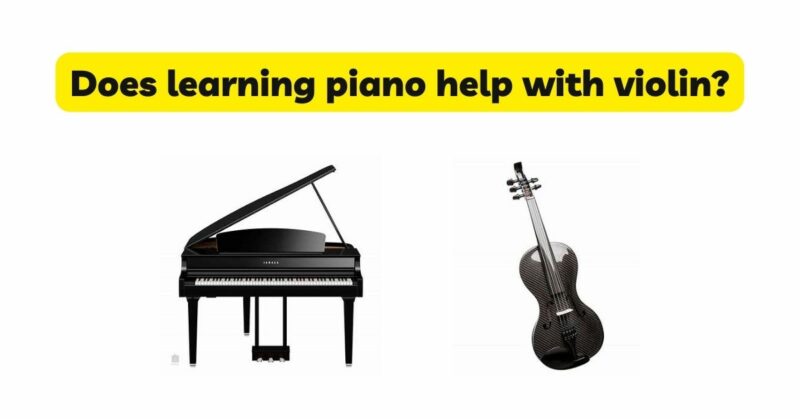
The world of music offers a vast array of instruments, each with its unique characteristics and challenges. When considering the relationship between the piano and the violin, aspiring musicians often wonder if learning one instrument can benefit their progress on the other. In this article, we will explore the interplay between the piano and the violin, examining the advantages, transferable skills, and synergies that arise from learning both instruments. By delving into aspects such as music theory, technical proficiency, sight-reading abilities, ear training, ensemble playing, and musical expression, we aim to shed light on the enriching connection between these two instruments and how learning one can enhance the proficiency on the other.
Music Theory and Understanding:
One of the significant advantages of learning the piano before the violin lies in the development of music theory and understanding. The piano’s visual layout, with its arrangement of keys representing specific pitches, provides a tangible and comprehensive platform for learning music theory concepts. Pianists gain familiarity with scales, chords, intervals, and key signatures through practical application on the keyboard. This foundation in music theory becomes a valuable asset when approaching the violin, as it helps violinists grasp the fundamental concepts of harmony, structure, and analysis more readily. The piano’s contribution to music theory comprehension can facilitate the interpretation and expression of music on the violin.
Technical Proficiency and Finger Dexterity:
Learning the piano fosters technical proficiency and finger dexterity, skills that seamlessly translate to the violin. Pianists develop finger independence, strength, and agility through the coordination required to play various melodies, harmonies, and rhythms simultaneously. This finger dexterity acquired on the piano provides an advantageous head start when transitioning to the violin, where precise finger placement and intonation are essential for producing accurate pitches. The ability to navigate the keyboard with precision translates into nimble fingerwork on the violin’s fingerboard, allowing for more efficient practice and faster progress in developing the necessary technique.
Sight-Reading and Musical Notation:
Proficiency in sight-reading and understanding musical notation is another area where the piano greatly supports violin learning. Pianists become adept at reading sheet music, associating notes with their corresponding keys, and navigating complex musical scores. This skill transfers directly to the violin, enabling violinists to more effectively decipher and interpret violin sheet music. Pianists often have an advantage in understanding rhythm, tempo, dynamics, and phrasing, which are crucial elements of sight-reading on any instrument. This foundation in musical notation and sight-reading acquired through the piano allows violinists to focus more on technical execution and musical expression when learning new pieces.
Ear Training and Intonation:
Ear training is a vital aspect of musical education, and pianists have a head start in this area due to their exposure to harmonies, intervals, and chords on the keyboard. Playing the piano provides a solid foundation in recognizing pitch relationships and intervals by ear. This ear training becomes a valuable asset for violinists, as they rely heavily on their sense of pitch and intonation to produce accurate and pleasing tones. The piano’s inherent pitch reference points help pianists develop a strong internal sense of relative pitch, which can be transferred to the violin. This transferable skill aids violinists in honing their intonation and pitch accuracy, enhancing their overall musicianship.
Ensemble Playing and Collaboration:
Learning both the piano and the violin opens doors to enhanced ensemble playing and musical collaboration opportunities. Pianists are often sought after as accompanists due to their ability to provide a solid harmonic foundation and support other musicians. The piano’s ability to play multiple voices simultaneously and understand harmonic progressions enables pianists to effectively collaborate with violinists and other instrumentalists. Similarly, violinists who have learned the piano can better understand the piano’s role in ensemble settings, leading to improved communication and musical cohesion within a group. The synergy between the piano and the violin in ensemble playing can create a more harmonious and expressive musical experience.
Musical Expression and Interpretation:
The piano and the violin offer distinct avenues for musical expression and interpretation. Pianists have the advantage of playing multiple notes simultaneously, allowing for rich harmonies, complex textures, and expressive possibilities. Learning the piano cultivates a keen sense of dynamics, touch, and phrasing, which directly influence musical expression. This sensitivity to musical nuances gained through piano playing can be transferred to the violin, enabling violinists to explore a wide range of tonal colors, dynamics, and expressive techniques. The piano’s contribution to musical expression and interpretation enriches the violinist’s playing, allowing for a more nuanced and emotive performance.
Personal Growth and Appreciation for Music:
Learning both the piano and the violin nurtures personal growth and a deep appreciation for music as a whole. The pursuit of multiple instruments broadens one’s musical horizons, allowing for a more comprehensive understanding of different musical styles, genres, and traditions. The ability to switch between instruments fosters adaptability and versatility as a musician, leading to a more holistic musical development. Moreover, the exploration of different instruments encourages a deeper appreciation of the interplay between melody, harmony, and rhythm, enhancing one’s overall musicianship and the ability to engage with music on a profound level.
Conclusion:
Learning the piano prior to taking up the violin offers numerous advantages and synergies between these two instruments. The piano’s contribution to music theory, technical proficiency, sight-reading abilities, ear training, ensemble playing, and musical expression sets a solid foundation for violin learning. The transferable skills acquired through piano playing facilitate faster progress, deeper musical understanding, and enhanced performance on the violin. However, it is worth noting that the benefits of learning the piano before the violin are not exclusive, and individuals can still achieve proficiency and musical excellence on the violin without prior piano experience. Ultimately, the decision to learn either instrument or both should be based on personal interest, goals, and aspirations. Regardless of the chosen path, the journey of learning and playing either the piano or the violin offers a lifelong pursuit of artistic expression, personal growth, and a profound connection with the world of music.