
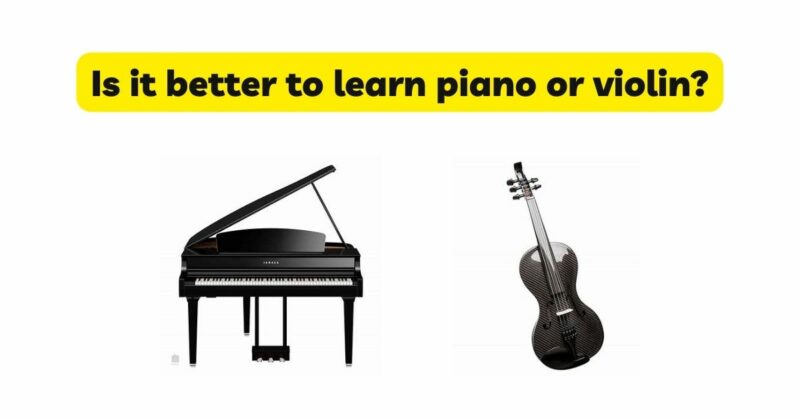
The choice to learn a musical instrument is a decision that can bring immense joy and personal enrichment. When faced with the question of whether it is better to learn the piano or the violin, aspiring musicians often find themselves in a conundrum. In this article, we will explore the benefits of learning both instruments, comparing their unique qualities, technical demands, expressive potential, versatility, and cognitive benefits. By examining these factors, we aim to provide insights into the advantages offered by each instrument and help readers make an informed decision based on their personal goals and preferences.
Technical Demands and Skill Development:
Both the piano and the violin present distinct technical demands and offer opportunities for skill development. The piano requires the pianist to develop coordination between both hands, enabling the execution of multiple melodies, harmonies, and rhythms simultaneously. This hand independence fosters fine motor skills, finger dexterity, and the ability to play complex musical passages. In contrast, the violin demands precise finger placement on a fretless fingerboard and mastery of bowing technique. Violinists develop finger strength, coordination, and intonation skills, as well as the ability to produce a rich and expressive sound. Both instruments offer challenges and rewards in terms of technical proficiency, allowing for continuous growth and refinement.
Expressive Potential and Musical Styles:
When comparing the expressive potential of the piano and violin, it becomes evident that both instruments offer unique avenues for artistic expression. The piano’s vast range and polyphonic capabilities allow for the creation of intricate harmonies, dynamic contrasts, and nuanced tonal variations. Pianists can explore a wide range of musical genres, from classical and jazz to pop and contemporary styles. The violin, renowned for its ability to emulate the human voice, possesses a distinct capacity for lyrical and expressive playing. With its ability to produce a wide array of tonal colors, the violin excels in classical music and chamber ensembles. However, it is worth noting that the piano’s versatility lends itself well to a broader range of musical genres, while the violin’s expressive qualities are particularly suited to melodic and emotional playing.
Versatility and Ensemble Opportunities:
The piano’s versatility makes it a valuable instrument for ensemble playing, accompanying other musicians, and serving as a foundation for musical collaborations. Pianists can engage in chamber music, accompany singers, or perform as part of an orchestra. The piano’s role as both a solo and collaborative instrument provides numerous opportunities for musicians to interact and create music together. On the other hand, the violin, with its rich history in orchestral and chamber music, offers opportunities to be part of string quartets, chamber ensembles, and symphony orchestras. The violin’s role as a melodic and expressive instrument makes it well-suited for solo performances and prominent soloist opportunities. Both instruments offer unique ensemble experiences, allowing musicians to explore different musical dynamics and learn from their peers.
Cognitive Benefits and Brain Development:
Learning to play either the piano or the violin provides cognitive benefits that extend beyond musical skill development. Research has shown that learning to play a musical instrument can enhance cognitive functions such as memory, attention, and problem-solving abilities. The piano, with its visual representation of notes on a keyboard, helps develop spatial-temporal skills and pattern recognition. It has been associated with improved mathematical and logical thinking. Conversely, the violin, with its focus on finger placement and precise intonation, fosters spatial awareness, auditory discrimination, and fine motor skills. Both instruments engage the brain in unique ways, promoting neural plasticity and supporting overall brain development.
Personal Preference and Motivation:
The decision between learning the piano or the violin should ultimately be guided by personal preference and motivation. It is essential to choose an instrument that resonates with one’s musical interests and goals. Reflect on the music that inspires you and the sound that captivates your imagination. Consider the musical genres and styles that align with your preferences and aspirations. The motivation to learn an instrument plays a crucial role in the dedication and commitment required for progress and enjoyment. Whether drawn to the versatility of the piano or the expressive qualities of the violin, personal preference should guide the decision-making process.
Instrument Accessibility and Practical Considerations:
Practical considerations also come into play when choosing between the piano and the violin. The piano, whether an acoustic or digital instrument, is widely accessible and readily available for practice and learning. It is a self-contained instrument that requires minimal setup. However, it is worth considering space constraints and potential costs associated with purchasing or renting a piano. The violin, while a more portable instrument, may require adjustments and maintenance, such as restringing or regular bow rehairing. Additionally, access to quality instruction and availability of educational resources should be considered. Practical considerations should align with one’s commitment and resources to ensure a smooth and enjoyable learning experience.
Conclusion:
The debate of whether it is better to learn the piano or the violin ultimately boils down to personal preferences, goals, and aspirations. Both instruments offer unique benefits and rewards, making them valuable choices for musicians at different stages of their musical journeys. The piano’s versatility, expressive potential, and ensemble opportunities make it a powerful instrument for a wide range of musical genres. Meanwhile, the violin’s lyrical and expressive qualities, coupled with its orchestral and chamber music traditions, offer a rich and emotional musical experience. The decision should be based on personal interests, musical goals, and the desire to connect with an instrument that resonates deeply. Whether choosing the piano or the violin, the journey of learning and mastering an instrument brings immeasurable joy, personal growth, and a lifelong appreciation for the art of music.