
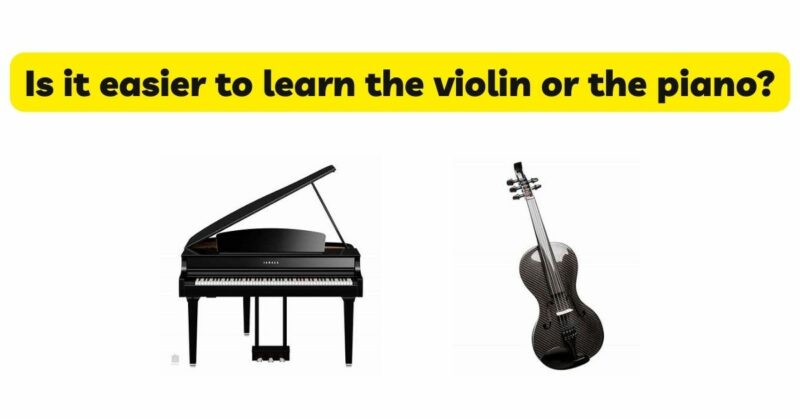
Embarking on a musical journey is an exciting endeavor, and choosing the right instrument can make all the difference. The violin and piano are two iconic instruments that have captivated musicians and audiences for centuries. Aspiring musicians often wonder which instrument is easier to learn: the violin or the piano. In this article, we will delve into various aspects of learning each instrument, considering factors such as technique, musicality, physical demands, and educational resources. By exploring these elements, we aim to provide a comprehensive analysis to address the question: Is it easier to learn the violin or the piano?
Technical Demands:
One fundamental aspect to consider when comparing the violin and piano is the technical demands placed on the learner. The violin requires precise hand positioning, bow control, and a keen sense of pitch. Beginners must develop finger dexterity, flexibility, and strength, which can be challenging at the outset. The piano, in contrast, entails coordinating both hands independently. While the initial learning curve may be smoother due to the familiarity of pressing keys, mastering complex fingerings, hand independence, and coordinating pedaling can present their own set of challenges.
Physicality and Ergonomics:
The physicality and ergonomics of an instrument play a significant role in its ease of learning. The violin demands a specific posture, including holding the instrument against the shoulder, placing the chin on the chinrest, and balancing the weight of the violin with the left hand. This posture can be physically demanding and may require time to build muscle strength and endurance. Conversely, the piano offers a more ergonomically friendly experience, as the instrument’s design allows for a natural sitting position. However, piano learners may face challenges in building finger strength and agility to navigate the keys smoothly.
Educational Resources:
The availability of educational resources can greatly impact the learning process. For both the violin and piano, a plethora of instructional materials, method books, and online resources are accessible. However, the piano benefits from a larger repertoire of beginner-friendly sheet music, providing learners with a wide selection of engaging and achievable pieces. Additionally, piano learners can take advantage of visual aids such as key stickers or color-coded sheet music to facilitate early learning. While resources for the violin are also abundant, beginners may encounter a steeper learning curve due to the instrument’s unique techniques and notation system.
Sight-Reading and Musical Notation:
A crucial skill for any musician is sight-reading and understanding musical notation. Both the violin and piano employ the same musical notation system, allowing learners to transfer their skills between the two instruments. However, violin sheet music often includes additional markings specific to string instruments, such as bowing indications and various types of articulations. Piano sheet music, though potentially less complex in terms of notations, presents its own challenges due to the need to coordinate both hands simultaneously. Ultimately, the complexity of sight-reading and musical notation is comparable for both instruments, with slight variations in specific requirements.
Tonal Expressivity and Musicality:
One of the most rewarding aspects of learning an instrument is the ability to express emotions through music. The violin and piano offer distinct avenues for tonal expressivity and musicality. The violin’s versatility in tone and its ability to produce singing, lyrical sounds make it an instrument with immense expressive potential. However, mastering the violin’s subtleties of vibrato, dynamics, and articulation can be demanding. The piano, with its wide range and polyphonic capabilities, allows for rich harmonies and dynamic contrasts. Achieving the desired tonal expressivity on the piano requires an understanding of touch, phrasing, and pedal techniques. Both instruments offer opportunities for musical expression, albeit with different technical requirements.
Learning Curve and Progression:
The learning curve and progression in mastering an instrument vary depending on individual aptitude, dedication, and practice habits. While it is challenging to compare the overall difficulty objectively, the piano often provides a more structured learning path for beginners. Piano learners can start with basic melodies and gradually progress to more complex compositions as they gain technical proficiency and musical understanding. On the other hand, the violin demands dedicated practice to develop correct bowing technique, intonation, and control over tone. Producing pleasing tones on the violin may take longer to achieve, making the initial stages more challenging for beginners.
Conclusion:
In the realm of music, the question of whether the violin or the piano is easier to learn does not have a definitive answer. Both instruments have their unique challenges and rewards. The violin requires mastering bowing technique, hand positioning, and intonation, which can be physically and technically demanding. The piano demands coordination, finger independence, and an understanding of complex harmonies, with challenges centered more on finger agility. Ultimately, the ease of learning an instrument depends on personal preferences, dedication, and perseverance. Regardless of the chosen instrument, a supportive learning environment, quality instruction, and regular practice are essential for progress and musical development. Embrace the instrument that resonates with your heart, and let your musical journey unfold with passion and commitment.