
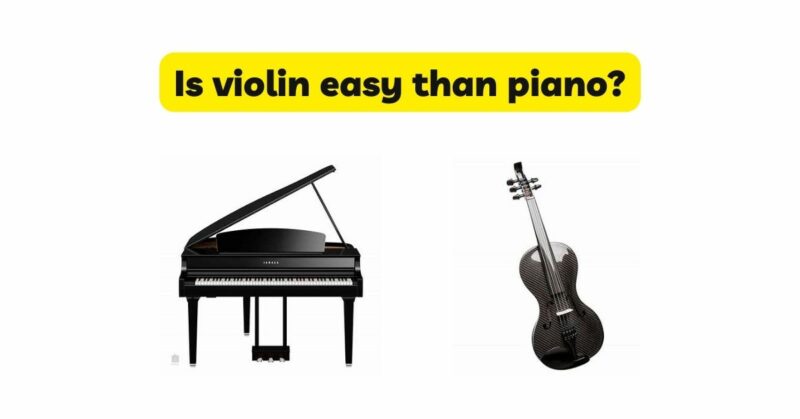
The world of music offers a diverse array of instruments, each with its unique qualities and challenges. The violin and piano are two of the most popular instruments in classical music, captivating audiences for centuries. Aspiring musicians often find themselves pondering which instrument would be easier to learn: the violin or the piano. While both instruments have their own complexities, this article aims to delve into various aspects and provide an in-depth analysis to answer the question: Is the violin easier than the piano?
Historical Background:
To understand the intricacies of the violin and piano, it is essential to explore their historical backgrounds. The violin, dating back to the early 16th century, has a long and rich heritage. Its characteristic sound and expressive capabilities have made it a staple in orchestras and chamber music ensembles. The piano, on the other hand, emerged during the 18th century and quickly gained popularity due to its versatility and ability to produce a wide range of dynamics.
Physical Demands:
One fundamental aspect to consider when comparing the violin and piano is the physical demands placed on the musician. The violin requires precise hand positioning, bow control, and a keen sense of pitch. Players must develop dexterity, flexibility, and strength in their fingers, which can be challenging for beginners. In contrast, the piano involves coordinating both hands independently, with the left hand managing the bass notes and the right hand playing the melody. The larger keys and broader hand movements required may be less physically demanding than the violin initially, but mastering the complex fingerings, hand independence, and coordinating pedaling can present their own set of challenges.
Technical Complexity:
Another factor to consider is the technical complexity of each instrument. The violin’s pitch is adjusted by placing the fingers in precise positions along the fingerboard, requiring an acute sense of pitch and intonation. Bowing techniques such as legato, staccato, and spiccato add another layer of complexity. The piano, on the other hand, relies on pressing keys to produce sound, making it easier to learn basic melodies and harmonies. However, mastering the instrument’s expansive range, finger independence, and intricate playing techniques, including scales, arpeggios, and chords, can be daunting.
Musical Notation:
Understanding musical notation is crucial for any musician. Both the violin and piano use the same musical notation system, which makes reading sheet music applicable to both instruments. However, the violin requires learning additional symbols and markings specific to string instruments, such as bowing indications and various types of articulations. While piano sheet music may appear less complex in terms of notations, the challenge lies in translating the notes into coordinated hand movements across the keyboard.
Expressive Potential:
One of the captivating aspects of music is its ability to convey emotions. Both the violin and piano possess immense expressive potential, allowing musicians to evoke a wide range of emotions through their playing. The violin, with its versatility in tone and expressiveness, enables musicians to produce a singing, lyrical sound. The piano, with its ability to play multiple notes simultaneously, allows for rich harmonies and dynamic contrasts. The expressive potential of both instruments is vast, but the violin may require additional technical mastery to achieve certain nuances.
Learning Curve:
When it comes to the learning curve, the difficulty of an instrument often depends on the individual’s prior musical experience and natural aptitude. However, the piano tends to offer a more structured learning path, with a gradual progression from basic melodies to complex compositions. The visual layout of the keys and the availability of pedagogical resources, such as beginner-level sheet music, can provide a solid foundation for beginners. The violin, on the other hand, requires dedicated practice to develop correct bowing technique, intonation, and control over the instrument’s sound. It may take longer to produce pleasing tones on the violin, making the initial stages more challenging for beginners.
Conclusion:
In the realm of music, the question of whether the violin is easier than the piano cannot be definitively answered. Both instruments have their own complexities and challenges, and the level of difficulty varies depending on the individual’s musical background and aptitude. The violin demands physical dexterity, precise intonation, and mastery of bowing techniques, while the piano requires coordination, finger independence, and an understanding of complex harmonies. Ultimately, choosing between the violin and piano should be guided by personal preference, passion, and dedication to mastering the instrument. With perseverance, guidance, and consistent practice, both instruments offer a rewarding musical journey for those willing to embark on the path of musical mastery.