
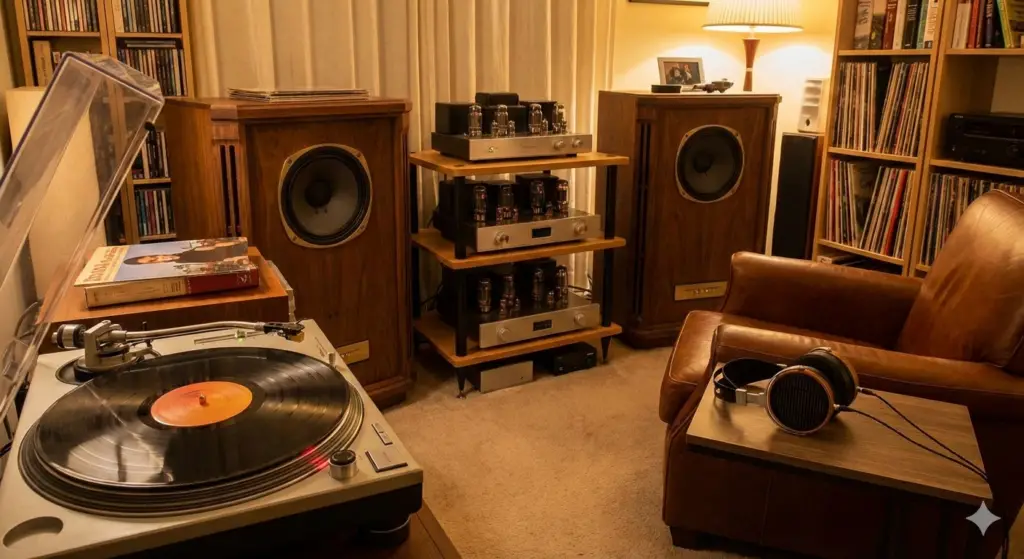
Vibration is one of the biggest enemies of vinyl playback. Footfalls, speaker energy, and even subtle room resonances can travel into a turntable, affecting tracking accuracy and sound clarity. That’s why isolation feet and platforms are so popular—but do they really work, or are they just audiophile accessories?
Let’s separate marketing claims from real-world results.
What Are Isolation Feet and Platforms?
Isolation Feet
Isolation feet replace or supplement a turntable’s stock feet. They’re designed to absorb, dissipate, or decouple vibration before it reaches the plinth.
Common materials include:
- Rubber
- Sorbothane
- Springs
- Silicone
- Composite elastomers
Isolation Platforms
Platforms sit under the entire turntable and provide a more comprehensive isolation solution.
Common designs:
- Heavy butcher blocks
- Constrained-layer platforms
- Spring-suspended platforms
- Wall-mounted shelves
Where Vibration Comes From
Turntables are affected by:
- Footfalls on suspended floors
- Low-frequency energy from speakers
- Motor vibration
- Structural resonance from racks and furniture
Unlike digital audio, vinyl playback is mechanical—so vibration control directly affects sound.
Do Isolation Products Actually Work?
The Short Answer
Yes—but only in the right situations.
Isolation products can produce real, audible improvements when vibration is a genuine problem. In already stable setups, the difference may be minimal.
Audible Benefits (When Isolation Is Needed)
When isolation is effective, listeners often report:
- Tighter, more controlled bass
- Reduced feedback and rumble
- Improved clarity and focus
- Better tracking during loud passages
- Fewer skips from footfalls
The biggest improvements usually occur in challenging environments.
Isolation Feet: Pros & Cons
Pros
- Affordable entry point
- Easy to install
- Effective for minor vibration issues
- No large space requirements
Cons
- Limited isolation range
- Must be properly matched to turntable weight
- Can alter tonal balance if too soft or too rigid
Best for:
Minor vibration problems or fine-tuning an existing setup.
Isolation Platforms: Pros & Cons
Pros
- Broader vibration control
- More consistent results
- Ideal for problematic rooms or floors
- Can dramatically reduce footfall issues
Cons
- More expensive
- Takes up space
- Must support correct weight
Best for:
Suspended floors, high-volume listening, or sensitive cartridges.
Wall-Mounted Shelves: The Ultimate Solution?
In many homes, a wall shelf offers the most effective isolation by completely removing floor vibration from the equation.
Pros
- Excellent footfall isolation
- Stable reference point
- Clean, repeatable results
Cons
- Requires wall mounting
- Not suitable for all walls
- Less flexible placement
For some setups, nothing works better.
When Isolation Makes the Biggest Difference
Isolation products are most effective if:
- Your turntable skips when you walk by
- Bass sounds muddy or uncontrolled
- You have a suspended wooden floor
- Speakers are close to the turntable
- You listen at higher volumes
If none of these apply, improvements may be subtle.
Common Isolation Myths
- “More isolation is always better” – Over-isolation can hurt sound
- “Soft feet work for all turntables” – Weight matching matters
- “Isolation fixes poor setup” – It doesn’t
Isolation complements proper setup—it doesn’t replace it.
Better Alternatives (Sometimes)
Before buying isolation products, consider:
- Moving the turntable farther from speakers
- Using a heavier, sturdier rack
- Leveling and securing furniture
- Improving room layout
These changes often cost nothing and can outperform accessories.
Final Verdict
Do isolation feet and platforms reduce vibration?
Yes—when vibration is the problem they’re designed to solve.
Isolation feet are excellent for fine-tuning, while platforms and wall shelves deliver more dramatic results in difficult environments. The key is identifying whether vibration is actually affecting your system.
When used correctly, isolation is one of the most effective—and scientifically grounded—turntable upgrades available.