
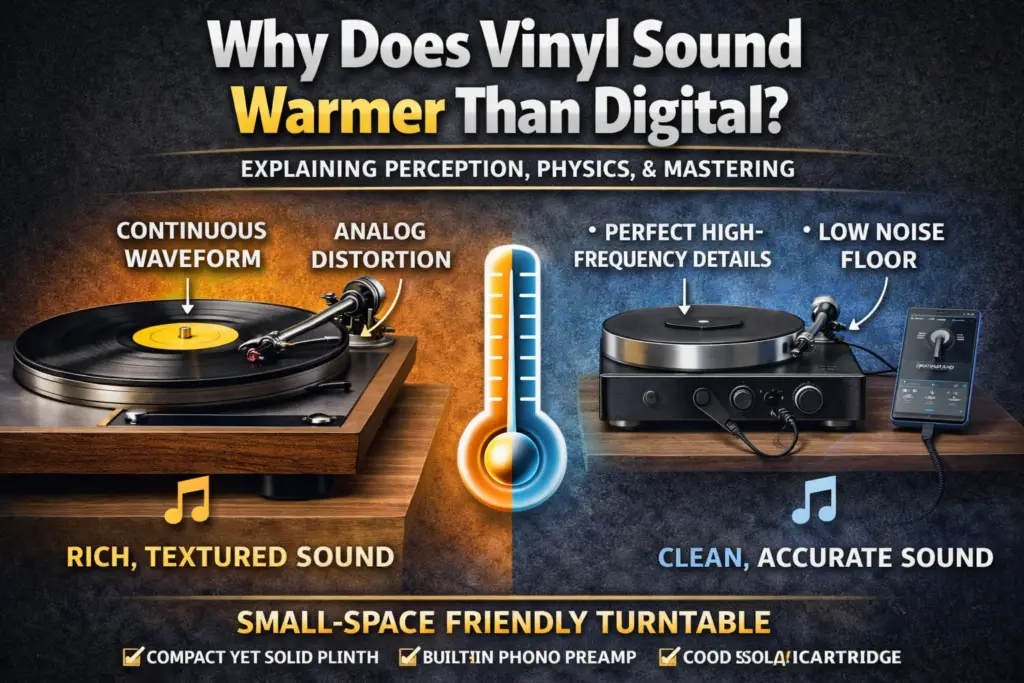
Few audio debates are as enduring as vinyl vs digital. Even listeners who embrace streaming often describe vinyl as “warmer,” “smoother,” or “more natural.” But what does warm really mean—and is vinyl objectively warmer, or does it just feel that way?
The answer lies in a mix of analog physics, distortion characteristics, mastering choices, and human perception.
🔥 What “Warmth” Means in Audio Terms
In audio, warmth usually refers to:
- Slightly emphasized midrange and upper bass
- Smooth, non-fatiguing highs
- Rounded transients rather than sharp edges
- A sense of fullness and body
Warmth is not about accuracy alone—it’s about how pleasing the sound feels.
🎵 1. Analog Harmonic Distortion (The Good Kind)
Vinyl playback introduces harmonic distortion, but not all distortion is bad.
- Turntables, cartridges, and phono stages add mostly even-order harmonics
- Even-order harmonics are musically related to the original note
- Our ears perceive them as richness and warmth
Digital distortion (when it occurs) often produces odd-order harmonics, which sound harsher.
💡 Vinyl’s imperfections tend to be euphonic rather than offensive.
📉 2. Gentle High-Frequency Roll-Off
Most vinyl systems naturally roll off very high frequencies:
- Cartridge limitations
- Stylus tracing accuracy
- Phono stage behavior
This results in:
- Softer treble
- Less glare
- Reduced listening fatigue
By contrast, digital audio can reproduce extended highs with surgical precision—which some listeners perceive as “cold” or “bright.”
🎚️ 3. Compression in Vinyl Mastering
Vinyl records are usually mastered differently from digital releases.
To fit music safely into grooves:
- Extreme dynamics are controlled
- Bass is centered
- Loudness is managed more carefully
This often leads to:
- More consistent levels
- Fuller midrange
- Less aggressive sound
In many cases, the vinyl mastering, not the format itself, is the biggest reason for warmth.
📐 4. Continuous Waveform vs Sampling
Vinyl playback is fully analog:
- The stylus follows a continuous groove
- No sampling or quantization
Digital audio reconstructs sound using:
- Discrete samples
- Filters and digital processing
Although modern digital is extremely accurate, some listeners prefer the continuous nature of analog reproduction, even if it’s technically less precise.
🎧 5. Psychoacoustics & Listening Ritual
Perception plays a powerful role.
Vinyl listening often involves:
- Focused attention
- Lower playback levels
- Physical interaction (handling records)
These factors:
- Reduce listening fatigue
- Increase emotional engagement
- Enhance perceived warmth
Expectation bias is real—but it doesn’t make the experience less valid.
⚠️ When Vinyl Doesn’t Sound Warm
Vinyl won’t automatically sound warm if:
- The record is poorly mastered
- The cartridge is overly bright
- Setup is incorrect (VTA, tracking force, alignment)
- The pressing is low quality
A bad vinyl setup can sound thin, noisy, or harsh.
📊 Vinyl vs Digital: Warmth Factors Compared
| Factor | Vinyl | Digital |
|---|---|---|
| Harmonic character | Even-order (warm) | Minimal or odd-order |
| High-frequency behavior | Slight roll-off | Extended & precise |
| Mastering style | Often conservative | Often louder |
| Noise floor | Higher | Extremely low |
| Consistency | Variable | Highly consistent |
🏁 Final Thoughts: Warmth Is a Feature, Not a Flaw
Vinyl sounds warmer not because it’s more accurate—but because its imperfections align well with human hearing preferences.
Digital audio excels at:
- Accuracy
- Dynamic range
- Convenience
Vinyl excels at:
- Texture
- Musicality
- Emotional connection
🎶 In the end, warmth isn’t about technology—it’s about how the sound makes you feel.