
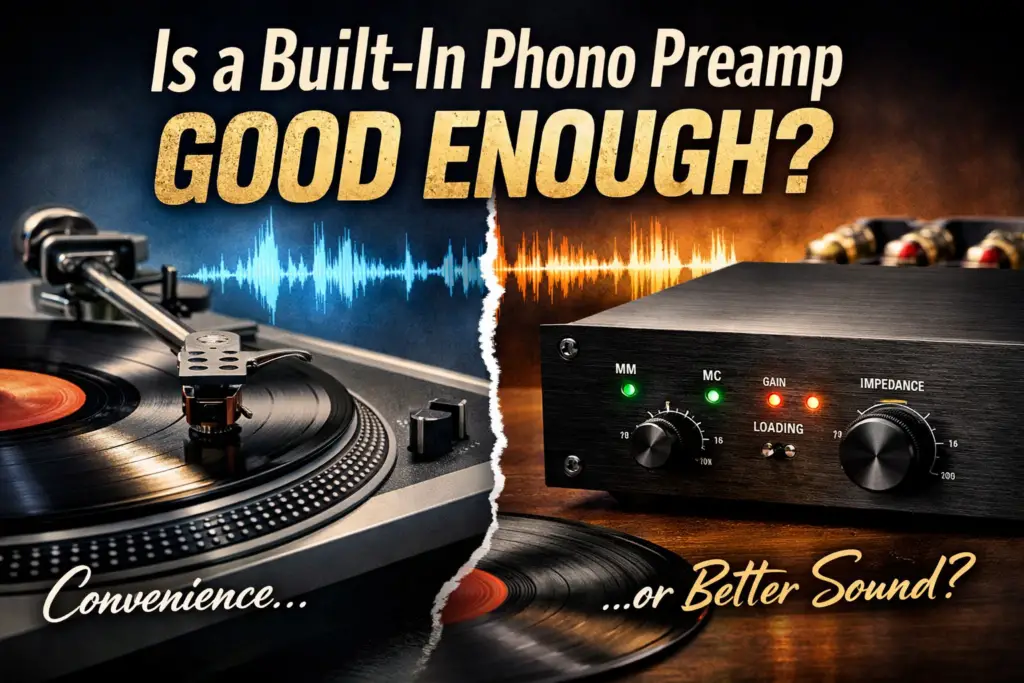
For anyone getting into vinyl—or getting back into it after years away—the question comes up fast: Is the built-in phono preamp in my turntable or amplifier actually good enough?
Manufacturers often advertise “phono stage included” as a major convenience. Just plug the turntable in, select Phono, and you’re spinning records in minutes. But audiophiles have long debated whether that convenience comes at the cost of sound quality.
So, let’s break it down—without dogma, hype, or gear snobbery.
What a Phono Preamp Actually Does (and Why It Matters)
A phono preamp isn’t just another input stage. It has two critical jobs:
- Amplification – The signal from a turntable cartridge is extremely small. A moving-magnet (MM) cartridge outputs around 5 mV, while moving-coil (MC) cartridges can be ten times lower.
- RIAA Equalization – Records are cut with bass reduced and treble boosted. The phono preamp must apply the inverse EQ curve accurately to restore the music’s tonal balance.
If either of these jobs is done poorly, the result can be noise, distortion, thin bass, harsh highs, or a flattened soundstage.
The Case For Built-In Phono Preamps
Built-in phono stages have improved dramatically in the last decade. They’re no longer all an afterthought.
They make sense if:
- You’re using an entry-level or mid-priced turntable
- You run a moving-magnet cartridge
- You value simplicity and clean setup
- Your listening space or system is modest
Many integrated amplifiers and receivers now include surprisingly competent phono stages—quiet, reasonably accurate, and musically enjoyable. Some well-regarded turntables also include internal preamps that outperform cheap external boxes.
For casual listening or starting a vinyl journey, a good built-in phono preamp can absolutely be “good enough.”
Where Built-In Phono Stages Start to Fall Short
The limitations usually show up as the rest of your system improves.
Common drawbacks include:
- Higher noise floor due to shared power supplies and cramped internal layouts
- Limited cartridge compatibility, often MM-only with fixed loading
- Less dynamic headroom, especially noticeable on complex music
- Reduced detail and soundstage depth
In many designs, the phono stage simply doesn’t get the same engineering budget or physical isolation as a dedicated unit.
You may not notice this at first—but once you hear a well-matched external phono preamp, it’s hard to unhear the difference.
When an External Phono Preamp Becomes Worth It
An external phono preamp starts to make sense when:
- You upgrade to a better cartridge (especially moving-coil)
- Your system becomes more resolving and transparent
- You want adjustable gain, loading, or impedance
- You’re chasing lower noise and greater musical realism
A good standalone phono preamp often delivers:
- Cleaner transients
- Deeper, more controlled bass
- Wider and more stable soundstage
- Better separation of instruments
Importantly, you don’t need to spend a fortune. Even modestly priced external phono stages can outperform many built-ins.
So… Is It Good Enough?
The honest answer: Yes—until it isn’t.
A built-in phono preamp can be:
- Perfectly enjoyable
- Technically competent
- A smart starting point
But it’s rarely the endgame for someone serious about vinyl playback.
Think of it like the lens on a kit camera: capable, convenient, and often underrated—but eventually, upgrading reveals just how much more your system can do.
A Practical Rule of Thumb
- New to vinyl? Use the built-in preamp and enjoy the music.
- Upgrading your cartridge or speakers? Start auditioning external phono stages.
- Chasing the last 10–20% of performance? A dedicated phono preamp is one of the most rewarding upgrades you can make.
Final Thoughts
Vinyl is a chain, and the phono preamp sits at one of its most sensitive points. Built-in phono stages are no longer automatically “bad,” but they are usually a compromise made for convenience.
Whether that compromise matters depends entirely on your system, your ears, and your goals—and that’s what makes the vinyl journey so personal in the first place.
Trust your ears. Upgrade with intention. And above all—keep spinning.