
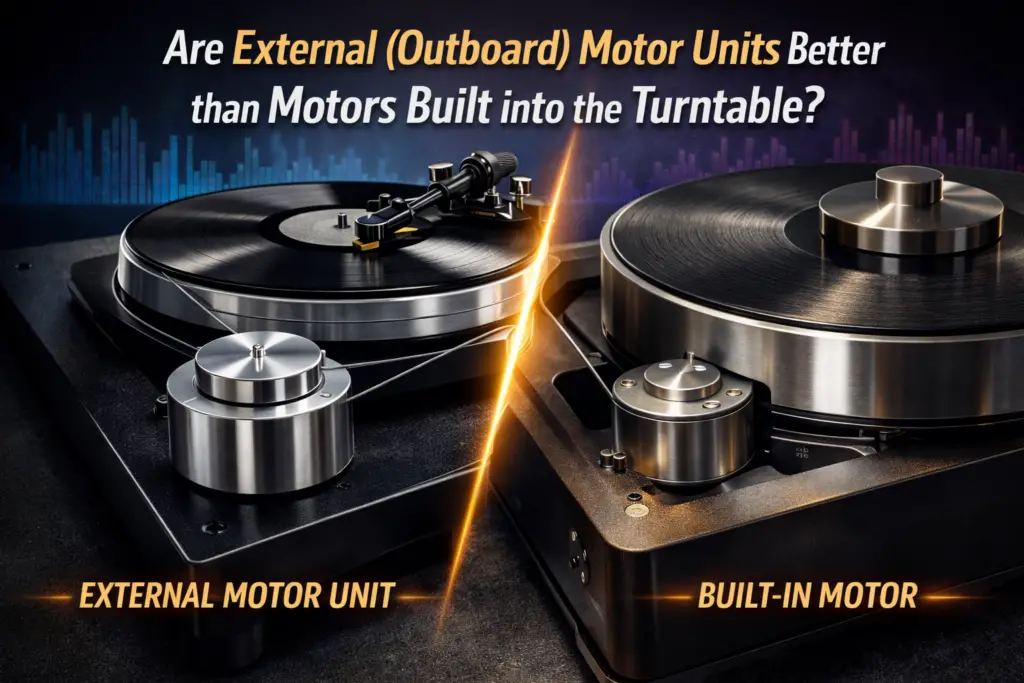
In high-end turntable design, moving the motor outside the plinth is often seen as a mark of seriousness—sometimes even superiority. Outboard motor units appear in many premium analog systems, promising lower noise, better isolation, and purer sound.
But does separating the motor from the turntable actually lead to audible improvements, or is it simply another audiophile trend?
Let’s examine what really matters.
Why the Motor Is Such a Critical Component
A turntable motor is both essential and problematic. It must provide consistent rotational speed while introducing as little vibration and electrical noise as possible. Any motor-related disturbance—mechanical or electromagnetic—can find its way into the platter, bearing, tonearm, and ultimately the cartridge.
The core challenge is energy control: delivering torque without contamination.
The Case for External (Outboard) Motors
Superior Vibration Isolation
By placing the motor in a separate housing, designers physically distance vibration from the platter and tonearm. This makes it easier to:
- Reduce structure-borne vibration
- Minimize motor noise entering the chassis
- Control resonance through independent damping
This is especially attractive for high-mass platters that demand strong motors.
Improved Power Supply Design
Outboard motor systems often include dedicated power supplies, allowing:
- More stable voltage and frequency control
- Fine speed adjustment (often electronically)
- Reduced electrical interference near the cartridge
Better power regulation can translate into smoother rotation and more consistent pitch.
Flexibility and Upgrade Potential
External motors can be:
- Repositioned for optimal belt tension
- Upgraded independently of the turntable
- Tuned to match platter mass and belt characteristics
This modularity appeals to enthusiasts who enjoy system optimization.
The Drawbacks of Going Outboard
External motors are not automatically superior.
Key challenges include:
- Increased setup complexity and alignment sensitivity
- Greater sensitivity to belt tension and placement
- More components, cables, and power connections
- Higher cost without guaranteed sonic benefit
Poorly implemented outboard systems can actually introduce instability rather than reduce it.
The Case for Integrated Motors
Mechanical Integrity and Simplicity
Built-in motors allow the designer to:
- Precisely control alignment and geometry
- Optimize coupling between motor, chassis, and platter
- Reduce user setup variables
Well-designed integrated systems can achieve excellent isolation using compliant mounts, suspended subchassis designs, or advanced damping techniques.
Compact and Consistent Performance
Integrated motors often offer:
- Faster start-up
- Greater immunity to accidental misalignment
- More predictable long-term stability
Many classic and modern reference turntables use integrated motors with outstanding results.
Sound Quality: What Do Listeners Actually Hear?
When done well, outboard motor turntables often sound:
- Quieter, with a darker background
- More spacious and refined
- Slightly more relaxed in presentation
Integrated motor designs may sound:
- More immediate and cohesive
- Tighter in timing and rhythm
- More “locked-in” dynamically
These differences are subtle and system-dependent. In blind listening, implementation quality often outweighs motor location.
Matching Motor Design to Turntable Architecture
External motors tend to work best with:
- High-mass, rigid plinth designs
- Heavy platters requiring strong torque
- Non-suspended turntables
Integrated motors often excel in:
- Suspended subchassis designs
- Compact, minimalist layouts
- Direct-drive or precision belt-drive systems
The motor must complement the overall vibration and energy-management strategy.
Final Verdict
External motor units are not inherently better—but they can offer advantages when thoughtfully designed and properly matched to the turntable. The true measure of performance lies not in whether the motor is inside or outside the plinth, but in how effectively vibration, speed stability, and energy transfer are controlled.
In analog playback, coherence beats separation. The best motor solution is the one that disappears sonically, letting the music emerge without distraction.