
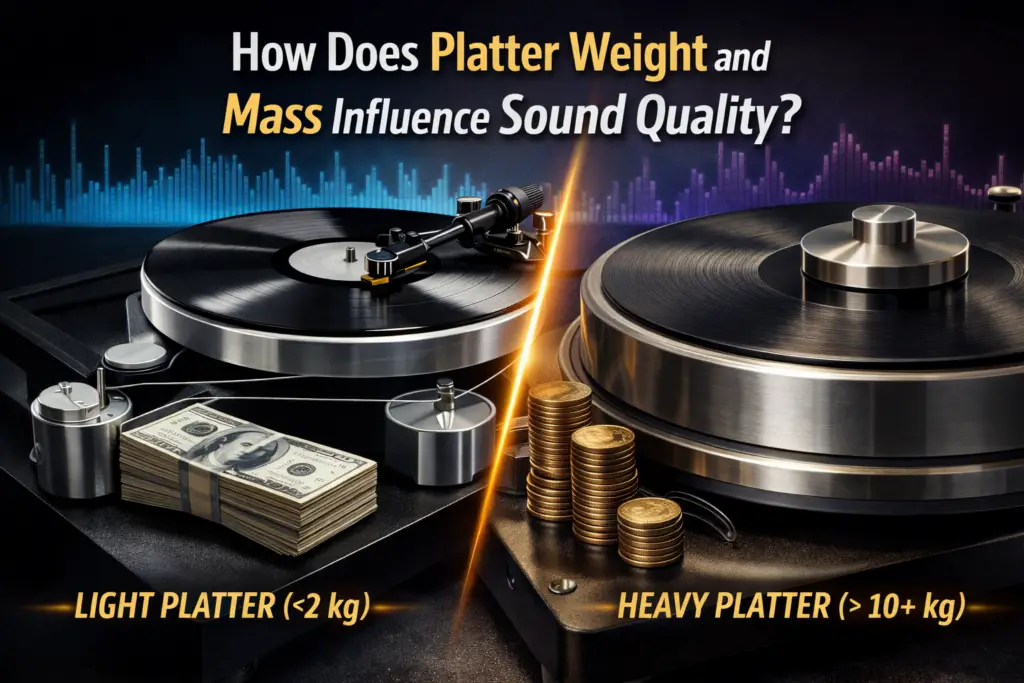
In turntable design, few components are as visually impressive—or as misunderstood—as the platter. From lightweight acrylic discs to massive metal slabs weighing tens of kilograms, platter weight is often associated with sound quality. But does a heavier platter automatically mean better sound?
The answer lies in how platter mass interacts with physics, motor design, and vibration control.
The Platter’s Core Role in Playback
The platter does more than support the record. It acts as a rotational flywheel, helping the turntable maintain consistent speed while resisting disturbances caused by stylus drag and motor irregularities.
A well-designed platter contributes to:
- Speed stability
- Low wow and flutter
- Vibration control
- Consistent groove tracking
Platter weight directly affects each of these areas—but not always in predictable ways.
Heavy Platters: Stability Through Inertia
The Benefits of Mass
A heavy platter stores more rotational energy. Once up to speed, it resists small variations caused by stylus drag or minor motor inconsistencies.
Audible effects often include:
- Improved pitch stability
- Tighter, more authoritative bass
- More solid image placement
- Greater sense of calm and control in complex passages
This is why many high-end turntables favor platters weighing 10 kg or more.
The Trade-Offs
Mass alone does not guarantee performance.
Potential downsides include:
- Increased load on the main bearing
- Greater demands on motor torque and power supply
- Longer start-up times
- Risk of low-frequency noise if bearing quality is insufficient
Without an excellent bearing and motor system, a heavy platter can actually introduce more problems than it solves.
Lightweight Platters: Speed and Energy Control
The Advantages
Lighter platters rely less on stored energy and more on precise motor control. When well engineered, they can sound exceptionally clean and responsive.
Common sonic traits:
- Fast transients
- Open, agile presentation
- Reduced bearing stress
- Lower stored vibrational energy
Materials like acrylic, composite polymers, or thin aluminum are often chosen to minimize resonance rather than maximize mass.
The Limitations
Lightweight platters are more vulnerable to:
- Stylus drag variations
- Motor cogging or belt irregularities
- Speed instability if motor control is poor
Their success depends heavily on motor accuracy and isolation.
Mass Distribution Matters More Than Total Weight
Where the mass is placed can be as important as how much mass there is.
- Perimeter-weighted platters increase rotational inertia without excessive total mass
- Damped, layered constructions control resonance better than solid metal discs
- Material combinations (metal + acrylic, aluminum + brass) can balance inertia and damping
A cleverly designed medium-weight platter can outperform a poorly designed heavy one.
Platter Materials and Resonance Control
Different materials influence how vibrations are absorbed or reflected:
- Aluminum / steel: Strong and precise, but require damping
- Acrylic: Good impedance match with vinyl, often clean and neutral
- Glass: Rigid but prone to ringing without mats
- Composite / sandwich designs: Often the most balanced solution
The goal is not just mass, but controlled mass.
System Matching Is Everything
Platter weight must be matched to:
- Bearing design and tolerances
- Motor torque and drive system
- Chassis rigidity and isolation strategy
High-mass platters tend to work best with:
- Robust bearings
- Powerful or multiple motors
- Rigid, non-suspended designs
Lower-mass platters often shine in:
- Suspended subchassis turntables
- Precision belt-drive systems
- Designs prioritizing low stored energy
Final Verdict
Platter weight and mass profoundly influence a turntable’s sound, but heavier is not automatically better. A heavy platter can deliver exceptional stability and authority—but only when supported by an equally capable bearing, motor, and structure. Lightweight platters, when paired with precise motor control, can sound just as musical, if not more engaging.
In analog playback, balance beats extremes. The best platter is not the heaviest one—but the one whose mass, material, and design are perfectly tuned to the rest of the turntable.