
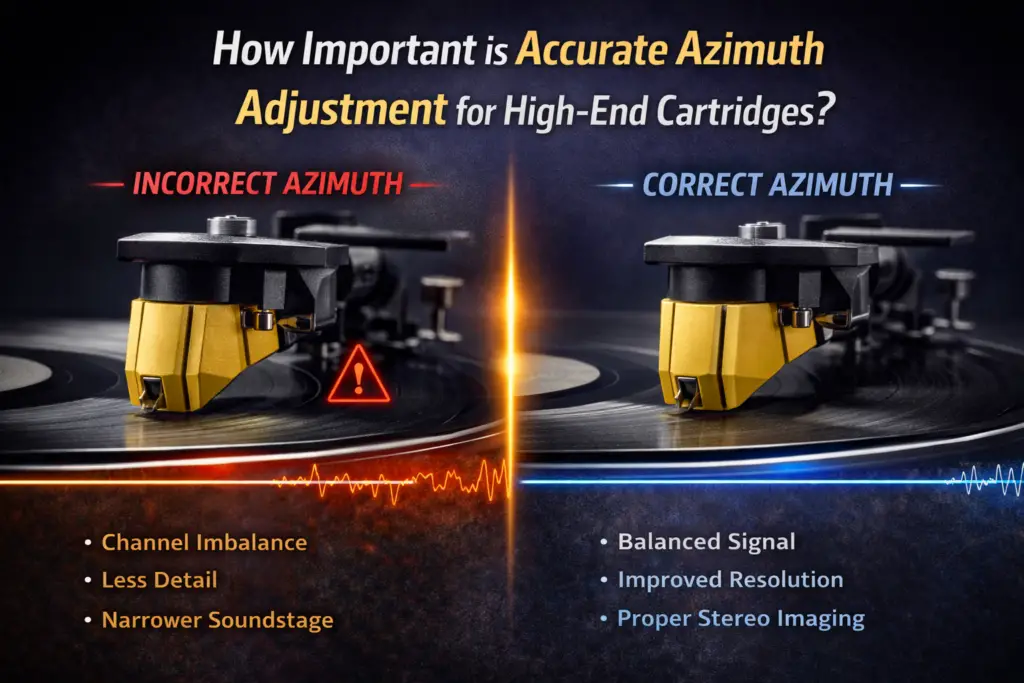
In high-end analog playback, small setup details often make the difference between good sound and truly exceptional performance. Among these details, azimuth adjustment—the side-to-side rotational alignment of the cartridge stylus—can be one of the most overlooked, yet sonically significant, parameters.
For advanced cartridges with extreme resolution, azimuth accuracy is not optional. It is fundamental.
What Is Azimuth in a Turntable Setup?
Azimuth refers to the angle at which the stylus sits in the record groove when viewed from the front. Ideally, the stylus should be perfectly vertical, ensuring equal contact with both groove walls.
When azimuth is correct:
- Each channel reads its respective groove wall accurately
- Channel balance is preserved
- Crosstalk is minimized
Even small deviations can audibly affect performance.
Why High-End Cartridges Are Especially Sensitive
Modern high-end cartridges use:
- Line-contact, micro-ridge, or Shibata stylus profiles
- Extremely fine contact areas
- Very low moving mass
These designs extract extraordinary detail—but they also magnify setup errors. A misaligned azimuth can prevent the stylus from fully contacting the groove walls, wasting much of the cartridge’s potential.
Sonic Effects of Incorrect Azimuth
When azimuth is off, listeners may notice:
- Blurred or unstable stereo imaging
- Reduced channel separation
- Loss of high-frequency detail
- Increased distortion, especially on inner grooves
- Uneven tonal balance between left and right channels
These effects can be subtle at first, but once corrected, the improvement is often unmistakable.
How Precise Does Azimuth Really Need to Be?
For high-end cartridges, azimuth accuracy often needs to be within fractions of a degree.
Manufacturing tolerances in cantilevers, stylus mounting, and even records themselves mean that:
- Visual alignment alone is rarely sufficient
- Factory cartridge alignment is not always perfect
This is why many serious tonearms offer fine azimuth adjustment.
Methods of Setting Azimuth
Visual Alignment
Using a mirror or reference block can provide a starting point, but it does not account for internal generator alignment or stylus geometry.
Test Records and Measurement
Using test records and tools such as oscilloscopes, Fozgometer-style meters, or audio analysis software allows:
- Measurement of channel crosstalk
- Objective optimization of stylus orientation
By Ear
Careful listening to mono recordings or centered vocals can help fine-tune azimuth, especially when combined with measurement.
The Role of Tonearm Design
Not all tonearms make azimuth adjustment easy—or even possible.
High-end arms often feature:
- Adjustable headshells
- Rotational arm tubes
- Precision set-screw systems
Rigid designs without azimuth adjustment may rely on manufacturing precision alone, which can be a limitation with advanced cartridges.
Is Azimuth More Important Than Other Alignments?
Azimuth works in concert with:
- Overhang and offset angle
- Vertical tracking angle (VTA)
- Tracking force
- Anti-skate
While no single adjustment exists in isolation, azimuth is often the final refinement that unlocks maximum channel separation and spatial realism.
Final Verdict
Accurate azimuth adjustment is critically important for high-end cartridges. As cartridge resolution increases, tolerance for error decreases. Proper azimuth alignment improves imaging, reduces distortion, and ensures the stylus reads the groove as the cutter intended.
In top-tier analog systems, azimuth is not a tweak—it is a necessity. Once properly set, it allows the cartridge to disappear, leaving only the music in its most precise and immersive form.