
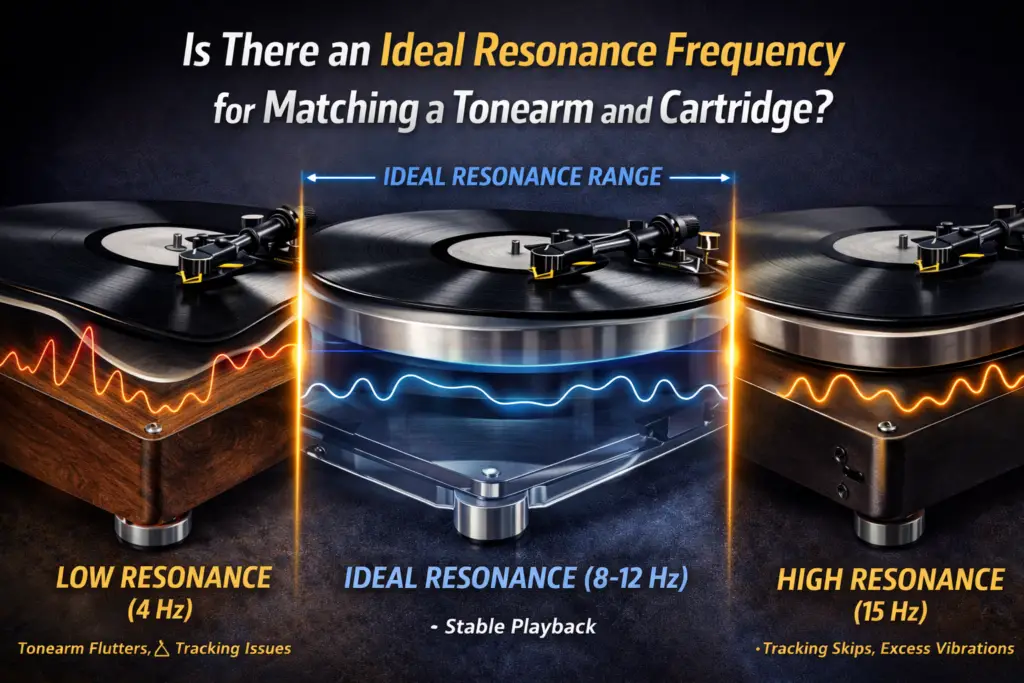
Matching a tonearm and cartridge is one of the most critical—and misunderstood—steps in building a high-performance analog playback system. At the center of this process lies a single, often-quoted concept: arm–cartridge resonance frequency. Get it right, and your turntable tracks cleanly, sounds balanced, and stays free of distortion. Get it wrong, and even the finest components can underperform.
So is there truly an ideal resonance frequency? And if so, why does it matter?
What Is Arm–Cartridge Resonance?
When a tonearm and cartridge are combined, they form a mechanical system with a natural resonant frequency. This resonance is determined primarily by:
- The effective mass of the tonearm
- The compliance of the cartridge suspension
- The total moving mass of the system
At this frequency, the arm and cartridge are most easily excited by external energy.
Why Resonance Frequency Matters
The goal is to keep resonance out of the audible band and away from record-related disturbances.
Two major problems must be avoided:
- Low-frequency disturbances such as warped records and footfalls
- Audible bass frequencies that can cause coloration, mistracking, or feedback
If resonance falls in the wrong range, it can compromise tracking, bass clarity, and overall musical stability.
The Widely Accepted “Ideal” Range
Most analog engineers and cartridge manufacturers agree that the optimal arm–cartridge resonance frequency lies between:
8 Hz and 12 Hz
This range is low enough to stay below audible bass, yet high enough to avoid excitation from warps and turntable rumble.
What Happens Outside This Window?
Below ~8 Hz
- Increased sensitivity to warps and footfalls
- Excessive arm movement
- Possible mistracking and low-frequency noise
Above ~12–14 Hz
- Resonance may intrude into audible bass
- Thinner or uneven low-frequency response
- Reduced tracking ability on difficult passages
How Tonearm Mass and Cartridge Compliance Interact
- High-compliance cartridges prefer low-mass tonearms
- Low-compliance cartridges work best with medium to high-mass tonearms
This is why some cartridges sound lifeless or unstable when installed on the “wrong” arm, even if setup appears correct.
Calculating Resonance Frequency
While listening is important, resonance can be estimated mathematically using tonearm effective mass and cartridge compliance. Online calculators and manufacturer data make this easier than ever.
However, real-world factors—such as mounting hardware, arm damping, and suspension design—can shift the final result.
The Role of Damping and Design
Modern tonearms often include:
- Fluid damping
- Internal arm tube damping
- Advanced bearing designs
These features can broaden and control resonance, making systems more forgiving even if the calculated frequency is slightly outside the ideal range.
Is “Perfect” Resonance Always Necessary?
Not necessarily. Many excellent systems operate slightly outside the 8–12 Hz window yet sound superb due to:
- Well-controlled damping
- Rigid turntable platforms
- Careful setup and alignment
Resonance frequency is a guideline—not an absolute rule.
Listening Clues of Poor Matching
Signs of problematic resonance include:
- Bloated or weak bass
- Audible woofer pumping
- Distortion on warped records
- Unstable imaging during loud passages
If these symptoms appear, arm–cartridge compatibility should be re-evaluated.
Final Verdict
Yes—there is an ideal resonance frequency range for matching a tonearm and cartridge, and it generally falls between 8 and 12 Hz. Staying within this window helps ensure stable tracking, clean bass, and freedom from unwanted vibration.
But resonance frequency is only one piece of a larger puzzle. Tonearm design, damping, turntable isolation, and precise setup all play equally important roles. In analog playback, success comes not from chasing a single number—but from achieving mechanical harmony across the entire system.