
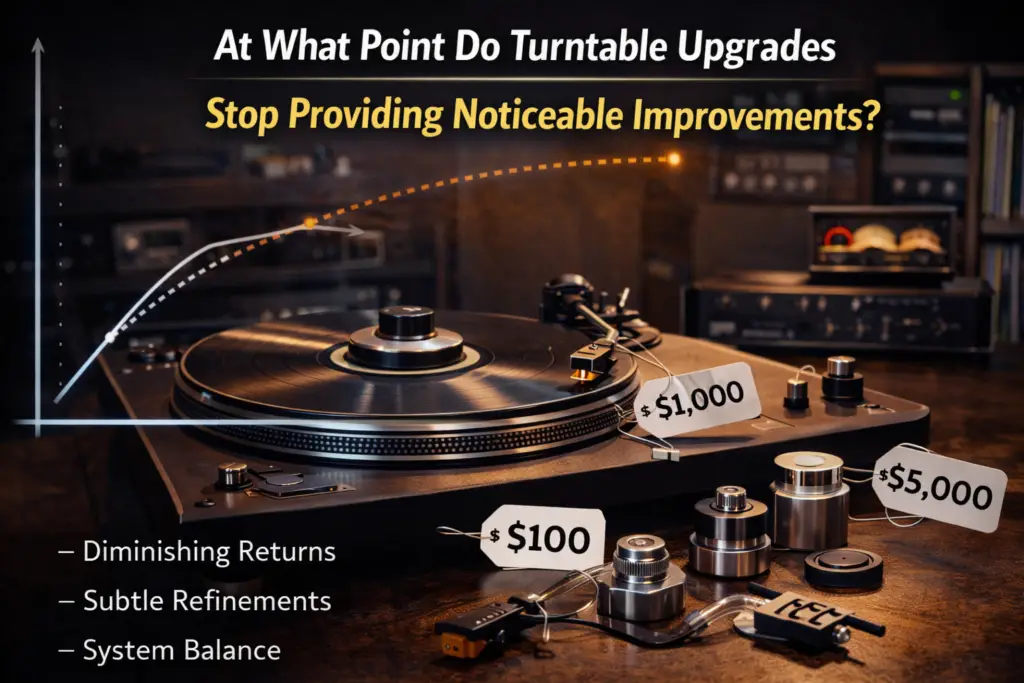
For many vinyl enthusiasts, upgrading a turntable is a journey rather than a destination. Each new cartridge, platter, power supply, or isolation platform promises greater realism and musical engagement. Yet a persistent question eventually arises: at what point do turntable upgrades stop providing noticeable improvements?
The answer is less about price and more about context, system balance, and listener priorities.
The Law of Diminishing Returns
In analog playback, early upgrades often produce dramatic gains. Moving from an entry-level turntable to a well-designed mid-tier deck can bring obvious improvements in:
- Speed stability
- Noise floor
- Tracking ability
- Tonal accuracy
However, as quality increases, each subsequent upgrade tends to yield smaller, more subtle benefits. The cost-to-improvement ratio rises steeply, and progress becomes incremental rather than transformational.
System Balance Matters More Than Absolute Quality
A turntable does not exist in isolation. Its performance is limited by:
- Cartridge quality and compatibility
- Tonearm geometry and setup
- Phono stage resolution
- Loudspeaker and room performance
Upgrading the turntable beyond the resolving power of the rest of the system often results in improvements that are technically real but subjectively hard to perceive.
The Role of Setup and Optimization
Many listeners chase hardware upgrades when greater gains could be achieved through optimization:
- Precise cartridge alignment
- Correct tracking force and anti-skate
- Improved isolation and placement
- Proper grounding and cable management
A well-set-up mid-range turntable can outperform a poorly optimized high-end one.
When Improvements Become Harder to Hear
For most systems, the “flattening” of audible improvement typically occurs when:
- Background noise is already extremely low
- Speed stability is well controlled
- Resonances are effectively managed
- Tonal balance feels natural and coherent
At this point, upgrades tend to refine microdetails—soundstage depth, transient decay, low-level ambience—rather than altering the core character of the sound.
Listener Experience and Expectations
Perception plays a major role. Experienced listeners with trained ears may appreciate subtle improvements that casual listeners might miss entirely. Listening habits, music preferences, and room acoustics all influence whether an upgrade feels worthwhile.
What sounds revelatory in a quiet, focused listening environment may be imperceptible in a more casual setting.
Psychological and Emotional Factors
Upgrading is not purely technical. Satisfaction often depends on:
- Pride of ownership
- Curiosity and experimentation
- The joy of fine engineering
For some enthusiasts, the process itself is as rewarding as the sonic outcome.
When to Stop—or Change Direction
Many listeners find a natural stopping point when:
- Music becomes more engaging than the equipment
- Upgrades no longer change emotional connection
- Funds deliver greater enjoyment elsewhere (records, room treatment, or live music)
At this stage, attention often shifts from upgrading hardware to refining the listening experience.
The Bottom Line
Turntable upgrades rarely stop providing improvements altogether—but there is a point where gains become subtle, system-dependent, and highly subjective. For most vinyl enthusiasts, this threshold lies somewhere in the upper mid-range to high-end level, where refinement replaces revelation.
The most meaningful upgrade is often knowing when to stop, sit back, and simply enjoy the music.