
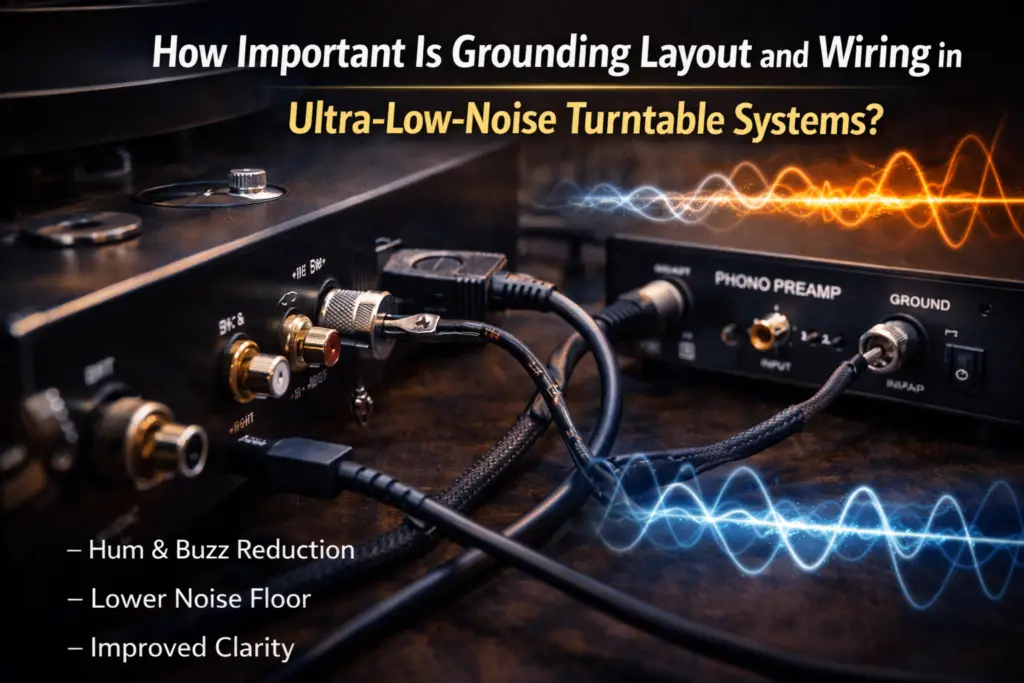
In ultra-low-noise analog playback, silence is not the absence of music—it is the foundation that allows music to emerge. While cartridges, phono stages, and isolation platforms often dominate discussions, one factor quietly determines whether a turntable system performs at its best: grounding layout and wiring. In highly resolving systems, grounding is not a minor detail—it is a core design and setup principle.
Why Turntables Are Especially Sensitive to Grounding
A phono cartridge outputs an extremely small signal, often measured in microvolts. At these levels, even minute electrical interference can become audible. Poor grounding can allow hum, buzz, and radio-frequency interference to enter the signal path long before amplification occurs.
Unlike line-level sources, turntables rely on:
- Unbalanced, high-gain signal paths
- Separate signal and chassis grounds
- External phono preamplifiers with 40–70 dB of gain
Any weakness in grounding layout is magnified dramatically downstream.
Common Symptoms of Grounding Problems
Improper grounding often reveals itself through:
- 50/60 Hz hum and harmonics
- Buzz that changes when touching metal parts
- Noise that varies with tonearm position
- Increased noise floor masking low-level detail
In ultra-quiet systems, these issues may not be obvious hums, but subtle veiling, reduced dynamic contrast, or unstable imaging.
Ground Loops: The Silent Saboteur
Ground loops occur when multiple paths to ground exist at different electrical potentials. In turntable systems, this often happens when:
- The turntable is grounded to both the phono stage and the amplifier
- Cable shields and chassis grounds are tied inconsistently
- External power supplies introduce secondary ground references
A single, well-defined grounding reference—often called a star ground—is critical to avoiding these problems.
Signal Ground vs Chassis Ground
One of the most misunderstood aspects of turntable grounding is the difference between signal ground and chassis ground.
- Signal ground provides a reference point for the cartridge’s electrical output
- Chassis ground is intended for safety and noise shielding
In high-end designs, these grounds may be separated, connected through a resistor or capacitor, or joined at a specific point to control noise flow. Randomly tying them together can increase interference rather than reduce it.
Wiring Layout and Cable Management
Grounding effectiveness is inseparable from wiring layout. Poor cable routing can reintroduce noise even with correct grounding.
Best practices include:
- Keeping phono cables short and away from power cords
- Avoiding parallel runs of signal and AC cables
- Using twisted pairs or well-shielded cables where appropriate
- Ensuring secure, oxidation-free ground connections
Even cable dressing inside the turntable plinth or tonearm base can influence noise performance.
Why Ultra-Low-Noise Systems Are Less Forgiving
As noise floors drop, previously masked issues become audible. High-gain, wide-bandwidth phono stages and highly sensitive cartridges reveal grounding flaws that would go unnoticed in less resolving systems.
This is why systems optimized for ultimate quiet often require:
- Experimentation with grounding schemes
- Manufacturer-recommended grounding methods
- Careful integration of external power supplies and isolation transformers
The Sonic Payoff of Proper Grounding
When grounding and wiring are optimized, listeners often report:
- Inky-black backgrounds
- Greater microdynamic expression
- Improved spatial focus and depth
- More natural decay and ambience retrieval
These improvements don’t draw attention to themselves—but once heard, they are difficult to give up.
The Bottom Line
Grounding layout and wiring are fundamental to achieving ultra-low-noise turntable performance. In high-end analog systems, they are not optional tweaks but essential elements of system design and setup.
For enthusiasts chasing the last few dB of silence, careful grounding may deliver greater sonic benefits than many far more expensive hardware upgrades.