
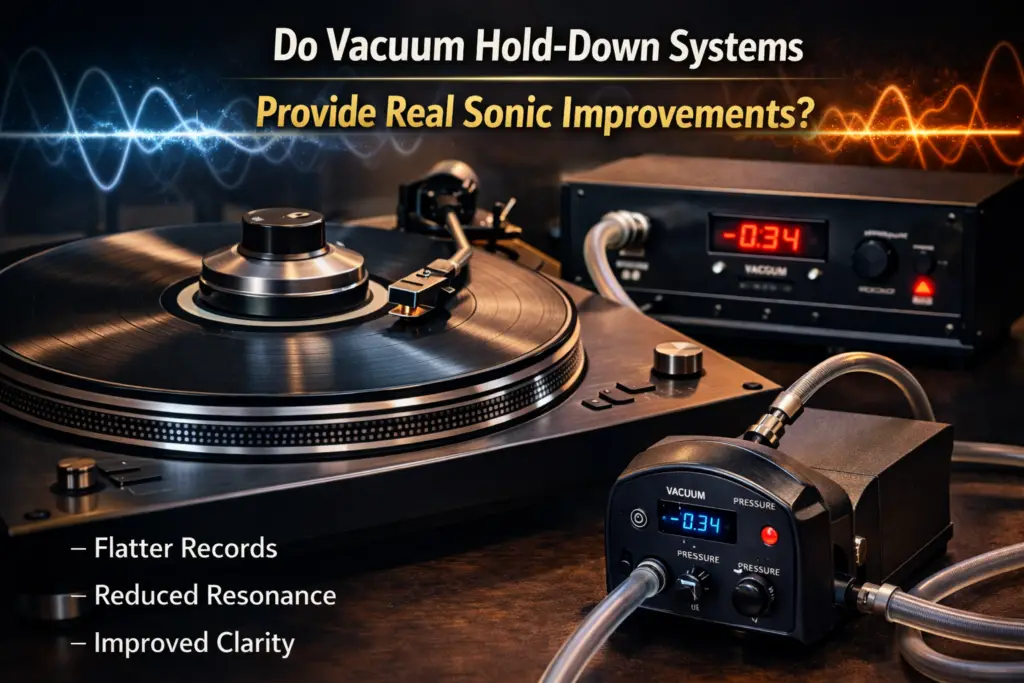
In the pursuit of perfect vinyl playback, audiophiles have explored everything from exotic platter materials to elaborate isolation platforms. One of the more extreme—and intriguing—solutions is the vacuum hold-down system. By actively pulling a record flat against the platter, these systems promise better contact, fewer resonances, and improved sound. But do vacuum hold-down systems deliver real sonic improvements, or are they simply engineering overkill?
What Is a Vacuum Hold-Down System?
A vacuum hold-down system uses a pump—either built into the turntable or housed externally—to create negative pressure beneath the record. This suction pulls the vinyl tightly against the platter surface, effectively eliminating warps and air gaps.
Unlike passive solutions such as record clamps or weights, vacuum systems apply uniform pressure across the entire record, not just at the center.
Why Record-to-Platter Contact Matters
A vinyl record is far from rigid. Even slight warps or uneven contact can cause:
- Vertical stylus movement unrelated to the music
- Variations in tracking angle and stylus pressure
- Resonances within the vinyl itself
- Reduced energy transfer away from the record surface
By coupling the record more firmly to the platter, a vacuum system aims to turn the record and platter into a single, mechanically stable structure.
Potential Sonic Benefits
When properly implemented, listeners often report several audible improvements:
- Lower noise floor: Better contact allows vibrational energy to be drained into the platter, reducing low-level haze.
- Improved bass definition: Tighter coupling can result in cleaner, more controlled low frequencies.
- Greater clarity and focus: Reduced micro-movement of the record can improve transient accuracy.
- More stable imaging: Flatter records help maintain consistent stylus geometry across the side.
These effects are often most noticeable on warped records or pressings with uneven thickness.
How It Compares to Clamps and Weights
Record clamps and weights can flatten the center of a record, but they are less effective at addressing edge warps and uneven contact across the surface.
Vacuum hold-down systems:
- Apply even pressure across the entire disc
- Avoid adding extra mass to the bearing
- Maintain consistent performance regardless of record thickness
However, high-quality clamps remain far simpler and more cost-effective—and can deliver a meaningful portion of the benefit.
Design and Implementation Matter
Not all vacuum systems are created equal. The effectiveness depends on:
- Platter material and damping characteristics
- Quality of the vacuum seal
- Noise and vibration isolation of the pump
- Precision of the bearing and motor system
Poorly implemented systems may introduce pump noise, vibration, or maintenance complexity that outweighs the benefits.
Practical Drawbacks
Vacuum hold-down systems come with trade-offs:
- High cost and mechanical complexity
- Additional setup time for each record
- Potential reliability and maintenance concerns
- Limited compatibility with some records and mats
For many users, these drawbacks may overshadow the sonic gains.
Who Benefits the Most?
Vacuum hold-down systems tend to shine in:
- Ultra-high-end analog systems with revealing cartridges
- Collections containing many warped or imperfect records
- Listening environments where noise floors are already extremely low
In more modest systems, the improvements may be difficult to justify relative to the investment.
The Bottom Line
Yes—vacuum hold-down systems can provide real sonic improvements, particularly in terms of clarity, bass control, and noise reduction. However, these gains are incremental rather than transformational and depend heavily on system resolution and implementation quality.
For most vinyl enthusiasts, a well-designed platter, proper setup, and a good record clamp will offer far better value. Vacuum hold-down systems remain a compelling—but specialized—solution for those chasing the final few percent of analog performance.