
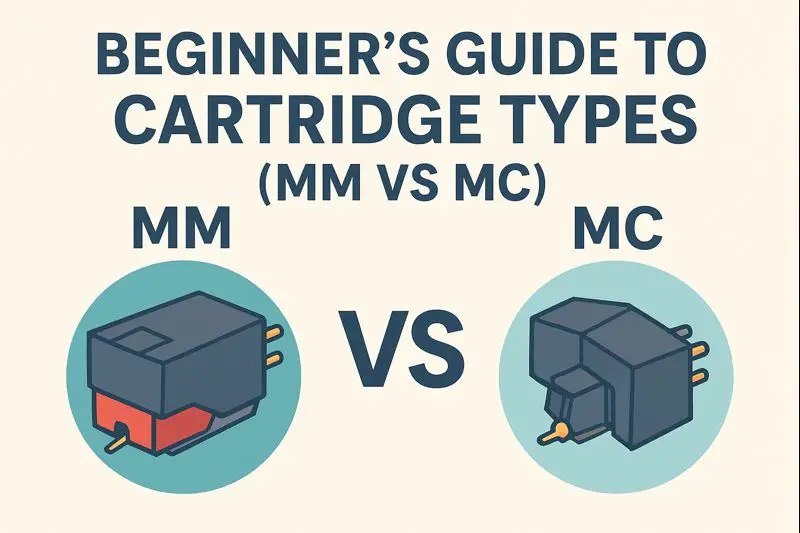
When building or upgrading a vinyl setup, one of the most important components you’ll encounter is the phono cartridge—the small device at the end of the tonearm that holds the stylus. The cartridge converts the physical movement of the stylus into an electrical signal, making it the very first stage of your audio chain.
While cartridges come in different designs, the two most common types are Moving Magnet (MM) and Moving Coil (MC). Understanding the differences between them helps you choose the right one for your budget, turntable, and listening preferences.
This guide breaks down how they work, how they sound, and which type is best for beginners.
What Is a Phono Cartridge?
A phono cartridge contains three main parts:
- Stylus (needle): Traces the grooves
- Cantilever: Transfers the stylus movement
- Generator: Converts movement into electrical signal
The difference between MM and MC cartridges comes from how the generator is designed.
Moving Magnet (MM) Cartridges
How MM Cartridges Work
Inside an MM cartridge:
- A tiny magnet is attached to the cantilever
- As it moves with the groove, the magnet vibrates between two fixed coils
- This movement creates an electrical signal
The coils stay still, while the magnet moves.
Sound Characteristics
MM cartridges typically offer:
- Warm, full sound
- Strong bass response
- Slightly less detail compared to MC cartridges
Pros of MM Cartridges
✔ Affordable – great entry-level choice
✔ Easily replaceable stylus
✔ Compatible with most phono preamps
✔ Higher output → less noise and simpler setup
Cons of MM Cartridges
✘ Less detailed high-frequency performance
✘ More moving mass → reduced tracking precision
Best For
- Beginners
- Casual to intermediate audiophiles
- Budget and mid-range turntables
- Anyone who wants easy stylus replacement
Moving Coil (MC) Cartridges
How MC Cartridges Work
Inside an MC cartridge:
- The coils are attached to the cantilever
- The magnet stays fixed
- The coils move inside the magnetic field to generate the signal
Because the coils are tiny, mass is much lower.
Sound Characteristics
MC cartridges are known for:
- Superior detail retrieval
- Excellent tracking ability
- Wider soundstage and clarity
- More accurate high frequencies
Pros of MC Cartridges
✔ High-resolution sound
✔ Lower moving mass → better tracking
✔ Outstanding refinement and separation
Cons of MC Cartridges
✘ Expensive
✘ Stylus often not replaceable (must replace entire cartridge)
✘ Low-output MC (LOMC) needs a specialized preamp or step-up transformer
Best For
- Audiophiles
- High-end turntables
- Critical listening setups
- Users willing to invest in proper preamps and alignment
High-Output vs Low-Output MC Cartridges
There are two types of MC cartridges:
High-Output MC (HOMC)
- Works with standard MM phono stages
- Easier to set up
- Sounds better than MM but not as refined as LOMC
Low-Output MC (LOMC)
- Requires a dedicated MC preamp or step-up transformer
- Delivers the best sonic performance
- Most expensive option
MM vs MC: Side-by-Side Comparison
| Feature | MM Cartridge | MC Cartridge |
|---|---|---|
| Stylus Replaceability | Replaceable | Usually non-replaceable |
| Sound Quality | Warm, good detail | Highly detailed, accurate |
| Output Level | High (easy to drive) | Low (needs special preamp) |
| Tracking Ability | Good | Excellent |
| Cost | Affordable | Moderate to high |
| Maintenance | Simple | Advanced |
| Best For | Beginners | Audiophiles |
Which Should You Choose?
Choose MM if you want:
- An easy beginner-friendly option
- Affordable upgrades
- Simple maintenance
- Compatibility with any standard phono preamp
Most beginners should start with MM.
Choose MC if you want:
- Higher fidelity
- Greater detail, clarity, and dynamics
- Advanced listening experience
- Willingness to invest in proper equipment
MC is best for audiophiles upgrading to higher-end setups.
Final Thoughts
The choice between MM and MC cartridges ultimately comes down to your listening goals and budget. MM cartridges offer outstanding value, simplicity, and warmth—perfect for newcomers. MC cartridges, on the other hand, deliver superior precision and refinement, making them the go-to choice for serious audiophiles.
Both types can unlock incredible sound from your vinyl collection, as long as they are paired with a well-matched system and properly aligned.