
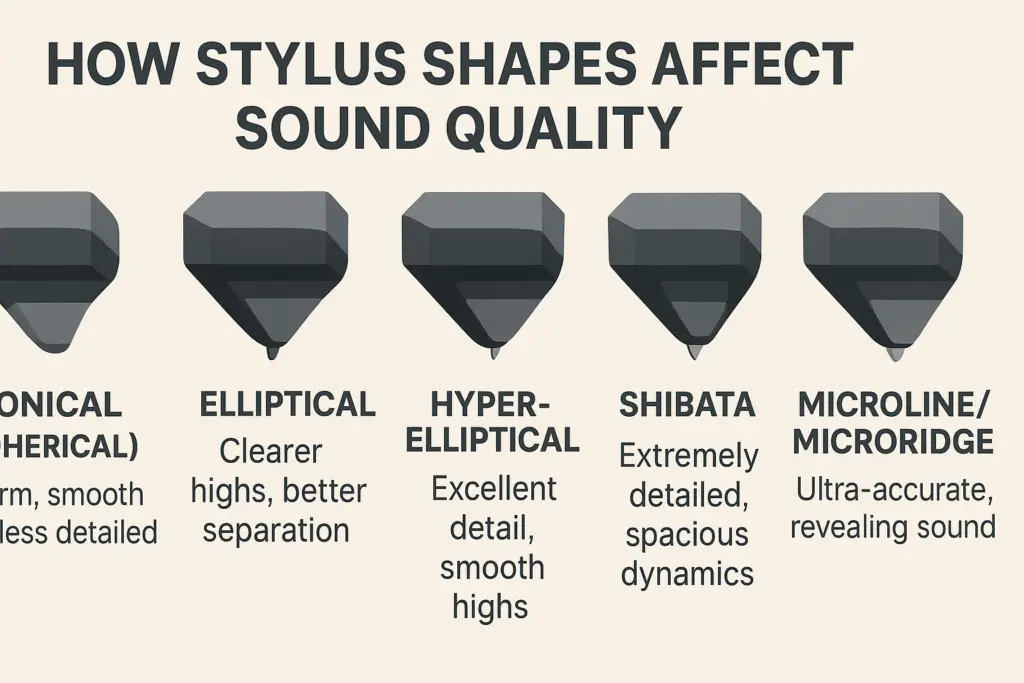
The stylus—often called the needle—is one of the most important components of a turntable. While cartridge type, tracking force, and turntable setup all matter, the shape of the stylus tip has a major impact on how your vinyl actually sounds. Different stylus profiles interact with the grooves in different ways, influencing clarity, distortion, tracking accuracy, record wear, and overall listening quality.
Whether you’re a beginner or upgrading your setup, understanding stylus shapes helps you choose the right one for your sound preferences and budget.
Why Stylus Shape Matters
Every vinyl record contains microscopic grooves filled with modulations that represent musical information.
The stylus must track these modulations accurately.
Stylus shape determines:
- How deeply it reaches into the groove
- How precisely it traces high-frequency details
- How well it handles inner grooves
- How gently it treats the vinyl surface
Better shapes equal better tracking—but often at a higher cost.
Main Stylus Shapes and Their Sound Characteristics
1. Conical (Spherical) Stylus
Shape
Rounded tip—simple and inexpensive to manufacture.
Sound Character
- Warm, smooth, but less detailed
- Struggles with high frequencies
- More inner-groove distortion (especially at the end of a record)
Pros
✔ Cheapest
✔ Easiest on worn or older records
✔ Durable
Cons
✘ Lower detail retrieval
✘ More distortion in inner grooves
Best For
- Casual listening
- Vintage players
- 45 RPM singles, jukeboxes
- Budget setups
2. Elliptical Stylus
Shape
More elongated than conical, allowing it to fit deeper into the groove.
Sound Character
- Clearer high frequencies
- Better separation and accuracy
- Lower distortion
Pros
✔ Great detail without a big price jump
✔ Handles inner grooves better
✔ Good balance of performance and cost
Cons
✘ Requires precise alignment
✘ Slightly more record wear if misaligned
Best For
- Entry to mid-level audiophile setups
- Modern hi-fi turntables
- Listeners who want noticeably better clarity
3. Hyper-Elliptical / Fine-Line Stylus
Shape
A more advanced, narrower version of an elliptical tip.
Sound Character
- Excellent detail retrieval
- Clean, smooth highs
- Better tracking of densely cut grooves
Pros
✔ Very low distortion
✔ Better for long record life
✔ Improves sibilance control
Cons
✘ More expensive
✘ Requires careful setup
✘ Sensitive to dirty or worn records
Best For
- Hi-fi listeners with well-kept vinyl
- Upgraded cartridges
- Critical listening environments
4. Shibata Stylus
Shape
Tall, narrow, multi-faceted tip designed for tracing high-frequency information in quadraphonic records.
Sound Character
- Extremely detailed
- Rich, spacious, and dynamic
- Captures extended high frequencies with precision
Pros
✔ Exceptional clarity
✔ Wider contact area reduces wear
✔ Ideal for audiophile listening
Cons
✘ Higher price
✘ Needs precise setup and alignment
✘ Sensitive to dirty grooves
Best For
- Modern audiophile cartridges
- High-resolution playback
- Enthusiasts upgrading for maximum fidelity
5. MicroLine / MicroRidge Stylus
Shape
One of the most advanced stylus tips—closest to the shape of a cutter head used to cut the original record.
Sound Character
- Ultra-accurate, revealing sound
- Excellent tracking of inner grooves
- Smooth, clean highs with minimal distortion
Pros
✔ Best tracing accuracy of all shapes
✔ Very low record wear
✔ Long lifespan
Cons
✘ Higher cost
✘ Requires careful alignment
✘ Reveals flaws in damaged records
Best For
- High-end turntables
- Audiophiles seeking the most accurate sound
- Listeners focused on preserving record longevity
Stylus Shape Comparison Table
| Stylus Shape | Detail Level | Tracking Accuracy | Inner Groove Distortion | Record Wear | Price |
|---|---|---|---|---|---|
| Conical | Low | Basic | High | Medium | $ |
| Elliptical | Medium–High | Good | Medium | Medium–Low | $$ |
| Hyper-Elliptical | High | Very Good | Low | Low | $$$ |
| Shibata | Very High | Excellent | Very Low | Low | $$$–$$$$ |
| MicroLine / MicroRidge | Extremely High | Best | Lowest | Lowest | $$$–$$$$ |
Which Stylus Shape Is Best for You?
Choose Conical if…
You want affordability, simplicity, and durability.
Choose Elliptical if…
You want a clear upgrade in sound without a big investment.
Choose Hyper-Elliptical if…
You want high fidelity without jumping into premium pricing.
Choose Shibata if…
You want a wide soundstage, clarity, and audiophile-grade tracking.
Choose MicroLine if…
You want the most precise, accurate, and long-lasting stylus shape available.
Do Better Stylus Shapes Always Sound Better?
Not always.
Your results depend on:
- Your cartridge quality
- Tonearm compatibility
- Turntable setup and alignment
- Condition of your vinyl
- Your personal sound preferences
However, in most cases, upgrading the stylus profile provides one of the biggest improvements in vinyl sound quality — often more noticeable than upgrading the turntable itself.
Final Thoughts
Stylus shapes play a major role in how your vinyl records sound and how long they last. Understanding each profile helps you choose a stylus that matches your audio goals, whether that’s warm casual listening or high-resolution, audiophile-grade performance.