
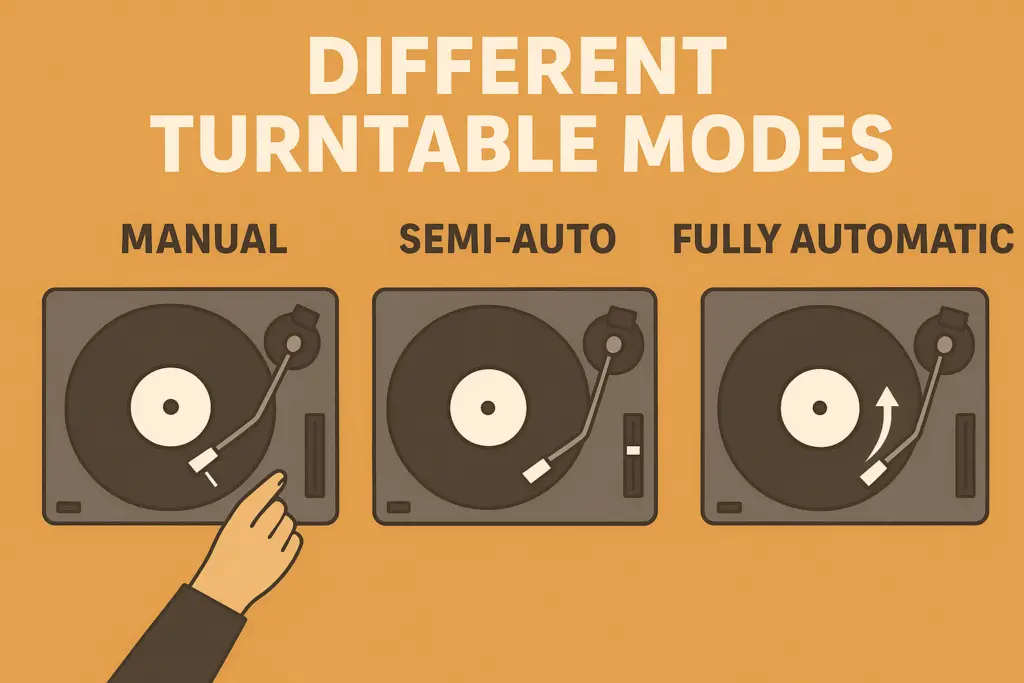
Turntables may all play records, but they don’t all operate the same way. One of the biggest differences between models is their operation mode—how the tonearm and playback process are controlled. Understanding whether a turntable is manual, semi-automatic, or fully automatic helps you choose a setup that fits your listening style, convenience needs, and level of involvement.
This guide breaks down each mode, how it works, and who it’s best for.
What Are Turntable Operation Modes?
Turntable modes refer to how much of the playing process is handled by you versus the machine.
This includes:
- Lifting or lowering the tonearm
- Moving the stylus into the groove
- Returning the tonearm when playback ends
- Starting or stopping the motor
Different modes offer different levels of convenience, precision, and hands-on experience.
1. Manual Turntables
How They Work
On a manual turntable, you handle every part of the process:
- Manually lifting the tonearm
- Positioning it over the record
- Lowering the stylus into the groove
- Lifting and returning the tonearm when the side ends
The platter typically keeps spinning until you turn it off.
Why People Love Manual Turntables
✔ Maximum control
✔ Preferred by audiophiles
✔ Fewer mechanical parts, less noise or vibration
✔ Typically better build and sound quality
Drawbacks
✘ Requires attention—if you forget to lift the tonearm, it will loop endlessly
✘ Not ideal for casual or multitask listening
Best For
- Audiophiles
- Listeners who want a hands-on analog experience
- High-quality, minimalist setups
2. Semi-Automatic Turntables
How They Work
You start the playback manually by lowering the tonearm onto the record.
But when the record finishes, the turntable:
- Automatically lifts the tonearm
- Returns it to the rest
- Stops the platter
Why People Love Semi-Auto Turntables
✔ Convenience without losing control
✔ Prevents stylus wear from end-of-groove looping
✔ Great compromise between manual feel and automatic protection
Drawbacks
✘ More mechanical complexity
✘ Slightly more internal noise possible than purely manual designs
Best For
- Beginner to intermediate listeners
- People who want safety and convenience
- Anyone who occasionally forgets the record is running
3. Fully Automatic Turntables
How They Work
A fully automatic turntable handles everything with one button or switch:
- Start: tonearm moves to the edge of the record and lowers automatically
- End: tonearm lifts, returns to rest, and the platter stops
Some models even detect record size automatically.
Why People Love Fully Automatic Turntables
✔ Easiest to use
✔ Protects stylus and records from damage
✔ Great for casual listening or multi-tasking
Drawbacks
✘ More mechanical parts = more potential vibration
✘ Slightly lower performance on some budget models
✘ Not as satisfying for enthusiasts who enjoy manual control
Best For
- Beginners
- Casual listeners
- People with mobility or dexterity limitations
- Plug-and-play setups
Which Turntable Mode Should You Choose?
Your ideal mode depends on how you listen to music:
Choose a Manual Turntable if you:
- Want the best sound quality for the price
- Enjoy fully interacting with the record
- Prefer simpler, audiophile-friendly designs
Choose a Semi-Auto Turntable if you:
- Want both control and safety
- Don’t want the stylus to wear from looping endlessly
- Like a balanced middle ground
Choose a Fully Automatic Turntable if you:
- Want maximum convenience
- Are new to vinyl
- Frequently multitask while listening
- Prefer press-and-play simplicity
Do Turntable Modes Affect Sound Quality?
Not directly—but indirectly, yes.
Manual turntables often have:
- Fewer moving parts
- Less vibration
- Better tonearms and components
Automatic systems add mechanisms that can introduce slight noise in lower-end models. However, high-quality automatic turntables still offer excellent audio.
In short:
➡ Mode doesn’t determine sound quality—build and component quality do.
Final Thoughts
Turntable operation modes shape the listening experience as much as sound quality does. Whether you want hands-on precision, convenient automation, or a balance of both, choosing the right mode ensures you enjoy vinyl the way you prefer.
Manual = Full control
Semi-auto = Best balance
Fully automatic = Maximum ease
Understanding these differences helps you pick a turntable that matches your lifestyle, listening habits, and level of involvement in the vinyl process.