
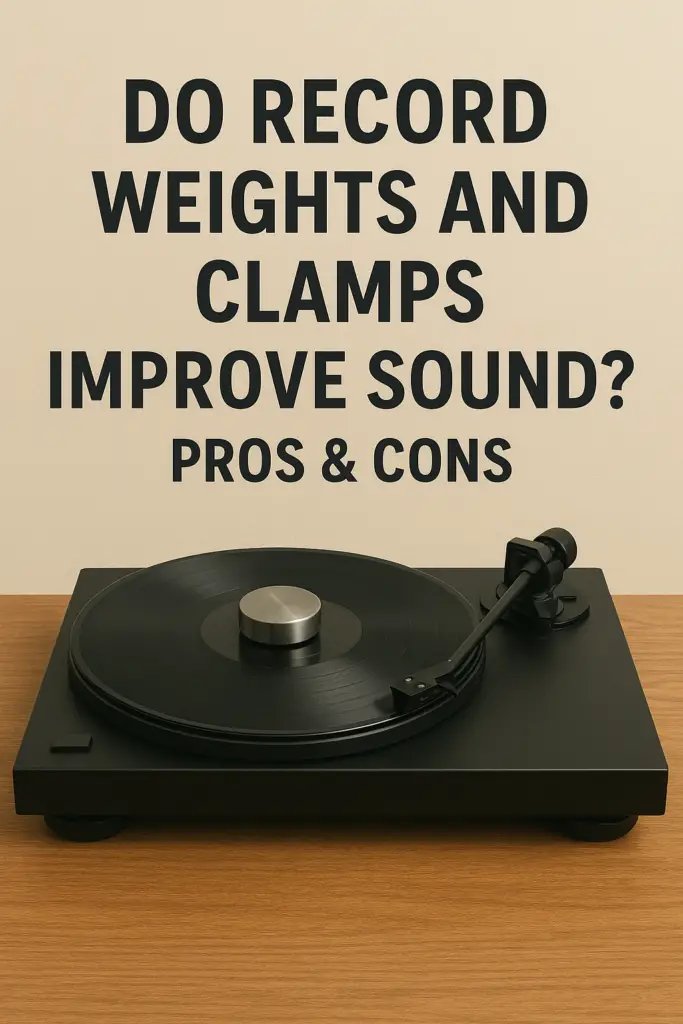
Record weights and clamps are among the most debated turntable accessories in vinyl playback. Some listeners swear by them, claiming tighter bass and quieter backgrounds—while others hear little to no difference or even report worse sound.
So what’s the truth? Do record weights and clamps actually improve sound, or are they just expensive accessories?
Let’s break it down clearly, with real pros, real cons, and when they actually make sense.
What Are Record Weights and Clamps?
Record Weights
A record weight is a heavy puck placed on top of the record, centered on the spindle. It uses mass to help flatten the record against the platter.
Record Clamps
A record clamp locks the record to the platter by applying downward pressure—usually without adding much weight.
Both aim to:
- Improve record-to-platter contact
- Reduce micro-vibrations
- Flatten minor warps
The Theory Behind Them
In theory, better contact between the record and platter should:
- Reduce resonance
- Improve stylus stability
- Lower noise floor
- Improve bass clarity
However, theory doesn’t always translate to audible improvements—especially across different turntable designs.
Potential Benefits (When They Work)
1. Improved Contact on Slightly Warped Records
Weights and clamps can help flatten mild warps, allowing the stylus to track more consistently.
Audible result:
- Fewer tracking issues
- More stable sound
2. Reduced Resonance (System-Dependent)
On lightweight or resonant platters, added coupling can reduce unwanted vibrations.
Audible result:
- Slightly tighter bass
- Cleaner mids
3. Better Performance with Certain Platter Materials
Clamps tend to work best with:
- Acrylic platters
- Glass platters
- Lightweight metal platters
These benefit more from improved coupling.
The Downsides (Often Overlooked)
1. Added Bearing Stress (Record Weights)
Heavy weights increase load on the main bearing, which can:
- Accelerate wear
- Affect speed stability on smaller motors
This is especially risky on entry-level turntables.
2. Minimal or No Audible Improvement
In many well-designed systems:
- Changes are subtle
- Improvements may be inaudible
Often, better setup or cartridge upgrades outperform clamps and weights.
3. Can Worsen Sound on Some Turntables
On mass-loaded or suspended designs:
- Added weight can upset suspension tuning
- Sound may become dull or compressed
4. Doesn’t Fix Severe Warps
Weights and clamps cannot correct major warps and may make them worse.
Weights vs Clamps: Which Is Better?
Record Weights
Pros:
- Simple to use
- Effective on mild warps
Cons:
- Adds bearing stress
- Not ideal for low-mass designs
Record Clamps
Pros:
- Minimal added mass
- Better for sensitive bearings
- More consistent results
Cons:
- Requires compatible spindle length
- Slightly more complex to use
When Record Weights or Clamps Make Sense
They are most useful if:
- You play slightly warped records often
- Your platter benefits from better coupling
- Your turntable manufacturer recommends them
- You use a lightweight platter design
When They’re Probably Not Worth It
Skip them if:
- Your turntable has a suspended chassis
- Your platter is already heavy and well-damped
- Your system is entry-level
- You haven’t optimized cartridge setup yet
Better Alternatives That Often Work More
Before buying a weight or clamp, consider:
- Proper cartridge alignment
- Correct tracking force and anti-skate
- Improved isolation
- Record cleaning
- Stylus upgrade
These almost always deliver bigger gains.
Final Verdict
Do record weights and clamps improve sound?
Sometimes—but only in the right system, and never dramatically.
Clamps are generally safer and more effective than heavy weights. For many systems, however, proper setup and smarter upgrades deliver far greater improvements.
In vinyl playback, less is often more—and understanding your turntable’s design matters more than adding accessories.