
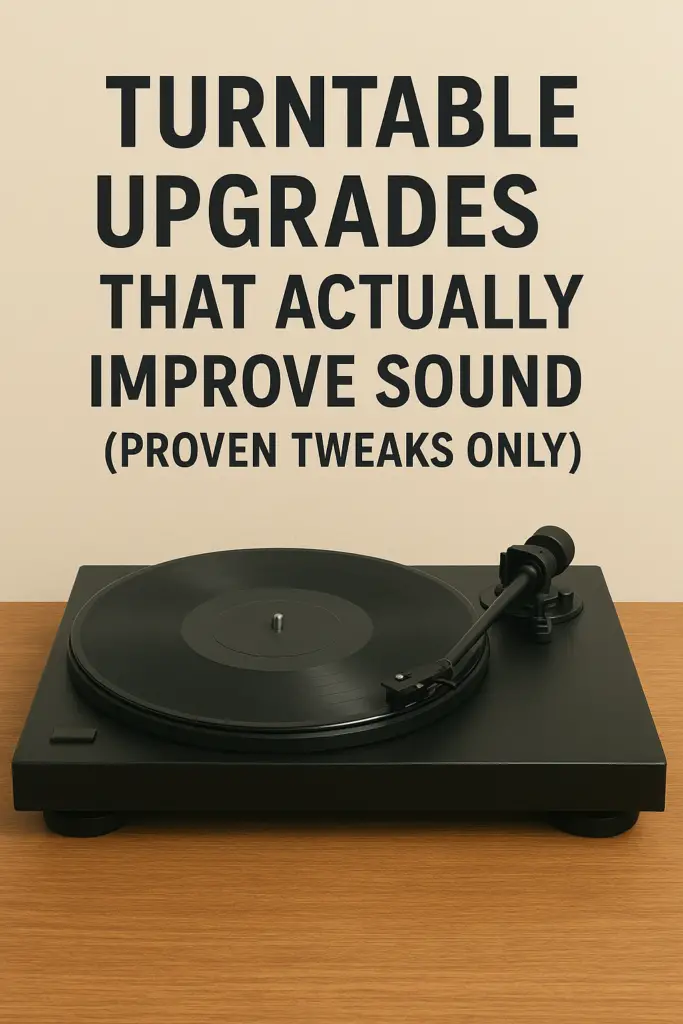
The world of turntable upgrades is full of tempting accessories—but not all of them deliver real sonic improvements. Some upgrades make measurable and audible differences, while others mostly change aesthetics or offer placebo-level gains.
In this article, we focus only on turntable upgrades that actually improve sound quality, based on proven physics, real-world listening, and long-standing analog best practices.
Upgrade First: Get the Basics Right
Before spending money, make sure your setup fundamentals are correct:
- Turntable is perfectly level
- Cartridge is aligned correctly
- Tracking force and anti-skate are properly set
- Records and stylus are clean
These steps cost little to nothing and often outperform expensive upgrades.
1. Upgrade the Stylus (Biggest Sound Improvement)
If your cartridge allows stylus replacement, this is the most effective upgrade you can make.
Why It Works
A better stylus shape tracks the groove more accurately, retrieving more detail and reducing distortion.
What You’ll Hear
- Clearer highs
- Better inner-groove performance
- Lower distortion
- Improved soundstage
Best Choices
- Elliptical → Nude elliptical
- Microline / Shibata / Fine-line
Verdict: Highest impact per dollar.
2. Upgrade the Cartridge (When the Stylus Isn’t Enough)
If your cartridge is basic or worn, a cartridge upgrade can transform your system.
Why It Works
The cartridge converts mechanical motion into electrical signal—its quality directly affects sound.
What You’ll Hear
- Better detail and separation
- Improved tonal balance
- More realistic dynamics
Proven Advice
- Match cartridge compliance to your tonearm
- Stay within your phono preamp’s compatibility
Verdict: Major improvement when properly matched.
3. Improve Isolation and Vibration Control
Vibration is the enemy of analog playback.
Effective Isolation Upgrades
- Isolation feet (rubber, sorbothane, spring-based)
- Heavy butcher block or isolation platform
- Wall-mounted shelf (especially on suspended floors)
What You’ll Hear
- Tighter bass
- Cleaner mids
- Reduced feedback and rumble
Verdict: Highly effective in real listening environments.
4. Upgrade the Phono Preamp
Many built-in phono stages are functional—but limited.
Why It Works
A good phono preamp:
- Applies accurate RIAA equalization
- Reduces noise
- Matches cartridge output correctly
What You’ll Hear
- Lower noise floor
- Better dynamics
- More accurate tonal balance
Verdict: One of the best upgrades once cartridge quality increases.
5. Use a Better Turntable Mat (Situational but Real)
A mat upgrade won’t transform a system—but it can refine it.
Proven Mat Options
- Cork or cork-rubber (balanced, affordable)
- Leather (warm, controlled)
- Acrylic (clarity and speed, when matched)
What You’ll Hear
- Subtle improvements in clarity
- Reduced static and resonance
Verdict: Fine-tuning upgrade, not a miracle.
6. Replace Cheap Interconnect Cables (Within Reason)
Exotic cables are unnecessary—but poorly shielded ones can hurt sound.
What Actually Matters
- Good shielding
- Secure connectors
- Proper grounding
What You’ll Hear
- Reduced hum
- Cleaner signal
Verdict: Fix problems, don’t chase luxury.
7. Upgrade the Platter or Sub-Platter (Model-Dependent)
Some turntables benefit significantly from platter improvements.
When It Works
- Lightweight stock platters
- Inconsistent speed or resonance issues
What You’ll Hear
- Better speed stability
- Improved bass definition
Verdict: Effective on specific models only.
Upgrades That Rarely Improve Sound (Be Skeptical)
These often offer minimal or no audible benefit:
- Record clamps (system-dependent)
- Ultra-expensive power cables
- Decorative weights and accessories
- “Resonance dots” and stickers
- Magic mats with no material explanation
If it sounds vague, it probably is.
Upgrade Priority Checklist
If you want the biggest improvements, follow this order:
- Stylus
- Cartridge
- Isolation
- Phono preamp
- Mat / cables
- Platter upgrades (if applicable)
This path delivers consistent, audible results.
Final Thoughts
Turntable upgrades don’t have to be expensive—or mysterious—to work. The best improvements are rooted in better tracking, vibration control, and signal integrity.
Focus on proven upgrades, ignore hype, and your vinyl system will reward you with cleaner sound, deeper engagement, and longer record life.