
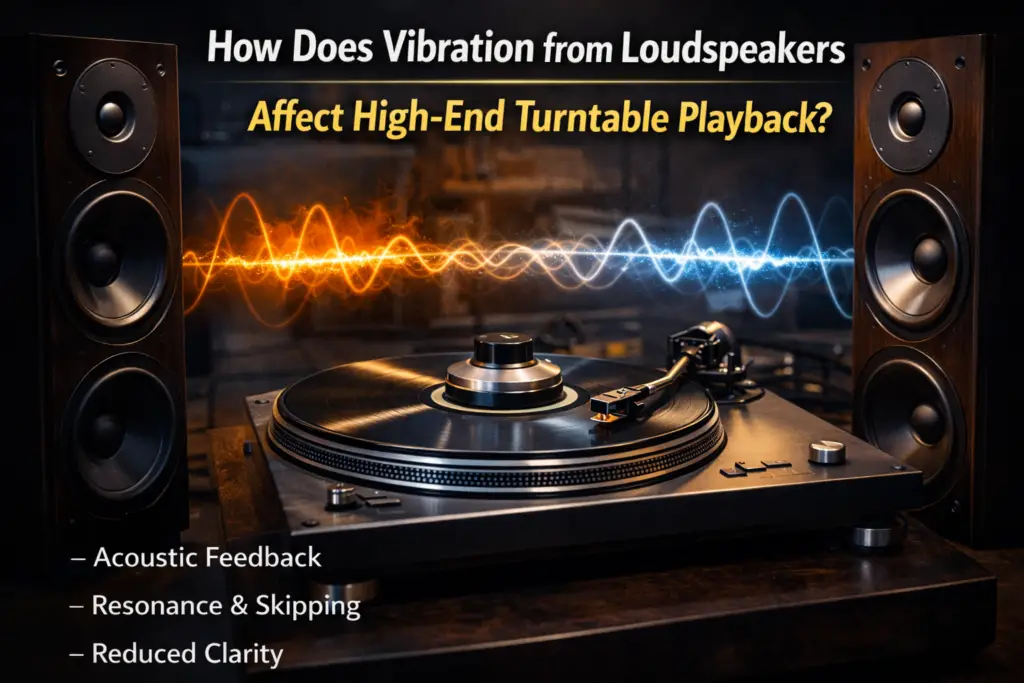
In high-end vinyl systems, the smallest mechanical influences can have audible consequences. One of the most underestimated—and misunderstood—factors is vibration from loudspeakers. While turntables are designed to extract microscopic musical information from a record groove, they are also vulnerable to external energy in the listening room. So how exactly does loudspeaker vibration affect high-end turntable playback, and when does it matter most?
Why Turntables Are Exceptionally Sensitive
A phono cartridge tracks groove modulations measured in microns. Any unwanted motion—whether from the record, the tonearm, or the plinth—can be interpreted as musical information. Unlike digital playback, analog systems have no error correction to distinguish signal from vibration.
Loudspeakers introduce energy into the room in two main ways:
- Airborne vibration from sound pressure waves
- Structure-borne vibration transmitted through the floor, racks, and furniture
Both can reach the turntable and interfere with playback.
Airborne Vibration and Acoustic Feedback
Low-frequency sound waves can physically vibrate the record, platter, or tonearm. When this vibration is picked up by the cartridge, it creates a feedback loop: the speakers excite the turntable, the cartridge converts that motion into signal, and the speakers amplify it again.
Audible symptoms may include:
- Bloated or indistinct bass
- Loss of midrange clarity
- Reduced dynamic contrast
- In extreme cases, audible low-frequency howling
This effect becomes more pronounced at higher volume levels and with speakers capable of deep bass extension.
Structure-Borne Vibration: The Hidden Culprit
Even if airborne feedback is controlled, vibration can travel through solid surfaces. Floor-standing speakers transmit energy into the floor, which then reaches the turntable via equipment racks or furniture.
Suspended wooden floors are particularly problematic, as they can resonate at frequencies that overlap with turntable suspension systems. Footfalls, bass transients, and even nearby movement can cause subtle stylus mistracking or speed irregularities.
Why High-End Turntables Can Be More Affected
Ironically, resolving turntables are often more sensitive to vibration. Lightweight designs with minimal damping may offer exceptional detail retrieval but rely heavily on external isolation. Similarly, ultra-rigid plinths can transmit vibration efficiently if not properly isolated.
High-end cartridges with fine stylus profiles and high compliance tend to reveal these issues more clearly, making vibration control essential rather than optional.
Design Approaches to Vibration Control
Turntable manufacturers address vibration in different ways:
- Mass-loaded designs aim to absorb and dissipate energy
- Suspended subchassis designs attempt to isolate the platter and tonearm from external vibration
- Rigid, low-mass designs rely on rapid energy evacuation rather than absorption
Each approach has strengths and weaknesses, and none is completely immune to loudspeaker-induced vibration.
Practical Solutions for the Listening Room
Effective mitigation often involves a combination of strategies:
- Positioning the turntable as far as practical from speakers
- Using wall-mounted shelves anchored to load-bearing walls
- Adding isolation platforms or footers
- Separating speaker and equipment supports
- Managing bass output with placement or room treatment
Even small changes in placement can yield audible improvements.
The Bottom Line
Vibration from loudspeakers can have a significant impact on high-end turntable playback, affecting clarity, bass control, and overall musical coherence. As system resolution increases, the importance of vibration control grows alongside it.
For vinyl enthusiasts pursuing the best possible performance, addressing speaker-induced vibration is not an optional tweak—it is a fundamental part of analog system setup.